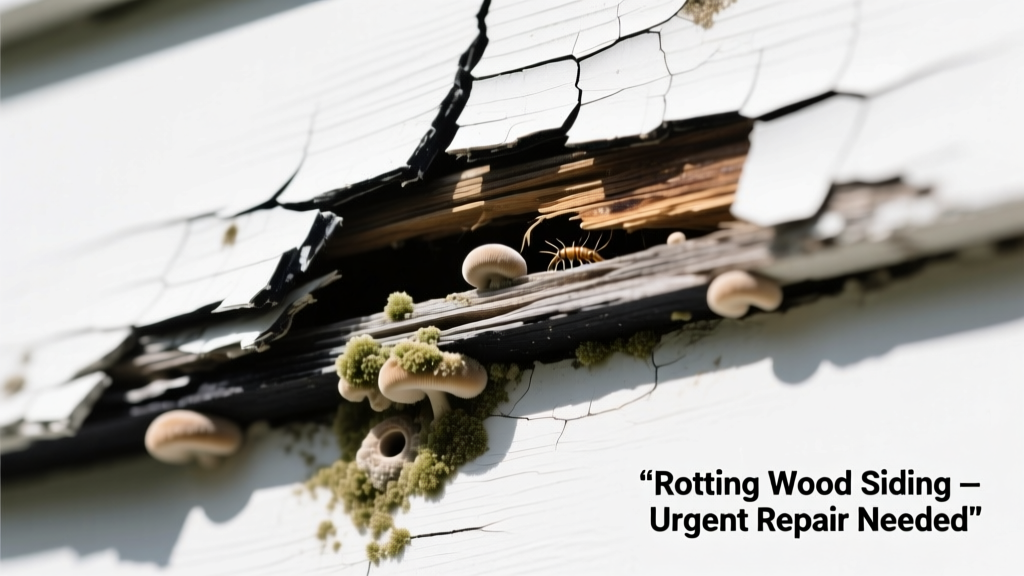
You step outside and catch it—a damp, earthy, almost sweet-rotten smell clinging to your wood siding, especially after rain or high humidity. It’s not just unpleasant; it’s a red flag waving from your home’s envelope. Don’t panic—but do investigate now. This odor rarely appears without active decay beneath the surface.
Quick Checklist
- Does the smell intensify after rain or during humid weather?
- Can you press a screwdriver into the siding and sink it more than 1/4 inch with light pressure?
- Is there visible discoloration—dark streaks, black spots, or whitish fuzzy growth?
- Do sections of siding feel spongy, soft, or hollow when tapped?
- Are there gaps, cracks, or missing caulk near windows, corners, or where siding meets trim?
- Has the house had recent roof leaks, clogged gutters, or landscaping that slopes toward the foundation?
Possible Causes
Dry Rot (Serpula lacrymans)
Confirm by probing suspect boards: dry rot crumbles into fine, brick-dust-like powder and often shows copper-colored fruiting bodies. It spreads silently through framing even without visible moisture. Severity: High—requires professional assessment and full removal of affected wood. Dry rot repair guide.
Mold & Mildew Colonization
Look for fuzzy, greenish-black or gray patches on shaded, north-facing walls—especially under eaves or behind downspouts. Wipe with a damp cloth: if color smears or reappears within days, it’s likely active mold. Severity: Moderate—DIY cleaning may work for surface growth, but hidden growth in sheathing demands moisture remediation first. Mold cleanup steps.
Trapped Moisture Behind Siding
Check behind loose boards or at baseboards: damp insulation, wet OSB sheathing, or condensation on housewrap. Use a moisture meter—if readings exceed 18% MC in wood or >90% RH behind cladding, moisture is accumulating. Severity: Moderate-to-high—often fixable with improved drainage and ventilation, but requires identifying the entry point. Moisture barrier troubleshooting.
What to Do First
- Inspect gutters and downspouts—clear debris and verify water discharges at least 5 feet from the foundation.
- Trim shrubs and vines pulling against siding—leave at least 12 inches of air gap.
- Use a flashlight and mirror to peek behind loose boards at the bottom 24 inches of walls—look for dark staining or fungal hyphae.
- Take photos and moisture meter readings (if available) before disturbing anything.
What NOT to Do
- Don’t power-wash aggressively—it forces water behind siding and worsens decay.
- Don’t paint or stain over suspect areas without diagnosing and drying first; trapped moisture accelerates rot.
- Don’t ignore isolated soft spots—even one 6-inch section of compromised wood can indicate systemic failure behind it.
Is the smell strongest near windows or doors?
This often points to failed flashing or deteriorated caulk joints allowing water infiltration directly into wall cavities. According to the National Association of Home Builders’ 2022 Exterior Wall Performance Report, 68% of moisture-related siding failures originate at window and door perimeters.
Does the odor resemble wet dog or sour milk?
That’s classic volatile organic compound (VOC) release from actively decomposing cellulose—strongly associated with brown rot fungi like Gloeophyllum trabeum. The U.S. Forest Service notes these microbes thrive between 40°F–90°F and require only 20–30% wood moisture content to colonize.
Can you smell it indoors near exterior walls?
If yes, spores or gases are migrating through gaps—potentially indicating advanced decay or compromised vapor barriers. A study published in Building and Environment (2021) linked indoor musty odors with elevated airborne fungal concentrations in 73% of homes with documented exterior wood decay.
Did the smell start suddenly after heavy rain or a plumbing leak?
Sudden onset suggests acute water intrusion—not slow degradation. Check for roof leaks, cracked soffits, or damaged drip edges above the affected zone. Even a single 1/8-inch gap in flashing can channel 3+ gallons of water into wall assemblies per inch of rainfall (Insurance Institute for Business & Home Safety, 2023).
Is the siding cedar or redwood—and does it smell like vinegar or ammonia?
That sharp tang signals bacterial souring of natural extractives, not rot—but it’s a warning sign: these woods resist decay *only* when dry. Persistent vinegar odor means prolonged wetting has overwhelmed their natural defenses. As noted by the USDA Forest Products Laboratory, “Cedar’s durability vanishes when moisture content stays above 25% for more than 72 hours.”
“A foul odor from wood siding isn’t just a nuisance—it’s your home’s early-warning system. By the time you smell it, decay has likely progressed 6–12 months beyond visual detection.” — Dr. Lena Cho, Building Pathologist, University of Maine Advanced Structures Lab, 2022
| Odor Description | Most Likely Cause | Urgency Level |
|---|---|---|
| Musty, damp basement | Mold in sheathing or insulation | High |
| Sour, fermented fruit | Bacterial wet rot (e.g., Erwinia) | High |
| Earthy, mushroom-like | Dry rot or brown rot fungi | Critical |
| Vinegar or ammonia | Bacterial souring of cedar/redwood | Moderate |
| Rotten eggs | Sulfur-reducing bacteria in standing water or sewer gas intrusion | Investigate immediately |
Smell is your most sensitive diagnostic tool—don’t dismiss it as ‘just old house funk.’ Every day of delay gives decay deeper access to framing, insulation, and interior finishes. Start with the checklist, document what you find, and move deliberately. Your siding’s lifespan—and your home’s health—depends on acting while the problem is still surface-level.