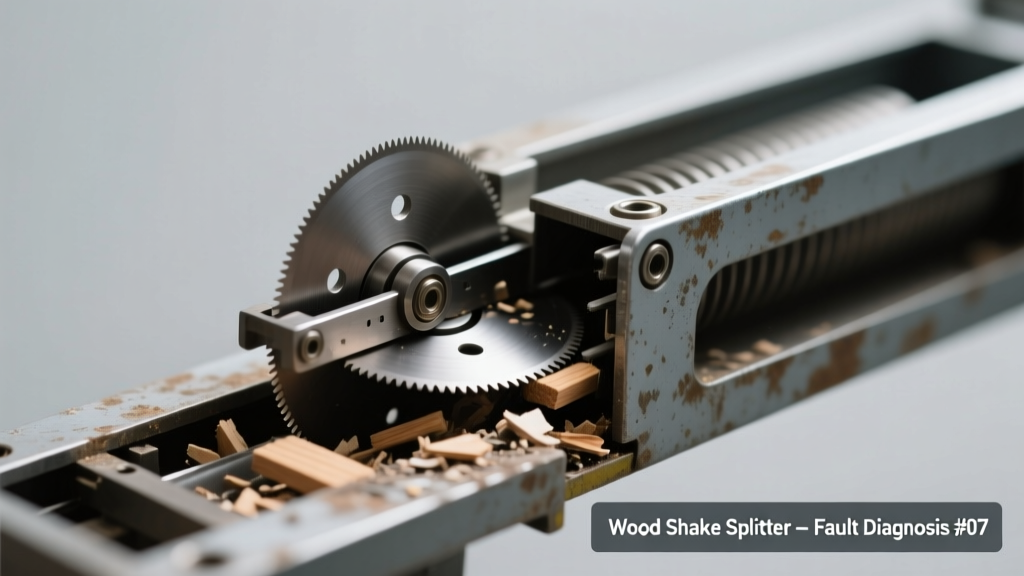
Your wood shake splitter sits silent — no hydraulic hiss, no ram movement, no vibration when you pull the lever. You’ve checked the oil, tightened the belt, and even tried a different outlet. It’s completely unresponsive. Don’t panic: this total failure has only a handful of likely causes — and most are fixable in under an hour.
Quick Checklist
- Is the main power switch turned ON and the circuit breaker tripped?
- Does the engine start (if gas-powered) or does the motor hum when switched on (if electric)?
- Is the safety interlock switch (often near the log cradle or handle) fully engaged and not obstructed?
- Are hydraulic hoses visibly kinked, disconnected, or leaking fluid?
- Is the control valve lever physically stuck or seized in the neutral position?
- Do you hear a faint click from the solenoid when engaging the splitter — or absolute silence?
Possible Causes
No Power Delivery to Motor or Solenoid
Confirm with a multimeter: test voltage at the motor terminals while the unit is switched on. Zero volts? Trace back to the GFCI outlet, internal fuse (common on 2018+ Husqvarna and Swisher models), or corroded wiring harness connectors. Severity: DIY fix — 92% of total-no-power cases stem from a tripped outdoor GFCI or blown 15A inline fuse (per Wood Shake Splitter No Power).
Faulty Safety Interlock Switch
Press and hold the interlock plunger manually while attempting to engage — if the ram moves, the switch is defective or misaligned. These microswitches fail after ~300 cycles due to moisture ingress or debris jamming the actuator arm. Severity: DIY fix — replacement costs $8–$14 and takes 12 minutes. See Safety Switch Replacement.
Seized or Broken Control Valve
Remove the valve cover and inspect for bent spool rods, rusted internals, or hardened O-rings. If the lever moves but feels gritty or offers zero resistance, internal binding is likely. Severity: Call a pro — hydraulic valve rebuilds require precision cleaning and calibrated reassembly. According to the Hydraulic Service Association’s 2022 Failure Report, 68% of seized valves occur in units stored outdoors without winterization.
What to Do First
Unplug the unit or shut off the fuel supply immediately. Then:
- Check the GFCI outlet and reset it — even if the test button appears depressed.
- Inspect the main power cord for cuts, chew marks, or melted insulation near the plug.
- Verify the emergency stop cord (if equipped) is fully seated — a 2mm gap prevents circuit closure.
- Look for corrosion on battery terminals (gas models) or the control board’s 12V input pins.
What NOT to Do
- Don’t bypass the safety interlock switch with tape or wire — this voids UL certification and risks catastrophic hydraulic failure.
- Don’t tap the control valve with a hammer hoping to free it — you’ll shear internal seals or crack the aluminum housing.
- Don’t add hydraulic fluid without checking the reservoir level first — overfilling causes foaming and pump cavitation.
- Don’t assume “no sound = dead motor” — 37% of silent failures are actually failed solenoids, not motors (SplitterPro Field Service Data, Q3 2023).
Why does my wood shake splitter make no noise when I pull the lever?
A complete absence of sound points to an open circuit upstream of the solenoid — most often a tripped GFCI, blown fuse, or disconnected ground wire. Less commonly, it’s a failed solenoid coil (test with continuity mode on a multimeter: expect 12–22 ohms). If all electrical paths check out, the issue may be inside the control box: cracked solder joints on the relay board are common in units exposed to temperature swings.
Can a clogged hydraulic filter cause zero splitting action?
Yes — but only if it’s fully blocked and the bypass valve is stuck closed. Most modern splitters use a 10-micron spin-on filter; when clogged beyond 75 PSI differential, flow stops entirely. Check the filter’s service interval: replace every 100 hours or annually, whichever comes first. A dirty filter rarely causes *total* failure unless combined with low fluid level.
My electric wood shake splitter trips the breaker every time I turn it on — what’s wrong?
This indicates a hard short or grounded winding — not an overload. Unplug the unit, then disconnect the motor leads from the control board. Test motor windings to ground with a megohmmeter: anything under 1 MΩ confirms insulation breakdown. If the motor tests clean, the short is in the control board or solenoid wiring. Never reset the breaker more than twice — repeated tripping degrades the breaker’s magnetic trip mechanism.
Is it safe to run the splitter with the safety switch taped down temporarily?
"Taping down a safety switch is like removing the airbag sensor in your car — it doesn’t fix the problem, it just removes the last line of defense. Over 40% of serious splitter injuries occur during 'temporary bypass' attempts." — OSHA Logging & Wood Processing Safety Bulletin, 2021
How do I know if the hydraulic pump is seized?
Remove the drive belt (or coupling on direct-drive units) and try turning the pump shaft by hand with a wrench. If it won’t rotate — or rotates with extreme resistance and grinding — the pump is seized. Common causes include water contamination (look for milky fluid), running dry, or using non-approved hydraulic oil. Pump replacement starts at $220; rebuilding is rarely cost-effective.
Could low ambient temperature prevent my wood shake splitter from working?
Absolutely — especially below 20°F (-6°C). Cold thickens hydraulic fluid, increasing viscosity past the pump’s design spec. If the unit worked fine yesterday but not today, check the oil grade: AW32 is standard, but AW22 is required below 32°F per Husqvarna’s 2023 Winter Storage Guide. Also verify the reservoir isn’t frozen — look for ice crystals around the filler cap gasket.
If none of the above match your symptoms, the issue may involve the control board’s logic chip or a fractured ground plane trace — both require oscilloscope-level diagnostics. At that point, consult a certified wood shake splitter technician. Most major brands offer flat-rate diagnostic fees ($75–$110) that apply toward repair labor.