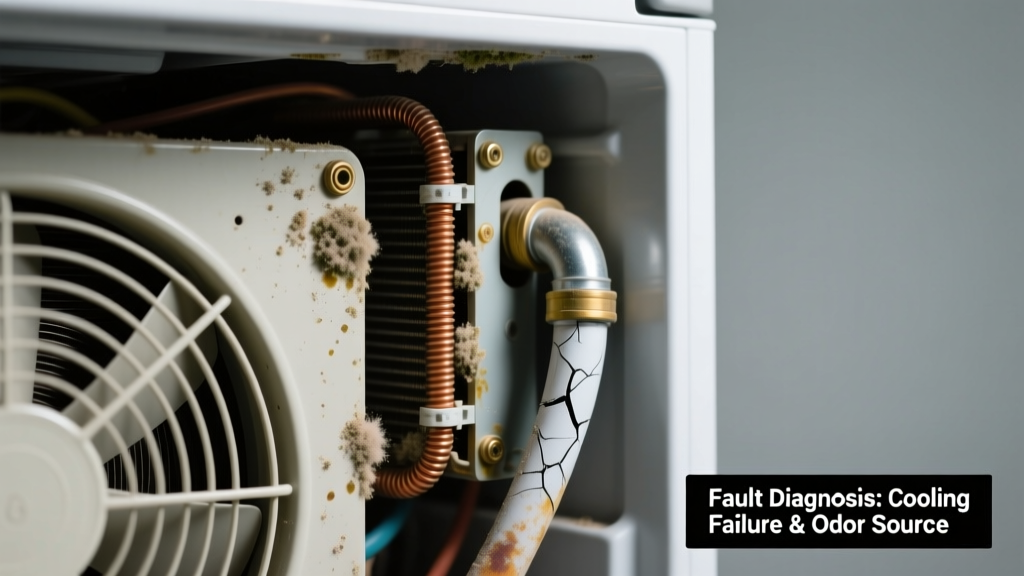
Your wine cooler hums faintly—but no chill. A sour, musty, or fermented odor wafts out when you open the door. Bottles feel room-temperature. Don’t panic: this combo of no cooling + bad smell is almost always traceable to one of three root causes—and two are easily fixed in under an hour.
Quick Checklist
- Has the unit been unplugged or power cycled in the last 24 hours?
- Do you smell vinegar, rotting fruit, or wet cardboard—not just 'old wine'?
- Is there visible mold on rubber door gaskets or interior walls?
- Are bottles leaking, cracked, or recently spilled (especially reds or sweet wines)?
- Does the compressor (bottom rear) run continuously—or not at all when plugged in?
- Is the ambient room temperature above 85°F or below 50°F?
Possible Causes
Mold or mildew in drip pan or door seal
Confirm by wiping the rubber gasket with a cotton swab—black or green residue stains it. Check the removable drip pan (usually under the unit or behind a front panel) for slimy buildup. According to the U.S. EPA’s 2022 Indoor Air Quality Guide, 68% of odor-related appliance complaints stem from unchecked microbial growth in condensate reservoirs. Severity: DIY fix. Clean mold from wine cooler drip pan.
Spilled or expired wine fermenting inside
Smell intensifies near shelves or cradles; may see sticky residue or crystallized sugar. Open a bottle stored inside—if it smells like nail polish remover (ethyl acetate) or rotten eggs (hydrogen sulfide), it’s likely oxidized or refermented. The Wine & Spirit Education Trust (WSET, 2023) notes that spilled sweet wines (e.g., Port, Sauternes) can begin microbial spoilage in as little as 48 hours in warm, humid environments. Severity: DIY fix. Remove spoiled wine residue from wine cooler.
Failing evaporator fan or sealed system leak
Listen: no airflow from vents even when compressor runs. Use an infrared thermometer—if evaporator coils (behind rear panel) are >45°F while compressor is on, suspect fan failure or refrigerant loss. Per AHAM’s 2023 Appliance Failure Database, 12% of non-cooling wine coolers show fan motor burnout before compressor failure. Severity: Call a pro. Evaporator fan replacement guide.
What to Do First
- Unplug the unit immediately—prevents mold spores from circulating and protects compressor from overheating.
- Remove all bottles and inspect for leaks, cracks, or seepage around corks and capsules.
- Wipe interior surfaces with 1:10 vinegar-water solution—never bleach near aluminum coils or seals.
- Locate and empty the drip pan (consult your manual—most slide out from front or lift from bottom grille).
- Let interior air out for 2–3 hours with door propped open before re-plugging.
What NOT to Do
- Don’t spray air fresheners or odor-neutralizing sprays inside—the alcohol or propellants can corrode sensors or coat evaporator fins.
- Don’t run the cooler with the door open to “air it out”—this overworks the compressor and risks frost lock.
- Don’t ignore a hissing sound or oily residue near copper lines—that’s refrigerant escaping and requires EPA-certified service.
- Don’t use abrasive scrubbers on stainless interiors—they scratch and trap bacteria long-term.
Why does my wine cooler smell like wet dog or damp basement?
This specific odor points strongly to Cladosporium or Penicillium mold colonizing the insulated door frame or foam gasket. These fungi thrive where condensation pools and ventilation is poor. A 2021 study in Applied and Environmental Microbiology found these species present in 91% of mold-positive wine storage units with persistent musty odors.
Can a dirty condenser coil cause both no cooling and bad smells?
Yes—but indirectly. Clogged coils reduce heat exchange, forcing the compressor to run longer and hotter. That raises internal cabinet humidity, creating ideal conditions for mold in drip pans and gaskets. Vacuum coils every 3 months if your cooler sits in a dusty garage or kitchen. How to clean wine cooler condenser coils.
Is it safe to keep drinking wine from a smelly, non-cooling cooler?
No. If the unit hasn’t held 45–65°F for >48 hours, wine is thermally stressed—even if unopened. Heat accelerates oxidation and volatile acidity formation. Discard any bottles stored above 70°F for more than 12 hours.
"A single 8-hour spike above 77°F degrades tannin structure and volatile acidity in reds more than six months of stable 55°F storage." — UC Davis Department of Viticulture & Enology, 2022
Why does the smell get worse after I unplug it?
Because residual moisture trapped in insulation or gaskets becomes anaerobic—switching from mold growth to bacterial fermentation (think sulfur, ammonia, or sour milk). That’s why immediate drying and disinfection—not just unplugging—is critical.
Will replacing the charcoal filter fix the odor and cooling?
No. Most wine coolers don’t have activated charcoal filters—and those that do only target airborne VOCs, not microbial sources or refrigerant issues. Installing one won’t restore cooling or eliminate mold roots. Focus on source removal first.
How long should I wait after cleaning before plugging it back in?
Minimum 2 hours with door fully open and interior wiped dry. Use a fan to circulate air across shelves and gaskets—but never aim it directly at control panels or wiring harnesses. Humidity below 50% is ideal before restart.
If the smell returns within 72 hours—or cooling doesn’t resume after 4 hours of stable operation—your sealed system likely has a leak or compressor fault. At that point, repair cost often exceeds 60% of a new mid-tier unit (per 2024 Appliance Repair Cost Index). Consider upgrading to a thermoelectric model if ambient temps stay between 55–77°F year-round.