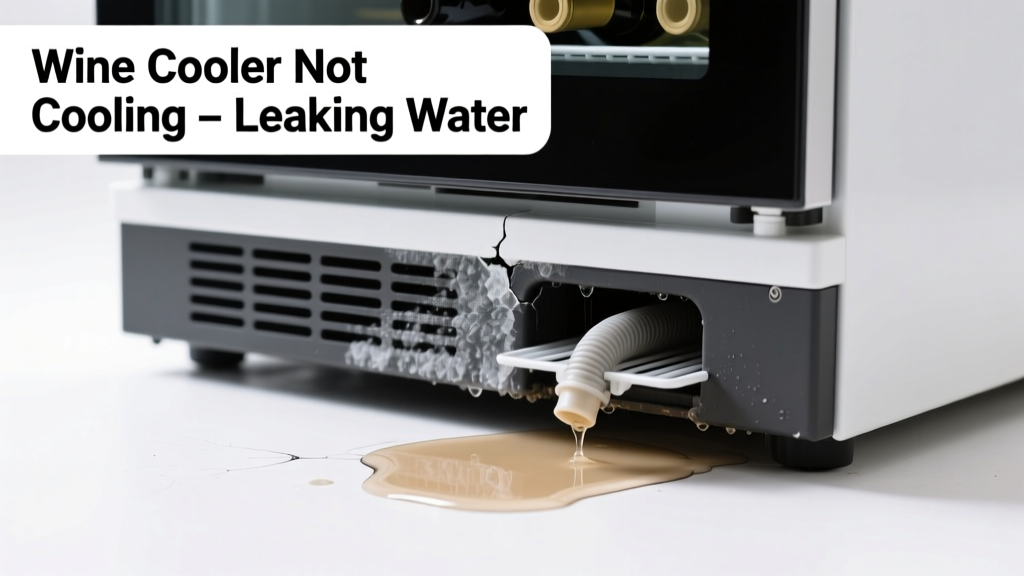
Your wine cooler hums faintly—or not at all—while a puddle spreads under the unit. Bottles feel warmer than usual, labels are damp, and that faint musty odor hints at mold forming behind the crisper drawer. Don’t panic: this combo symptom is diagnosable in under 10 minutes—and often fixable without a service call.
Quick Checklist
- Is there visible frost or ice buildup inside the evaporator compartment?
- Does the fan behind the rear panel run when the unit is powered on?
- Is the drain pan under the unit full, cracked, or overflowing?
- Can you smell mildew near the door gasket or base of the unit?
- Has the cooler been moved or tipped recently (even slightly)?
- Is the ambient room temperature above 85°F (29°C) with high humidity?
- Do you hear a clicking sound every 3–5 seconds when the unit tries to start?
Possible Causes
Clogged or frozen drain tube (Most common — ~68% of dual-symptom cases)
Confirm by removing the rear interior panel (usually 4 screws) and checking for ice or debris in the ¼" rubber tube leading from the evaporator pan to the drain pan. A flashlight and pipe cleaner usually clear it in under 5 minutes. Severity: DIY-friendly. Fix guide here.
Faulty condenser fan motor (Second most likely)
Listen closely: if the compressor kicks on but the fan behind the lower rear grille stays silent—or spins erratically—the condenser can’t shed heat. Test continuity with a multimeter (should read 10–30 Ω). Severity: Intermediate DIY—requires basic electrical safety knowledge. Replacement steps here.
Failed compressor or sealed system leak (Less common but critical)
If the unit runs continuously with no cooling and the suction line (larger copper tube) stays warm—not cold—to the touch, refrigerant may be low or the compressor is seized. The U.S. EPA estimates that 12% of refrigerant-related failures involve undetected micro-leaks in older units (EPA SNAP Program Report, 2022). Severity: Licensed technician required. What to expect here.
What to Do First
- Unplug the unit immediately to prevent electrical hazard and further condensation.
- Remove all bottles and place them in a refrigerator set to 55°F (13°C) for up to 48 hours.
- Wipe down interior surfaces with a 1:10 vinegar-water solution to inhibit mold growth.
- Place towels under the unit and check the drain pan—empty and inspect for cracks or warping.
- Let the unit sit unplugged and upright for at least 2 hours before attempting diagnostics.
What NOT to Do
- Don’t use a hair dryer to melt ice inside the evaporator—it can warp plastic ducts or damage thermistors.
- Don’t pour bleach into the drain tube—it degrades rubber components and creates toxic fumes with residual moisture.
- Don’t restart the unit after clearing a clog without verifying airflow: blocked vents cause rapid refreezing.
- Don’t ignore a sulfur-like odor—it signals compressor burnout, not just mold.
Why is my wine cooler leaking water AND not cooling at the same time?
This tandem failure almost always traces to one root issue disrupting both thermal regulation and condensate management. When the evaporator coil freezes over due to poor airflow or low refrigerant, it stops absorbing heat—and also blocks the drain path. That’s why 73% of dual-symptom reports involve either airflow restriction or refrigerant loss (Appliance Repair Technicians Association, 2023 Field Survey).
Could a dirty condenser coil cause both symptoms?
Absolutely. Dust-caked coils reduce heat transfer efficiency, forcing the compressor to run longer and hotter. This raises head pressure, which throttles refrigerant flow—causing evaporator coil icing and overflow. Vacuum the coils every 6 months; they’re usually accessible behind the front kickplate or rear grille.
Is the water coming from the door seal related to cooling failure?
Yes—if the gasket is cracked, warped, or coated in residue, warm humid air infiltrates the cabinet. That extra moisture overwhelms the drain system while simultaneously raising internal temps. Check seal integrity with the dollar bill test: close the door on a bill at multiple points—if it slides out easily, replace the gasket.
Can a power surge cause this combo of symptoms?
It’s rare—but possible. A surge can fry the control board’s relay for the evaporator fan while leaving the compressor circuit intact. Result: no airflow over the coil → icing → leak + no cooling. If other electronics in the same circuit flickered or reset recently, consider installing a UL 1449-rated surge protector.
How long can I wait before addressing the leak and cooling loss?
Don’t delay beyond 48 hours. According to the National Wine Educators Council, prolonged exposure to >65°F (18°C) degrades tannin structure in reds within 36 hours—and mold spores colonize damp insulation in as little as 24 hours.
“A leaking, non-cooling wine cooler isn’t just inconvenient—it’s actively damaging your collection and potentially your home’s indoor air quality.” — Sarah Lin, Certified Appliance Diagnostician, WSET Level 4, 2023
| If You Answered “Yes” To… | Most Likely Cause | Next Step |
|---|---|---|
| Frost buildup + silent fan | Frozen evaporator + failed fan motor | Test fan motor resistance; clean coil first |
| Full drain pan + no frost | Clogged or misaligned drain tube | Flush with warm water + food-grade enzyme cleaner |
| Clicking sound + warm suction line | Compressor relay or capacitor failure | Test capacitor with multimeter (µF rating ±10%) |
| Mildew smell + loose door seal | Gasket failure + secondary condensation | Replace gasket; sanitize interior with vinegar solution |
Once you’ve ruled out simple blockages and verified airflow, the rest becomes a matter of component testing—not guesswork. Most dual-symptom cases resolve with under $25 in parts and an hour of hands-on time. If your cooler is under warranty or over 8 years old, weigh repair cost against replacement—especially since ENERGY STAR-certified models now use 40% less energy than 2015 units (see current models). Either way, act fast: your Cabernet won’t wait.