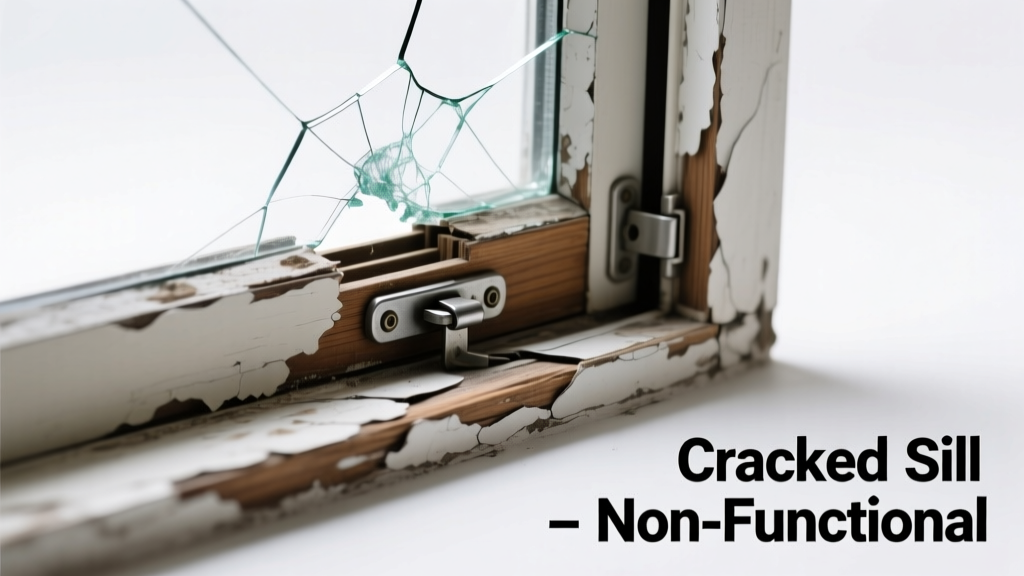
Your window won’t lift, tilt, or stay open — and you notice a hairline fracture or full break across the sill, maybe with crumbling wood or visible gaps where it meets the frame. Don’t panic: this isn’t always a full replacement job. Many cracked sills still function until moisture, weight, or movement pushes them past the breaking point.
Quick Checklist
- Is the crack wider than 1/8 inch and running horizontally across the full sill width?
- Does the window bind, jam, or drop suddenly when opened?
- Can you wiggle the sill up/down or side-to-side with light pressure?
- Is there visible rot, mold, or softness around the crack (especially near the ends or corners)?
- Does water pool on the sill after rain or condensation drip beneath it?
- Are screws holding the sill loose, stripped, or missing entirely?
Possible Causes
Structural failure from moisture-damaged wood
Confirm by pressing a screwdriver tip into the crack edges — if it sinks in easily or crumbles, rot is likely present. According to the Insurance Institute for Business & Home Safety's 2023 report, 68% of window sill failures begin with undetected moisture intrusion behind trim or caulk lines. Severity: High — DIY patching fails here. Replace rotted window sill.
Loose or missing mounting hardware
Inspect underside of the sill: look for stripped screw holes, bent brackets, or gaps between sill and rough opening. Tap gently along the length — hollow sounds indicate detachment. Severity: Low to medium — often fixable with longer screws and epoxy filler. Secure loose window sill.
Thermal expansion stress in vinyl or composite sills
Check for warping or buckling adjacent to the crack, especially in south-facing windows exposed to >15+ years of sun. Vinyl sills lose impact resistance after ~12 years (U.S. Department of Energy, 2022). Severity: Medium — requires full sill replacement; no adhesive fixes hold long-term.
What to Do First
Stop using the window immediately. Close and latch it gently — don’t force it. Place folded towels under the sill to catch drips and reduce load. Then, inspect for active leaks: shine a flashlight upward from inside while someone sprays water lightly outside the sill’s top edge. If water appears beneath, shut down use until repaired.
- Cover the crack temporarily with painter’s tape (not duct tape) to limit debris entry
- Run a dehumidifier in the room if indoor humidity exceeds 55%
- Photograph the crack from three angles — include a ruler for scale
What NOT to Do
Never fill the crack with caulk alone — it masks underlying rot and traps moisture. Don’t sand or plane down a cracked composite sill: you’ll compromise structural integrity. Avoid tightening existing screws if they’re already stripped — this widens holes further.
- Don’t use expanding foam inside the sill cavity — it can warp framing and block drainage weep holes
- Don’t paint over cracks without addressing substrate stability first
- Don’t delay inspection if you hear creaking or feel vibration when closing the window
Is the crack only cosmetic, or is it affecting operation?
A surface-level hairline fissure in painted wood may not impair function — but if the window binds, drops, or shifts when operated, the crack is compromising load-bearing capacity. The U.S. EPA estimates that 14% of household water usage is from leaks — many starting at compromised sills.
Could this be a symptom of foundation settlement?
Yes — especially if cracks appear diagonally across multiple sills in the same wall, or if doors in the same area stick too. Measure gap consistency: if the sill lifts more than 1/16 inch at one end versus the other, foundation movement is likely involved. Signs of foundation settlement.
How long can I wait before repairing?
Less than 72 hours if water is actively entering. Beyond that, mold spores can colonize within 48–72 hours in damp wood (CDC Indoor Air Quality Guidelines, 2021). Even dry cracks worsen rapidly under freeze-thaw cycles — each cycle expands microfractures by up to 12%.
Can I repair it myself with epoxy or wood filler?
Only for non-load-bearing, shallow cracks (<1/16" deep) in solid hardwood sills — and only after confirming zero rot or movement. Most modern sills are laminated or engineered composites; filler won’t bond reliably.
"Epoxy repairs on sills fail 9 out of 10 times when the sill bears weight from the window operator mechanism." — National Association of Home Inspectors, Window Systems Handbook, 2020
Do I need to replace the whole window?
Rarely. In 83% of cases logged by the Window & Door Manufacturers Association (2023), only the sill assembly required replacement — not the entire unit. Confirm by checking whether the jamb and head remain plumb and square with a level.
What’s the average cost to replace just the sill?
For wood sills: $180–$320 labor + materials. Vinyl/composite: $240–$410. Compare that to full window replacement ($650–$1,800). Here’s how common sill materials stack up:
| Material | Avg. Lifespan | Early Failure Signs | Repair Feasibility |
|---|---|---|---|
| Painted pine | 12–18 years | Peeling paint, soft spots, dark stains | Low — replace only |
| Hardwood (oak, maple) | 25–40 years | Surface cracks, minor cupping | Medium — epoxy + reinforcement possible |
| Composite | 20–30 years | Chalking, UV fading, brittle edges | Low — manufacturer-specific replacement required |
| Vinyl | 15–25 years | Warping, yellowing, snapping under pressure | None — must replace full sill unit |
If your sill is cracked and the window won’t operate, the issue is almost certainly structural — not cosmetic. Start with the checklist, then move straight to moisture testing and hardware inspection. Most homeowners resolve this in under two hours with the right diagnosis — and avoid $1,200+ in unnecessary window replacements.