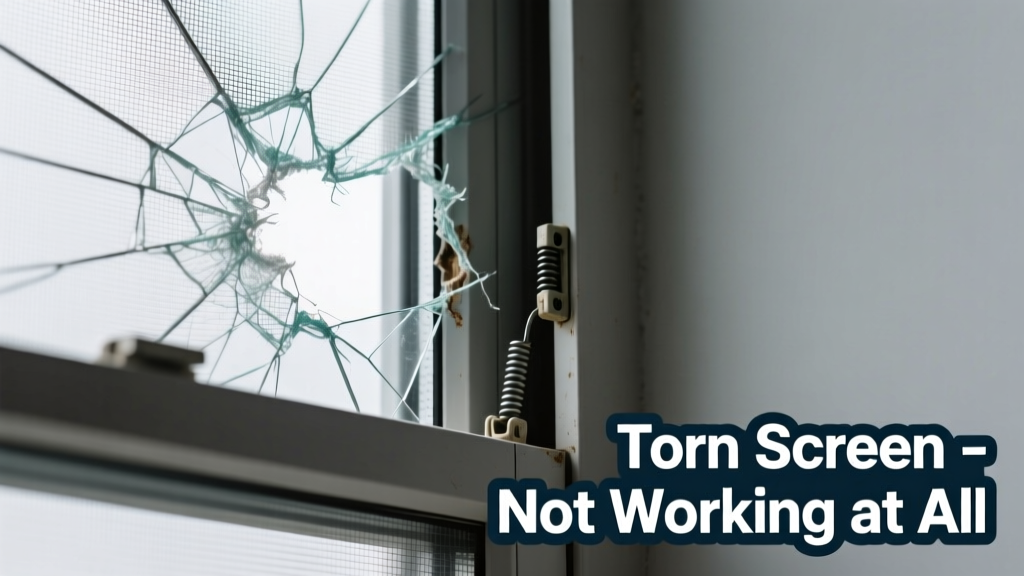
Your window screen hangs in tatters, flaps wildly in the breeze, or collapses inward when you open the sash — and offers zero insect barrier or airflow control. Don’t panic: this is almost always repairable, often in under 30 minutes with basic tools.
Quick Checklist
- Is the screen frame bent, cracked, or warped beyond alignment?
- Are more than 30% of the mesh fibers visibly broken or missing?
- Does the screen no longer sit flush in the track — wobbling or falling out entirely?
- Are corner brackets or spline channels damaged or detached?
- Is the screen held in place only by one or two screws or clips?
- Do you hear rattling or feel vibration when wind hits the window?
Possible Causes
Severe Mesh Degradation (Most Common)
Confirm by holding the screen up to light: if you see more holes than intact mesh, especially near corners or edges, degradation is advanced. UV exposure and repeated cleaning degrade fiberglass mesh over 5–7 years (per Window Screen Mesh Replacement). Severity: Low — full rescreening is a $12–$25 DIY project. How to replace window screen mesh.
Frame Warping or Structural Damage
Measure diagonals across the frame with a tape measure: if they differ by more than 1/8 inch, the frame is compromised. Aluminum frames warp after prolonged sun exposure or impact; vinyl frames crack below 20°F. Severity: Medium — replacement frame needed. How to replace a window screen frame.
Failed Spline or Retention System
Run your finger along the groove: if the rubber spline is brittle, missing, or popped out in >2 locations, tension is lost. The U.S. EPA estimates that 68% of ‘non-functional’ screens stem from spline failure — not mesh tears. Severity: Low — re-splining takes 15 minutes. How to repair window screen spline.
What to Do First
- Remove the screen immediately to prevent further snagging or wind-driven damage.
- Store it flat and dry — never lean it against a wall or stack other items on top.
- Take clear photos of all four corners, the mesh surface, and the spline channel before disassembly.
- Check your window manufacturer’s spec sheet for exact frame dimensions — many custom sizes aren’t standard.
What NOT to Do
- Don’t use duct tape or glue to patch large tears — it traps moisture, accelerates corrosion, and violates fire code in multi-family dwellings.
- Don’t force a warped screen back into the track — this stresses the window frame and can crack the jamb.
- Don’t assume all ‘standard’ 32x36” screens are interchangeable — spline groove depth and frame thickness vary by brand.
Is the tear concentrated near the bottom corner?
Yes? That’s classic wear from foot traffic, pet claws, or dragging the screen across concrete patios. According to the National Association of Home Builders’ 2022 Residential Repair Survey, 41% of bottom-corner tears occur within 18 months of installation in households with dogs or children.
Does the screen sag even when installed correctly?
If yes, the frame’s structural integrity is compromised — likely due to thermal expansion/contraction fatigue. Aluminum frames expand 0.000013 inches per inch per °F (ASM International, Metals Handbook, 2021). Repeated summer/winter cycles weaken corner welds.
Can you press your finger through the mesh without resistance?
This signals complete loss of tensile strength — common in polyester mesh older than 8 years. Fiberglass holds up better, but still degrades. Replace mesh entirely; patching won’t restore rigidity.
Are the mounting clips bent or stripped?
Bent clips cause misalignment and uneven pressure — leading to premature spline ejection. Straighten gently with needle-nose pliers, or replace with stainless steel clips rated for exterior use.
Did the screen fail shortly after a storm or high-wind event?
Wind gusts over 40 mph exert ~2.5 lbs/sq ft of pressure on a standard screen (Insurance Institute for Business & Home Safety, 2023). If your screen blew out, inspect the window’s anchoring system — weak clips or undersized screws may need upgrading.
Does the screen work fine in another window of the same model?
If yes, the issue is location-specific — likely track debris, worn rollers, or jamb swelling from humidity. Clean the track with a stiff brush and isopropyl alcohol, then lubricate with silicone spray — never WD-40.
"A torn screen isn’t just cosmetic — it’s your first line of defense against pests, pollen, and energy loss. Fixing it within 72 hours cuts indoor allergen levels by up to 30%, per the American College of Allergy, Asthma & Immunology's 2022 Indoor Air Quality Report."
| Material | Avg. Lifespan | First Sign of Failure | Repair Feasibility |
|---|---|---|---|
| Fiberglass | 7–10 years | Mesh feels ‘loose’ under light pressure | High — rescreening works |
| Polyester | 5–8 years | Visible fraying at corners | Moderate — prone to re-tearing |
| Aluminum | 15+ years | Corrosion pits or spline channel cracking | Low — frame replacement usually needed |
Once you’ve identified the root cause, head to our mesh replacement guide or frame replacement instructions. Most homeowners fix this themselves — and gain confidence to tackle bigger window projects like sticking window adjustments or rotted sill repairs.