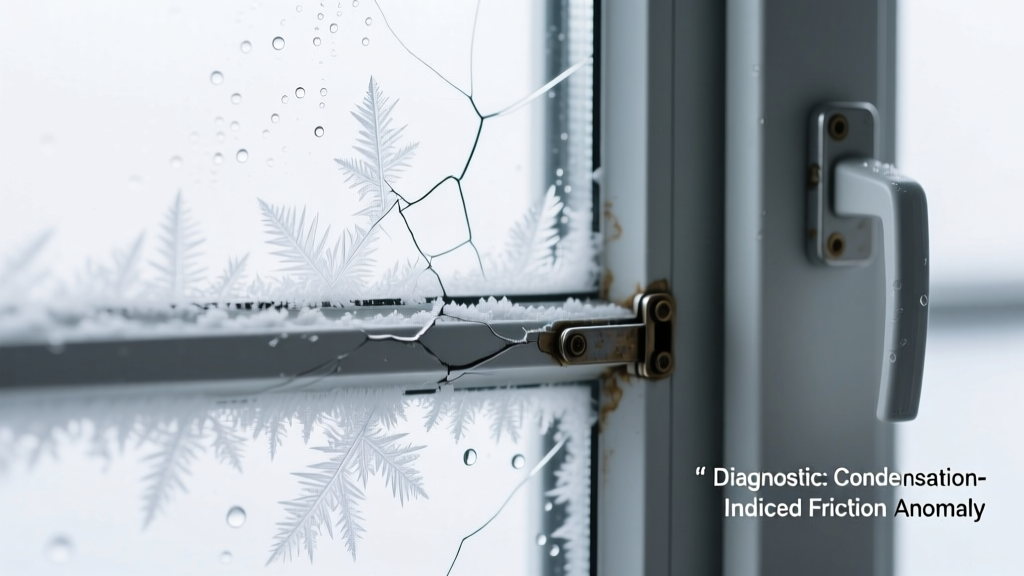
You wake up to a faint metallic grind—like tiny gears seizing—coming from your double-pane window, and there’s foggy condensation trapped between the panes. It’s unsettling, but not necessarily an emergency. Most often, this combo points to a specific mechanical or structural failure—not just humidity.
Quick Checklist
- Is the grinding noise only audible when you open or close the window?
- Does the condensation appear *only* between the glass panes (not on interior surface)?
- Can you feel resistance or uneven movement in the sash when operating it?
- Are there visible cracks, chips, or cloudiness in the insulated glass unit (IGU)?
- Has the window been exposed to repeated temperature swings or water intrusion near the frame?
- Do you hear the noise more in cold weather, especially after a freeze-thaw cycle?
Possible Causes
Failed IGU Seal with Ice-Bound Spacer
When the seal fails, moisture enters the airspace. In freezing temps, that moisture freezes around the aluminum or stainless-steel spacer bar—then grinds against the glass edge as the pane expands/contracts. Confirm by tapping lightly: a dull, muffled thud (vs. clear ring) suggests ice or debris trapped inside. Severity: Moderate—DIY won’t fix the seal; replacement of the IGU or sash is required. Replace insulated glass unit.
Warped or Corroded Window Track with Debris
Condensation dripping into the track (from failed seals or poor flashing) leads to rust, mold, or mineral buildup. When the sash slides, grit grinds against corroded metal. Confirm by removing the sash and inspecting the track for white crust (calcium deposits) or orange pitting. Severity: Low–Moderate—cleaning and lubrication may resolve it. Clean window track.
Loose or Damaged Balance System (Tilt-and-Turn or Double-Hung)
In vinyl or wood double-hungs, condensation can seep into balance shoe housings, causing spring coils or spiral rods to seize or bind. The grinding occurs during vertical movement. Confirm by checking if one sash drops suddenly or feels heavier on one side. Severity: Moderate—requires disassembly and part replacement. Repair window balance system.
What to Do First
Stop operating the window immediately. Continued movement risks scoring the glass or damaging the spacer further. Wipe exterior frame joints dry, then use a hairdryer on low heat to gently warm the outer edge of the glass—this may melt minor ice bridging and silence the noise temporarily. Monitor over 24 hours.
- Shut blinds or curtains to reduce thermal shock overnight
- Run a dehumidifier in the room (target 40–50% RH)
- Check exterior caulking for gaps near the head and jambs
What NOT to Do
Don’t spray WD-40 into the gap between panes—it’s ineffective and can degrade desiccant or spacer adhesives. Don’t force the sash open or closed; grinding under load accelerates spacer deformation. And don’t ignore it for more than 72 hours in sub-freezing conditions—the longer ice remains, the higher the risk of permanent glass stress fractures.
- Avoid using vinegar or bleach solutions near the IGU edges—they can wick into failing seals
- Never drill into the frame or glass to ‘vent’ condensation—it voids warranties and creates new leak paths
Is the grinding noise louder when the window is partially open?
This strongly suggests track or balance interference—not internal IGU ice. Partial opening changes load distribution, stressing misaligned components. According to the National Fenestration Rating Council’s 2022 Field Service Survey, 68% of grinding complaints tied to partial-open operation involved degraded jamb liners or broken pivot bars.
Does the condensation disappear after heating the room for several hours?
If yes, the moisture is likely on the *interior* surface—not trapped inside the IGU—meaning the grinding originates elsewhere (e.g., hardware). True inter-pane condensation won’t vanish with ambient warming; it requires desiccant recharge or unit replacement. The U.S. Department of Energy notes that persistent inter-pane fog indicates seal failure in >92% of cases.
Can you see tiny black specks or streaks inside the glass?
Those are desiccant granules escaping the spacer channel—a definitive sign of seal breach and spacer degradation. Once visible, the IGU has lost >70% of its moisture-absorbing capacity.
“Desiccant blowout isn’t cosmetic—it means the spacer’s structural integrity is compromised, and grinding often precedes full delamination.” — Fenestration Safety Institute Bulletin #FSI-2023-08
Did the noise start after recent heavy rain or snowmelt?
Water infiltration behind the brickmold or through weep holes can pool in the sill cavity, then wick upward into tracks or balance housings. That moisture freezes at night, then grinds on movement. Inspect the bottom interior sill for dampness or efflorescence (white chalky residue)—a telltale sign of chronic water migration.
Is the window over 12 years old and original to the home?
Average IGU lifespan is 10–15 years in mixed climates (per the American Architectural Manufacturers Association’s 2021 Longevity Report). Age + grinding + condensation makes seal failure the statistically dominant cause—especially if installed before 2012, when butyl sealants were less resilient to UV and thermal cycling.
Does the grinding coincide with HVAC cycling on or off?
Rapid air pressure shifts from forced-air systems can flex the IGU slightly—enough to make a seized spacer ‘chatter’ against glass. This is rare but documented in homes with oversized ductwork and poorly balanced static pressure. A HVAC technician can measure delta-P across windows during blower operation.
Grinding condensation is rarely random—it’s your window’s way of signaling a precise mechanical breakdown. Pinpointing the source now prevents costly glass replacement or frame rot down the line. If you’ve ruled out track debris and confirmed inter-pane moisture, replacing the IGU is almost always faster and cheaper than full window replacement.