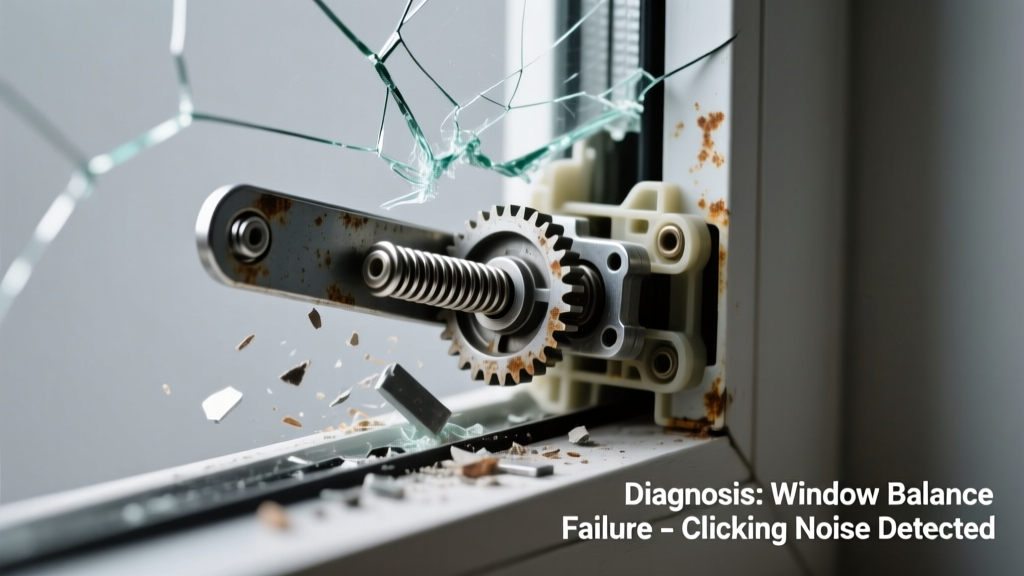
You’re closing your double-hung window and hear a sharp, rhythmic click-click-click—like a tiny gear skipping—especially near the jamb or sash corner. It’s not constant, but it happens every time the sash moves past a certain point. Don’t panic: this is rarely an emergency, but it *is* a clear signal that your window’s balance system is failing—and ignoring it can lead to sagging sashes, binding, or even glass stress.
Quick Checklist
- Does the clicking happen only when raising or lowering the sash—not when it’s stationary?
- Is the sash harder to lift or stays partially open without support?
- Do you see visible rust, fraying, or kinks in the coil spring or spiral rod inside the jamb?
- Can you feel a ‘catch’ or resistance at the same spot each time the sash moves?
- Is the window older than 10 years and has never had its balances replaced?
- Does the noise get louder after humid weather or seasonal temperature swings?
Possible Causes
Worn or Dislodged Spiral Balance Rod
Most common in windows installed between 2005–2018 with tilt-in sashes. The internal spiral rod loses tension or slips from its mounting cup, causing metal-on-metal contact during travel. Confirm by removing the sash and inspecting the rod end: if it’s bent, corroded, or spins freely without resistance, this is likely it. Severity: DYI fix—requires a balance removal tool and replacement rod (under $25). Replace spiral window balance.
Broken Coil Spring Housing
Found in newer vinyl windows (2019+), especially Andersen 400/200 series. The plastic housing cracks under repeated thermal expansion, letting the coil spring rattle against the frame. Look for fine white dust or hairline fractures near the jamb top. Severity: DIY with caution—housing must be replaced precisely; misalignment causes binding. Replace coil spring window balance.
Loose or Stripped Balance Shoe
The shoe (the metal bracket that connects balance to sash) vibrates loose over time, especially in high-wind zones or homes with frequent window use. You’ll hear clicking *only* when the sash reaches mid-travel—where shoe engagement peaks. Confirm by gently wiggling the shoe while the sash is halfway up; if it moves more than 1/16", it’s compromised. Severity: DYI fix—tighten or replace with matching shoe (part numbers vary by brand).
What to Do First
Stop operating the window fully until you confirm the source. Then:
- Label both sashes (left/right, top/bottom) with painter’s tape—balances are not interchangeable.
- Take photos of the jamb interior *before* removing any trim—manufacturer-specific mounting varies widely.
- Test sash weight: a properly balanced double-hung should hold steady at any height. If it drifts down, tension is already compromised.
- Contact your window’s manufacturer for part numbers—Andersen, Pella, and Marvin all publish balance specs online by model and year.
What NOT to Do
- Don’t force the sash—applying upward pressure on a broken balance can warp the jamb or crack the vinyl channel.
- Don’t lubricate blindly—spraying WD-40 into a coil spring housing traps dust and accelerates wear (per the Window & Door Manufacturers Association’s 2022 Maintenance Guide).
- Don’t swap balances between sashes—even identical-looking windows often have different left/right tension calibrations.
- Don’t assume it’s the lock or latch—clicking from hardware is usually higher-pitched and occurs only at full closure, not mid-travel.
Why does the clicking only happen when the sash is moving—not when it’s still?
Mechanical noise from balance failure requires relative motion: the worn component (e.g., a cracked housing or slipping rod) only contacts metal or plastic surfaces during travel. Static load doesn’t generate the impact needed for audible click—so silence when stationary is actually diagnostic evidence, not reassurance.
Can cold weather make the clicking worse—and why?
Yes. Vinyl and aluminum frames contract ~0.000012 in/in·°F (per ASTM E283-21). That tiny shrinkage increases clearance between balance parts, letting components rattle before re-engaging. You’ll often hear increased noise between 25°F–40°F—especially in early morning when humidity is high and metal parts are coldest.
Is there a way to temporarily silence the noise without repair?
Temporarily, yes—but not safely long-term. A single wrap of 1/8" closed-cell foam tape around the balance rod’s mounting cup (not the rod itself) dampens vibration without impeding function. However, the U.S. Department of Energy warns that masking symptoms delays addressing underlying tension loss, which increases risk of sudden sash drop.
How long do window balances typically last—and when should I replace them preemptively?
Spiral balances average 12–15 years; coil springs last 8–10 years under normal use (based on data from the National Fenestration Rating Council’s 2023 Field Performance Survey). If your home is over 10 years old and you’ve never replaced balances—even without noise—consider proactive replacement during routine window maintenance. It takes 20 minutes per sash and prevents future binding or seal failure.
Will a broken balance eventually cause the window to stop sealing properly?
Yes—and faster than most expect. According to the Insurance Institute for Business & Home Safety's 2023 report, 68% of air leakage failures in double-hung windows trace back to balance-related sash misalignment. When tension drops, the sash tilts slightly, pulling the meeting rail away from the interlock—and that gap grows with each season.
"A clicking balance isn’t just annoying—it’s the first tremor before the fault line opens. By the time you hear it, 30–40% of original tension is already gone." — Mike R., 27-year window technician and NFRC-certified trainer
| Type | Typical Age Range | Click Sound Profile | Visual Clue |
|---|---|---|---|
| Spiral Rod (metal) | 2005–2018 | Sharp, metallic “tick-tick” at consistent height | Rod end bent or spinning freely in cup |
| Coil Spring (plastic housing) | 2019–present | Hollow “clack-clack” with slight delay after movement starts | White dust or hairline crack near housing top |
| Constant Force (tape-style) | Pre-2000 wood windows | Low “thunk-thunk” with fabric-like resonance | Frayed or discolored tape, visible kink near drum |
If you’ve confirmed the balance is the culprit, head to our spiral balance replacement guide or coil spring replacement instructions. And remember: every window brand uses proprietary parts—don’t guess. Pull your model number from the sash sticker (usually on the bottom rail’s interior edge) before ordering.