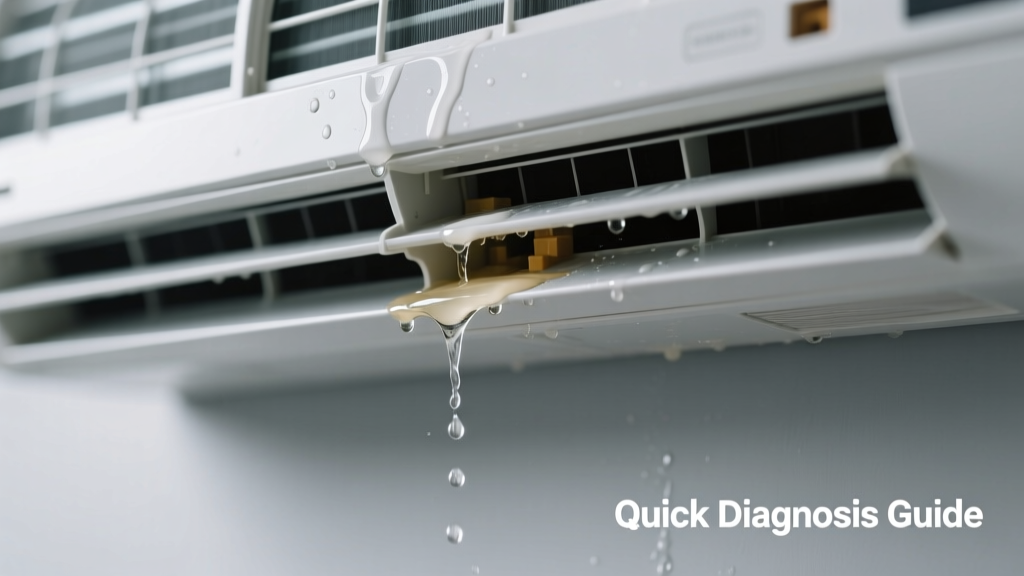
You wake up to a wet spot on the floor beneath your window AC — maybe a steady drip, a puddle pooling near the unit’s base, or damp drywall staining the wall behind it. It’s alarming, but not usually an emergency — and in most cases, the cause is simple, visible, and fixable in under an hour.
Quick Checklist
- Is the unit tilted slightly downward (toward the outside)?
- Can you hear gurgling or see water dripping from the front or bottom of the unit?
- Has the drain hole or rear drip tray been cleaned in the last 3 months?
- Is there visible mold or mildew around the indoor side of the unit or sill?
- Does the leak happen only during high humidity or after long runtime?
- Is the air filter visibly dirty or clogged with dust and pet hair?
- Did you recently move or reinstall the unit without resealing the window frame?
Possible Causes
Clogged condensate drain or drip tray
Confirm by removing the front panel and inspecting the plastic tray behind the evaporator coils — look for standing water, algae, or debris blocking the rear drain hole. Use a pipe cleaner or compressed air to clear it. Severity: Low — fully DIY. Fix clogged drain
Improper installation angle
Check with a level: the unit should slope 1/4″ to 1/2″ downward toward the outside. If it’s level or sloping inward, condensate flows backward into your room. Severity: Low — adjust shims or brackets. Fix installation tilt
Frozen evaporator coils (then thawing)
Look for frost or ice buildup on the coils (visible after turning off and opening the front panel). Confirm with a thermometer reading below 32°F at the coil surface. Often caused by low airflow or refrigerant issues. Severity: Medium — clean filter first; if ice returns, call a pro. Fix frozen coils
What to Do First
- Turn off the AC immediately to prevent electrical hazards and further water spread.
- Place towels or a shallow pan under the leak to contain runoff.
- Unplug the unit — don’t just flip the thermostat switch.
- Wipe down all wet surfaces and run a dehumidifier nearby to limit moisture absorption.
- Inspect the exterior drain path — ensure no leaves, wasp nests, or caulk are blocking the exit point.
What NOT to Do
- Don’t tape over the drip hole or seal the rear drain with silicone — this traps water inside the unit.
- Don’t ignore a musty odor or black specks — that’s mold growth, not just water.
- Don’t run the unit while water pools in the drip tray — it can overflow into the blower motor.
- Don’t use a shop vac to suck water out of the internal tray unless the unit is unplugged and fully cooled.
Why is my window AC leaking water only at night?
Nighttime leaks often point to temperature differentials: cooler outdoor temps cause condensate to form more readily on cold components, and lower fan speeds (in sleep mode) reduce airflow, increasing coil saturation. Check your fan setting and ensure the unit isn’t oversized for the room — oversizing causes short cycling and poor moisture removal.
Is it normal for a window AC to drip water outside?
Yes — but only outside, and only from the designated rear drain port. According to the Air-Conditioning, Heating, and Refrigeration Institute’s 2022 Installation Standards, all properly installed units must discharge condensate externally. If water drips indoors, the tilt or drain path is compromised.
Can a dirty air filter cause water leakage?
Absolutely. A clogged filter reduces airflow across the evaporator coil, causing surface temperatures to drop below freezing. When the coil thaws (often during off-cycles), excess water overwhelms the drain tray. The U.S. Department of Energy estimates that 68% of seasonal window AC leaks begin with neglected filters.
My AC leaks only when it’s humid — is that normal?
Some increased condensation is expected, but active dripping indoors isn’t. At 70%+ relative humidity, a typical 8,000 BTU unit produces ~1–2 pints of water per hour. If your drain system can’t handle that volume, it’s likely clogged or undersized. Clean the tray and check for algae — it’s the #1 culprit in high-humidity environments.
Could a refrigerant leak cause water leakage?
No — refrigerant doesn’t produce water. But low refrigerant *indirectly* contributes: it lowers coil temperature, leading to excessive frost buildup and eventual thaw-drip cycles. If you hear hissing, notice oil residue on copper lines, or feel weak cooling, refrigerant loss is likely — and requires EPA-certified service.
"A single ounce of refrigerant loss can drop coil surface temp by 12°F — enough to trigger freeze-thaw leaks within hours." — HVAC Technician Certification Manual, North American Technician Excellence (NATE), 2023
| Symptom | Most Likely Cause | First Action |
|---|---|---|
| Water pooling on sill, dripping onto floor | Unit tilted inward or blocked drain | Check level; clear rear drain with wire |
| Steady drip from front grille during operation | Frozen coils thawing mid-cycle | Replace filter; run on fan-only for 2 hrs |
| Musty smell + black residue near drain | Mold in drip tray or drain line | Clean tray with vinegar; replace foam gasket |
| Leak only after heavy rain | Failed exterior seal or missing weatherstripping | Re-caulk frame; install foam backer rod |
If you’ve ruled out tilt, clogs, and airflow — and the leak persists after cleaning and leveling — it may be time to inspect the condensate pump (if equipped) or consult a technician. Most leaks resolve with basic maintenance, but ignoring them for more than 48 hours risks drywall rot, electrical shorts, or mold colonization behind the unit. Start with the checklist, act fast, and remember: water follows gravity — so follow the drip backward to its source.