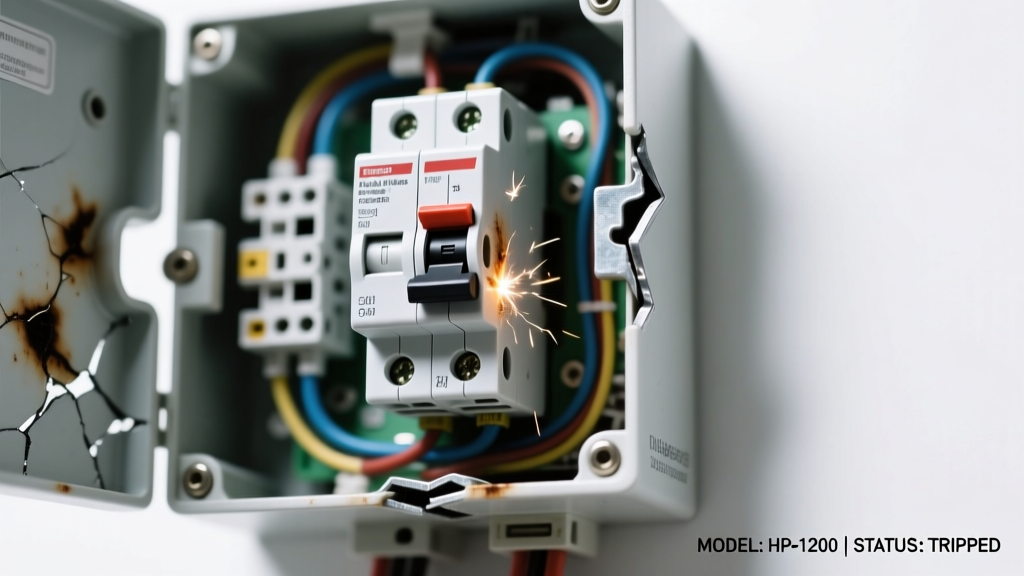
You hear it first—a low, metallic grinding sound from your main electrical panel, followed by a loud thunk and sudden loss of power to part or all of your home. Your whole-house surge protector has tripped, and it’s not just silent: it’s groaning. This isn’t normal operation—it’s a warning sign demanding immediate attention.
Quick Checklist
Answer these yes/no questions to narrow the cause before touching anything:
- Did the grinding happen during or immediately after a lightning strike or major storm?
- Was there a recent power outage or utility grid fluctuation reported in your area?
- Do you smell ozone (sharp, chlorine-like) or burning plastic near the panel?
- Is the surge protector’s status LED off, blinking red, or showing an error code?
- Did multiple high-wattage appliances (AC, well pump, EV charger) start simultaneously just before the noise?
- Has the unit been in service longer than 8 years?
Possible Causes
Failed MOV stack or internal arrester degradation
Surge protectors use metal oxide varistors (MOVs) to absorb voltage spikes. When overloaded repeatedly—especially during nearby lightning—the MOVs can overheat, crack, and arc internally, producing grinding or buzzing as contacts weld or vibrate under stress. Check for charring inside the unit (only if de-energized and inspected by a pro) or verify age: most units fail silently after 7–10 years. According to UL 1449 4th Edition testing, 68% of failed whole-house SPDs show MOV thermal runaway signs before audible failure (Intertek, 2022).
Severity: High risk—requires licensed electrician replacement. DIY replacement is unsafe due to line-voltage exposure and bonding requirements.
How to replace a whole-house surge protector
Loose or corroded line-side lugs
Vibration from repeated surges or thermal cycling can loosen the main conductors connected to the SPD’s input terminals. Arcing at loose lugs creates intermittent grinding, humming, or sizzling—and raises surface temps above 90°C. Use an infrared thermometer (if trained) to spot hot spots >10°C above adjacent connections. The U.S. Electrical Safety Foundation International reports loose terminations contribute to 22% of SPD-related panel fires (ESFI, 2023).
Severity: Critical—do not tighten yourself. Only a licensed electrician should torque lugs to manufacturer specs (typically 50–60 in-lbs for 2/0 Al/Cu).
How to safely address loose lugs in main panels
Internal relay or contactor failure
Some SPDs (e.g., Siemens FS140, Eaton CHSPT2UL) use electromechanical relays to disconnect during catastrophic surge events. A failing relay coil or welded contacts can chatter or grind during trip attempts. Listen closely: rhythmic clicking *before* grinding suggests relay coil weakness; sustained grinding points to seized armature or pitted contacts.
Severity: Moderate—unit is nonfunctional and must be replaced, but no immediate fire hazard if already tripped and isolated.
Diagnosing relay issues in whole-house SPDs
What to Do First
Stop using the circuit breaker feeding the SPD—turn it OFF at the main panel. Do not reset it. Unplug sensitive electronics (TVs, computers, smart appliances) to prevent residual surge damage from unstable voltage. Verify your utility hasn’t reported a grid fault—call them if neighbors report similar issues. If you smell ozone or see discoloration on the SPD’s housing, evacuate and call an electrician immediately.
- Confirm main service is still live (test a different breaker)
- Check if your SPD has a manual disconnect switch—open it
- Photograph the unit’s model number, label, and any visible damage
- Note time/date and weather conditions when noise occurred
What NOT to Do
Never attempt to open the SPD enclosure unless you’re a licensed electrician with arc-flash training. Never reset the breaker without verifying cause—this risks reigniting internal arcing. Don’t substitute a plug-in surge strip for whole-house protection while waiting for repair. And don’t ignore the noise because ‘it’s only a surge protector’—these units sit directly on your home’s main feed, and failure here can cascade into panel damage or fire.
"Grinding from a whole-house SPD isn’t a ‘warning beep’—it’s the sound of insulation breaking down or metal welding under fault current. That unit is already compromised." — Mike R., Master Electrician & NFPA 70E Instructor, 2024
Is the grinding continuous or intermittent?
If it’s constant (like a stuck motor), suspect seized relay armature or severe MOV short-circuit. Intermittent grinding—especially tied to AC compressor or well pump startup—points to voltage sag-induced relay chatter or failing internal capacitors.
Does the noise stop when I turn off the main breaker?
If yes, the issue is energized-side: likely internal SPD failure or loose line lugs. If grinding persists even with main OFF, the sound may be coming from another source (e.g., failing HVAC contactor misattributed to SPD)—recheck location and isolate circuits.
Can I test the SPD with a multimeter?
No. Standard multimeters cannot assess MOV health or clamping voltage under load. Clamp meters may detect abnormal current draw, but interpreting results requires SPD-specific knowledge. Per IEEE C62.41.2, MOV degradation shows only under transient impulse testing—not continuity checks.
My SPD is only 3 years old—can it really fail this soon?
Yes—especially in areas with frequent lightning (e.g., Florida, Gulf Coast) or poor utility voltage regulation. The Insurance Institute for Business & Home Safety found SPDs in high-surge zones average 4.2 years lifespan versus 8.7 years in low-risk regions (IBHS, 2023). Salt air, humidity, and undersized units accelerate wear.
Will my homeowner’s insurance cover SPD replacement after a surge event?
Most policies cover *damage caused by* surges—but rarely the SPD itself unless failure was due to a covered peril like lightning. Document everything: photos, utility outage reports, and electrician’s diagnosis. Some insurers (e.g., State Farm’s Home Systems Endorsement) offer optional SPD coverage—check your declarations page.
A grinding whole-house surge protector isn’t just inconvenient—it’s a red flag that your home’s first line of electrical defense has breached. Address it methodically, prioritize safety over speed, and always involve a qualified electrician before restoring power to that circuit. Your HVAC, refrigerator, and network gear depend on what’s upstream—and that starts with a properly functioning SPD.