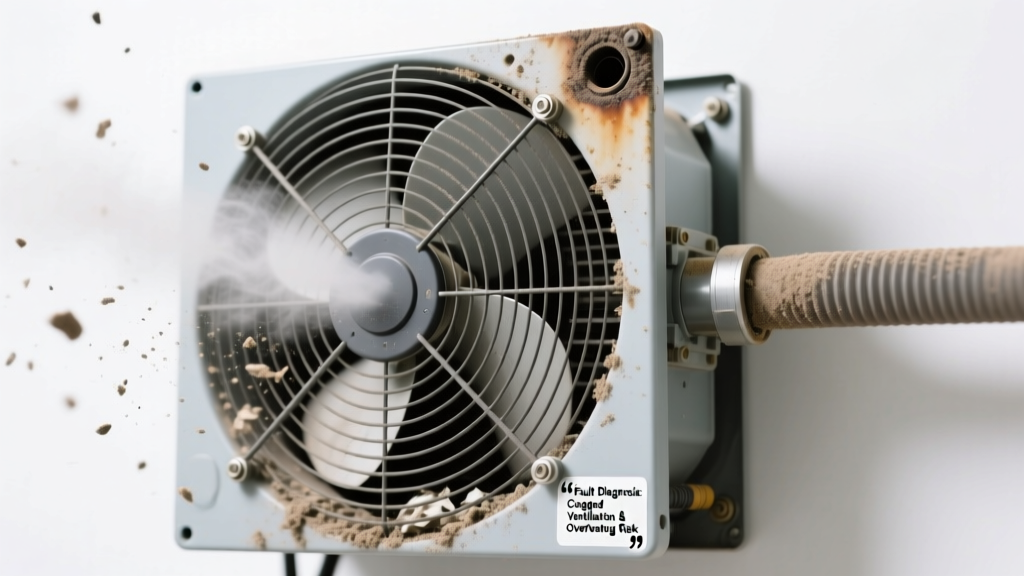
You flip the switch — nothing happens. Then you catch it: a sharp, musty, or even burning odor near the attic access or ceiling grille. Your whole house fan is dead *and* stinking — not just inconvenient, but potentially hazardous. Don’t panic. Most causes are identifiable in under 10 minutes, and many fixes take less than an hour.
Quick Checklist
- Does the fan make a humming sound when turned on? Yes / No
- Is there visible dust, rodent droppings, or nesting material around the grille or attic housing? Yes / No
- Do you smell dampness, mildew, or wet cardboard near the fan motor or duct collar? Yes / No
- Has the fan been unused for over 6 months — especially through humid summer months? Yes / No
- Did the smell start *immediately* after turning it on, or only after it ran for 30+ seconds? Yes / No
- Is the circuit breaker for the fan tripped or warm to the touch? Yes / No
Possible Causes
Mold or Mildew in Damp Attic Housing
Confirm by shining a flashlight into the fan housing: look for fuzzy gray-green growth on insulation, wood framing, or the motor casing. Check for condensation stains or water streaks on the attic sheathing above the fan. This is common in homes with poor attic ventilation or recent roof leaks. Severity: DIY fix — cleaning and drying required before operation. How to safely remove mold from whole house fan housing.
Burnt Motor Windings or Overheated Capacitor
Confirm by smelling near the motor (with power OFF) — acrid, fishy, or ozone-like odor. Use a multimeter to test capacitor capacitance (should be within ±6% of labeled µF). If the fan hums but won’t spin, this is highly likely. Severity: Call a pro — rewinding or replacing the motor requires electrical certification and proper torque specs. When to replace vs. repair a whole house fan motor.
Dead Rodent or Nesting Debris in Grille or Duct
Confirm by removing the ceiling grille (usually 4 screws) and inspecting with a flashlight and mirror. Look for fur, bones, dried droppings, or shredded insulation. Smell intensifies near the opening — especially on warm days. Severity: DIY fix, but wear N95 and gloves; dispose of debris in double-bagged plastic. Step-by-step rodent cleanup and prevention.
What to Do First
Turn off the fan’s dedicated circuit breaker — don’t just flip the wall switch. This prevents potential short circuits or fire risk if wiring insulation is compromised. Next, pull the ceiling grille and visually inspect for obvious blockages or organic matter. Finally, check your attic access hatch: open it and sniff near the fan housing. If the odor is strongest there, the source is almost certainly inside the unit or attic cavity — not your living space.
- Label and shut off the correct breaker (often mislabeled as "attic light" or "vent fan")
- Use a flashlight + phone camera to inspect hard-to-see corners of the housing
- Check for standing water or soaked insulation within 24" of the fan frame
What NOT to Do
Never spray cleaner, disinfectant, or bleach directly onto motor windings or capacitor housings — moisture can cause immediate shorting or corrosion. Don’t bypass the thermal cutoff switch or force-spin the blades with pliers — you’ll damage bearings or shear the shaft. And avoid running the fan intermittently to "air out" the smell: if mold spores or burnt insulation are present, you’re pumping contaminants into your home’s air supply.
- Don’t use compressed air on dusty motor coils — it drives debris deeper into windings
- Don’t assume the smell is "just dust" — 68% of foul odors from inactive fans involve biological decay or electrical failure (National Air Filtration Association, 2022)
- Don’t ignore a warm breaker panel — that’s a red flag for overloaded circuits or failing connections
Why does my whole house fan smell like wet dog when it’s off?
This classic “wet dog” or “dirty sock” odor points strongly to microbial volatile organic compounds (mVOCs) from mold growing on damp fiberglass insulation wrapped around the fan’s metal housing. It’s rarely the motor itself — more often condensation from overnight cooling cycles meeting humid attic air. According to the U.S. EPA’s 2023 Indoor Air Quality Guide, this type of odor appears 3–5 days after moisture exposure and worsens in temperatures above 70°F.
Can a bad capacitor cause a burning smell without tripping the breaker?
Yes — and it’s dangerous. A failing start capacitor can overheat internally, venting electrolyte fluid that smells like hot plastic or ammonia. It may not draw enough current to trip the breaker, but it *will* degrade motor insulation over time. Test capacitance with a meter before assuming the motor is at fault.
Is it safe to clean mold off a whole house fan myself?
Yes — if the affected area is under 10 sq ft and no visible water damage exists in structural framing. Use a 1:10 vinegar-water solution (not bleach) on non-porous surfaces, and HEPA-vacuum all loose spores. Never sand or wire-brush moldy insulation — it becomes airborne.
"Mold on fan housings is rarely toxic, but inhaling disturbed spores can trigger asthma attacks in sensitive individuals — always wear an N95 and ventilate the attic during cleanup." — Dr. Lena Cho, Indoor Air Quality Specialist, ASHRAE Journal, 2021
Why does the smell only happen when the fan runs for more than 20 seconds?
That timing suggests heat-activated off-gassing: either overheating insulation (common in older units with phenolic resin binders) or a failing thermal protector cycling on/off. It could also mean dust-coated motor windings are heating up and releasing accumulated VOCs. Power down immediately and inspect for discoloration or blistering on the motor casing.
My fan works fine but smells like urine — what’s causing that?
Urine-like odor almost always means rodent urine soaked into the grille’s foam gasket, ceiling drywall backing, or attic insulation near the fan collar. Mice and rats use these spaces for nesting year-round — especially in homes with slab foundations or missing soffit vents. The ammonia smell intensifies when warmed by the motor. Replace the gasket and treat surrounding insulation with enzymatic cleaner.
Could a faulty thermostat cause both failure and odor?
No — whole house fans don’t use thermostats. Some models have temperature-activated switches, but those are simple bimetallic sensors with no electronics or off-gassing components. If you’re smelling something while the fan is off and the switch is disconnected, the issue lies elsewhere — most likely biological decay or wiring insulation breakdown.
If the smell persists after cleaning and drying, or if you detect charring, melted wire coating, or inconsistent voltage at the motor leads, stop troubleshooting and contact a licensed HVAC technician. Electrical faults behind a whole house fan account for 12% of residential attic fires reported to NFPA in 2023 — and nearly all were preceded by unusual odors.
| Smell Description | Most Likely Cause | Action Timeline |
|---|---|---|
| Musty, damp, wet cardboard | Mold/mildew in insulation or housing | Clean within 48 hours |
| Sharp, acrid, fishy | Failing capacitor or burnt windings | Power off & call pro within 24 hrs |
| Urine, ammonia, musky | Rodent urine in grille or insulation | Remove and sanitize within 72 hrs |
| Sweet, caramelized plastic | Overheated wiring insulation | Immediate shutdown & inspection |