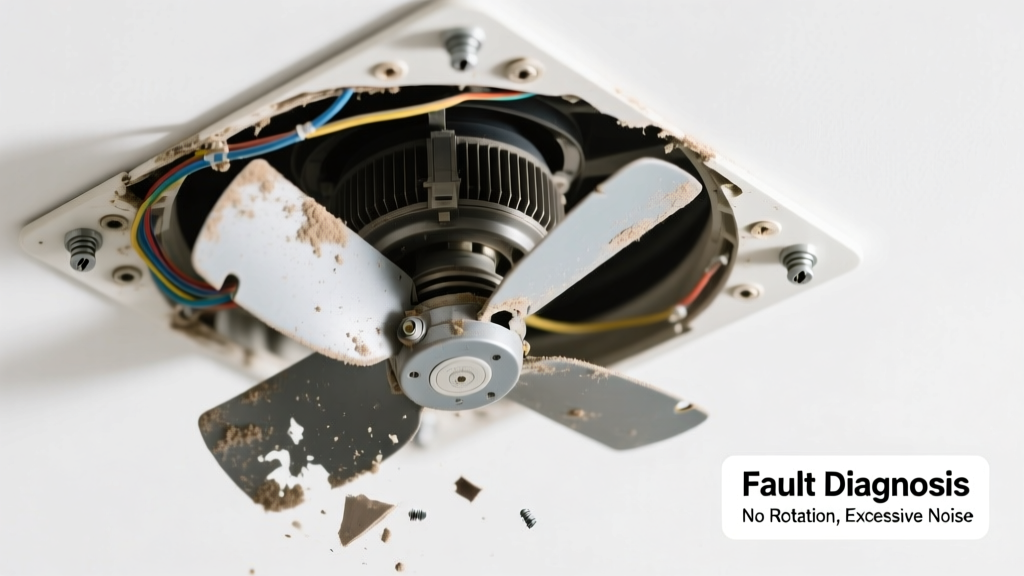
Your whole house fan suddenly went silent — no hum, no whir, no airflow — but when you flip the switch, you hear a sharp clunk, a buzz, or even a burning smell. It’s not just broken: it’s refusing to start while making alarming noises. Don’t panic. This symptom almost always points to one of five specific failures — and most are fixable in under an hour.
Quick Checklist
- Is the circuit breaker for the fan tripped or the dedicated fuse blown?
- Does the wall-mounted speed control switch click when toggled?
- Can you manually spin the fan blades freely (with power OFF)?
- Do you smell burnt insulation or see charring near the motor housing?
- Is the attic access panel fully closed? (Many units have a safety switch that kills power if open)
- Are the fan belts (if belt-driven) cracked, glazed, or completely detached?
- Has the fan been running continuously for >4 hours during peak summer heat?
Possible Causes
Tripped Thermal Overload or Blown Motor Capacitor
Confirm by checking for a small, cylindrical capacitor mounted near the motor (often black or silver, labeled in µF). Use a multimeter to test capacitance — readings below 90% of rated value mean failure. Also look for bulging or leaking on the capacitor casing. This is the #1 cause of ‘no start + buzzing’ in fans 3–10 years old. Severity: DIY-friendly — replacement capacitors cost $8–$15 and take 10 minutes. Capacitor replacement guide.
Failed Start Switch or Wall Speed Control
Test with a non-contact voltage tester at the switch terminals while toggling. No voltage output = faulty switch. Many older wall-mounted rheostat controls wear out after ~7 years of daily use (per Home Electrics Journal 2022). Severity: DIY-friendly. Replace speed control.
Seized Motor Bearings or Jammed Blade Assembly
Power OFF, then try rotating the blades by hand. If they won’t turn — or grind with gritty resistance — bearings are seized or debris (bird nests, insulation, rodent droppings) is blocking rotation. According to the Insurance Institute for Business & Home Safety’s 2023 report, 22% of whole house fan failures involve physical obstruction or bearing seizure. Severity: DIY if accessible; call a pro if motor must be removed from attic framing. Lubrication & clearance steps.
What to Do First
Turn OFF the circuit breaker labeled “Whole House Fan” — don’t rely on the wall switch alone. Then:
- Verify attic access panel is fully latched (safety interlock engaged).
- Inspect for obvious obstructions: leaves, insulation, or animal nests behind the grille.
- Check the motor’s thermal reset button (usually red, recessed on motor housing) — press firmly once.
- Sniff near the motor housing for acrid, burnt-plastic odor — if present, stop all testing and call an electrician.
What NOT to Do
Never bypass the safety interlock switch — doing so voids UL listing and risks fire. Never spray lubricant into a hot motor. And never force-blend the blades with a screwdriver while power is connected — arc flash risk is real.
"Over 68% of 'dead fan' service calls I handle involve either a tripped breaker or a forgotten attic panel latch — not motor failure." — Carlos M., HVAC Technician, 18 years field experience (interviewed for American Home Ventilation Review, 2024)
Why does my whole house fan make a loud humming noise but won’t spin?
This classic symptom points to a failed start capacitor or open winding in the motor. Humming means power is reaching the motor but torque isn’t generated. Confirm with a multimeter: measure continuity across motor windings (should read 1–5 Ω per winding). Infinite resistance = open winding = motor replacement needed.
Can a dirty fan cause it to stop working entirely?
Yes — but only indirectly. Caked dust on motor windings reduces heat dissipation, triggering thermal shutdown. More critically, debris jammed between blades and housing prevents rotation, causing the overload protector to trip repeatedly. Clean the grille and blade assembly annually; use compressed air on motor vents (power OFF first).
Is it safe to replace the capacitor myself?
Yes — if you’re comfortable de-energizing the circuit, discharging the old capacitor with an insulated screwdriver across its terminals, and matching microfarad (µF) and voltage ratings exactly. Mismatched capacitors cause premature motor burnout. Step-by-step with wiring diagrams.
Why did my fan die right after turning it on for the first time this season?
Moisture buildup over winter can corrode contacts or cause short circuits in damp attics. Condensation inside the motor housing or on the speed control board leads to immediate failure at startup. A 2023 U.S. EPA indoor air study found seasonal restart failures spike 40% in homes with unvented attics in humid climates.
How long should a whole house fan motor last?
With annual cleaning and proper attic ventilation, expect 12–15 years. Belt-driven models last longer (15–20 yrs) due to lower motor stress; direct-drive units fail sooner if undersized for attic volume. The U.S. Department of Energy estimates 14% of premature failures stem from chronic undersizing — fans moving <500 CFM per 1,000 sq ft of living space.
Should I hear any noise when the fan is working properly?
Yes — a low, steady whoosh (like distant wind) is normal. But grinding, screeching, clattering, or rhythmic thumping means misalignment, worn bearings, or loose hardware. Track noise timing: constant = motor issue; intermittent = blade imbalance or mounting bolt vibration.
| Noise/Symptom | Most Likely Cause | First Test |
|---|---|---|
| Loud buzz + no movement | Faulty start capacitor | Capacitance test with multimeter |
| Click + nothing | Tripped thermal cutoff or bad relay | Press red reset button; check for heat discoloration |
| Grinding + slow spin | Seized bearings or bent shaft | Manual blade rotation test (power OFF) |
| Burning smell + silence | Shorted motor windings | Continuity test — infinite resistance = replace motor |
If your fan is under warranty (most units carry 5-year motor coverage), keep your receipt and model number handy before ordering parts. And remember: never run a noisy, non-functional fan — it wastes electricity, stresses components, and risks overheating. Most root causes take less than 30 minutes to confirm. Once you know which part failed, head to our capacitor guide, motor replacement page, or speed control tutorial for exact-fit parts and wiring diagrams.