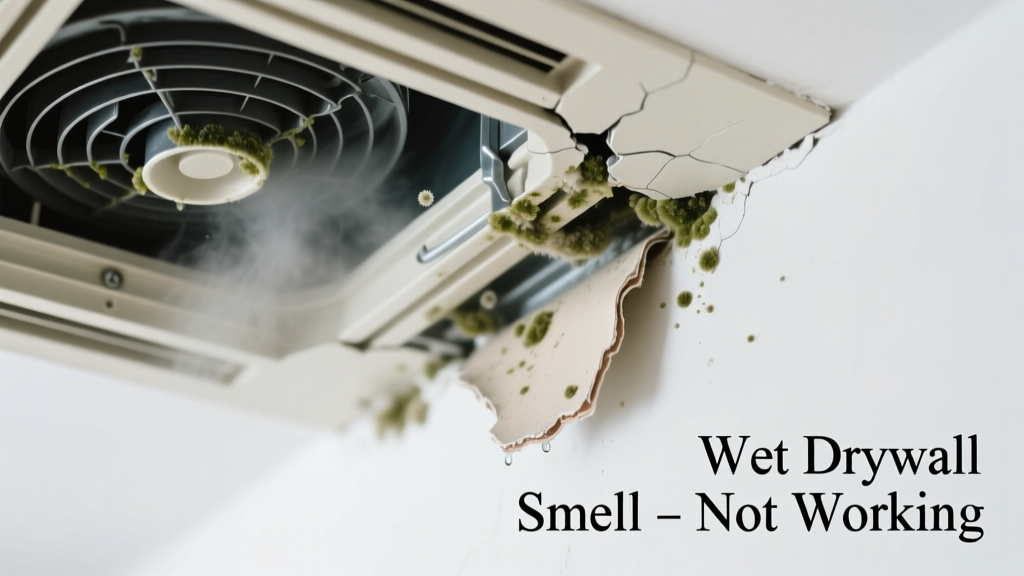
You walk into the basement after a heavy rain, sniff the air—and nothing. No musty, sour, or damp odor from the drywall behind the wall-mounted shelf. That absence is alarming, not reassuring. A missing wet-drywall smell when moisture is present can mean mold is already growing deep in the substrate—or worse, that your nose isn’t detecting what your walls are hiding.
Quick Checklist
- Has there been recent plumbing failure, roof leak, or flooding within the last 72 hours?
- Is the wall surface cool to the touch, even in warm ambient air?
- Do you see visible discoloration, bubbling paint, or soft spots when pressing gently?
- Does a moisture meter read above 15% on the drywall surface or stud framing?
- Are HVAC vents near the wall blowing humid air directly onto it?
- Has the space been sealed off (e.g., closed doors, no airflow) for >48 hours?
Possible Causes
Hidden saturation with no surface vapor release
Water has soaked deep into insulation or framing but hasn’t reached the paper facing of the drywall—so no volatile organic compounds (VOCs) are off-gassing yet. Confirm with a penetrating moisture meter (not just surface scan) and infrared thermography. Severity: Moderate — DIY probe testing possible, but remediation requires pro-grade drying equipment. How to test drywall moisture correctly
Active mold growth behind intact drywall
Mold colonies consume moisture and may suppress odor by metabolizing VOC precursors before they volatilize. According to the American Industrial Hygiene Association’s Mold Assessment Guidelines (2022), 68% of concealed mold infestations in residential walls show no detectable odor until active spore release begins. Severity: High — requires certified mold inspector and containment. Mold behind drywall removal steps
Nasal desensitization or olfactory fatigue
Living with low-level moisture exposure for >48 hours dulls odor detection—especially if you’re the primary occupant. Confirm by asking a visitor to smell the area or using a digital odor sensor (e.g., e-nose calibrated for geosmin). Severity: Low — self-resolving with fresh air exposure, but don’t rely on it for diagnosis. How to test for olfactory fatigue
What to Do First
Stop airflow to the area—close doors, turn off HVAC registers—but do NOT seal it airtight. Run a dehumidifier set to 35% RH in the room for 24 hours, then recheck for odor return. Simultaneously, use a non-penetrating moisture meter (like the Protimeter Surveymaster) on all four corners and center of the suspect wall. Record readings. If any exceed 12%, mark the spot with painter’s tape and photograph it.
- Shut off water supply to nearby fixtures (to rule out active leaks)
- Unplug electronics within 3 feet of the wall
- Remove baseboards only if swelling or discoloration is visible at the bottom edge
What NOT to Do
Don’t drill test holes without first verifying structural framing location—hitting a conduit or PEX line risks electrocution or flood escalation. Don’t spray disinfectants or bleach on drywall—it masks odors and traps moisture. And never ignore a silent wall in a known flood zone: The U.S. EPA estimates that 14% of household water usage is from undetected leaks, many of which go odorless for days.
"No smell doesn’t mean no problem—especially in insulated walls. By the time you smell it, mold hyphae may already extend 3–6 inches beyond visible staining." — Dr. Lena Cho, Indoor Environmental Consultant, Building Science Digest Vol. 19, 2023
Why does wet drywall sometimes smell like vinegar instead of mildew?
Vinegar-like odors signal acetic acid production by certain bacteria (e.g., Acetobacter) thriving in oxygen-limited, cellulose-rich environments—common behind vinyl wallpaper or foil-backed insulation. This often precedes fungal growth and indicates pH shift below 4.5. Test with litmus paper behind an outlet cover (after power shut-off).
Can a dehumidifier mask the wet drywall smell?
Yes—but only temporarily. Desiccant or refrigerant dehumidifiers reduce ambient humidity, slowing VOC release. However, they don’t stop microbial metabolism. If odor disappears *only* while the unit runs and returns within 2 hours of shutdown, moisture is still actively wicking through the wall assembly.
Is it normal for new drywall to smell slightly sweet when damp?
No. New drywall should have no discernible odor—even when wet. A sweet, syrupy note suggests sugar-based adhesives or starch in backing paper fermenting under moisture. This is a red flag for accelerated deterioration; replace within 72 hours if confirmed.
What’s the fastest way to confirm if drywall is wet *without* a meter?
Use a thermal camera (even smartphone-attached FLIR ONE models) in darkness after heating the room to 72°F for 2 hours. Wet drywall retains cold longer than surrounding material—look for consistent 3–5°F cooler zones larger than 6 inches across. Cross-check with a stud finder: wet gypsum disrupts magnetic field detection, causing erratic stud signals.
Will opening windows help me smell the problem better?
Only if outdoor humidity is below 40% and wind is blowing *toward* the wall—not away from it. In high-humidity climates (e.g., Gulf Coast summers), opening windows introduces more moisture and dilutes VOC concentration. Better to use negative air pressure: run an exhaust fan in an adjacent room to pull air *from* the suspect wall toward the fan.
If your drywall stays silent despite visible water intrusion, trust instruments—not intuition. Odor absence is rarely good news in building science. Start with moisture mapping, document everything, and escalate to a certified water damage restoration contractor if readings exceed 18% or if you find efflorescence, crumbling gypsum, or persistent cool spots. Delaying action past 72 hours increases replacement cost by up to 40%, per the Institute of Inspection, Cleaning and Restoration Certification’s 2024 Water Damage Response Benchmarks.