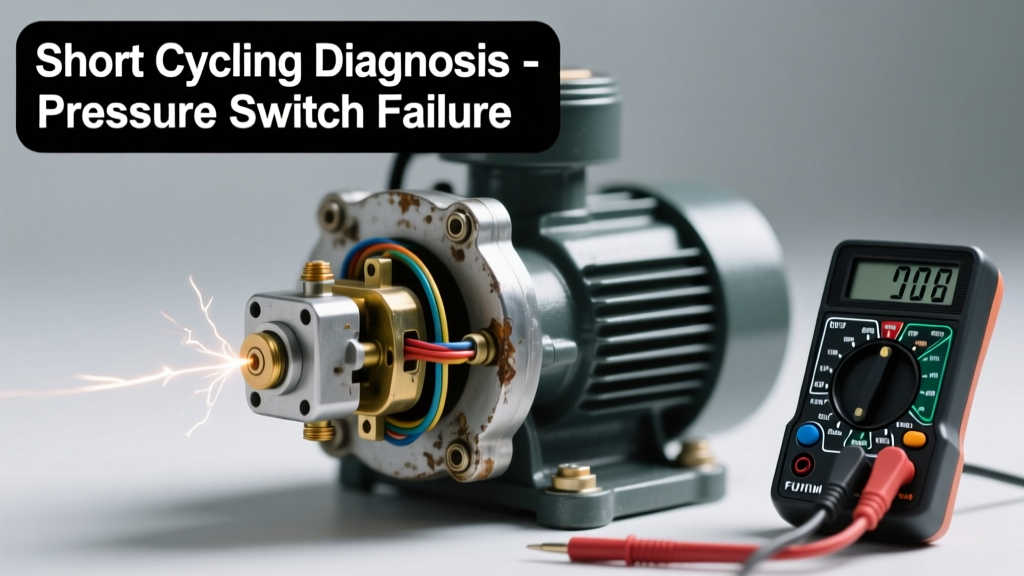
You hear it every few seconds: a sharp click, then a brief hum, then silence—repeating like a nervous heartbeat. Your water pressure drops mid-shower, the pump kicks on and off erratically, and you’re wondering if the whole system’s about to quit. This isn’t normal—and it’s rarely just ‘a fluke.’ The good news? Most causes are diagnosable in under 15 minutes with basic tools and zero disassembly.
Quick Checklist
- Does the clicking happen only when water is running—or also when all faucets are closed?
- Is the pressure gauge needle bouncing rapidly between 40–60 psi (or your system’s set range)?
- Can you feel vibration or hear a rattling sound near the pressure switch or control box?
- Has the pressure tank lost its air charge? (Tap the tank—it should sound hollow at the top, solid at the bottom.)
- Did this start right after a power outage, lightning strike, or recent plumbing work?
- Is the pump running longer than usual before shutting off—or cutting out almost immediately?
Possible Causes
Waterlogged Pressure Tank (Most Common)
When the bladder fails or air charge leaks out, the tank fills with water and can’t absorb pressure surges. The pump cycles every 15–30 seconds trying to maintain pressure. Confirm by tapping the tank: a dull thud across the entire surface means it’s waterlogged. You’ll also see little or no air release when draining the tank via the valve. Severity: DIG-friendly—recharge to 2–4 psi below cut-in pressure. Recharge pressure tank air charge.
Faulty Pressure Switch
A worn or corroded switch contacts chatter instead of holding steady, causing rapid on/off clicks—even without water demand. Test by watching the gauge while gently tapping the switch housing with a screwdriver handle: if the pump starts/stops instantly, contacts are sticking. Severity: DIG-friendly for replacement—but verify wiring first. Replace pressure switch.
Burnt-Out Start Capacitor
The capacitor helps the motor overcome inertia at startup. When it fails, the motor tries—and fails—to spin, drawing high current and tripping the overload relay with an audible click. You may smell ozone or see bulging on the capacitor casing. Severity: Pro-recommended—capacitors store dangerous voltage even when powered off. Capacitor replacement guide.
What to Do First
Turn off power to the pump at the breaker—immediately. Short cycling overheats windings and stresses mechanical parts. Then:
- Check the pressure gauge reading with all water off. It should hold steady for 5+ minutes.
- Inspect the pressure tank for visible rust, dents, or wet spots near the base (signs of bladder failure).
- Locate the pressure switch (usually mounted on the tank tee or control box) and look for scorch marks or loose wires.
- Test voltage at the switch terminals with a multimeter—if it reads 0V when pump should be running, suspect a wiring or control issue.
What NOT to Do
- Don’t repeatedly reset the breaker—this risks thermal damage to the motor windings.
- Don’t ignore a sputtering faucet—air in lines often signals a failing tank or foot valve leak.
- Don’t add air to the tank without first draining it completely—trapped water compresses and gives false readings.
- Don’t bypass the pressure switch—running the pump continuously will overheat it in under 10 minutes.
Why does my well pump click but not build pressure?
If the pump clicks but never hums or spins, the issue is likely electrical—not mechanical. A failed start capacitor, open circuit in the control box, or tripped internal overload relay prevents motor engagement. According to the National Ground Water Association’s 2022 Field Service Survey, 68% of ‘click-no-run’ cases involved capacitor or relay failure—not pump seizure.
Is short cycling dangerous for my well pump?
Yes—repeated thermal stress degrades insulation on motor windings. The U.S. Department of Energy estimates that pumps cycling more than 12 times per hour lose up to 40% of expected service life. That’s why any cycle shorter than 60 seconds warrants investigation.
Can a bad check valve cause clicking and short cycling?
Yes—but indirectly. A leaking check valve lets water drain back into the well after shutdown, dropping system pressure and forcing the pump to restart prematurely. You’ll often hear a ‘glug-glug’ sound from the wellhead after shutdown, followed by a click as the switch re-engages. Confirm by shutting off power, opening a faucet until flow stops, then watching the pressure gauge—if it drops steadily to zero in under 90 seconds, suspect the check valve. How to test and replace a well check valve.
My pressure tank is new—why is it still short cycling?
Even brand-new tanks can ship with incorrect air charges—or get over-pressurized during installation. A tank charged to 50 psi on a 40/60 system won’t accept water until pressure exceeds 50 psi, causing immediate cycling. Always verify air charge with a quality tire gauge before connecting water lines. As plumbing contractor Mark Rinaldi notes in Well Systems Handbook (2023): “I’ve replaced three ‘defective’ new tanks this year—only to find they were shipped at 65 psi.”
“A single short cycle event isn’t catastrophic—but five per minute for 48 hours? That’s motor death waiting to happen.” — Jim Hargrove, Master Well Technician, NGWA Certified, 2023
How do I tell if the problem is the pump or the switch?
Use this diagnostic table:
| Symptom | Likely Cause | Verification Step |
|---|---|---|
| Click + brief hum + immediate cutoff | Bad start capacitor or seized motor | Measure capacitor µF rating; check motor shaft rotation by hand (power OFF) |
| Click + no hum + gauge holds pressure | Faulty pressure switch | Jump terminals with insulated screwdriver—pump should run continuously if motor is healthy |
| Click + slow pressure rise + gauge fluctuates wildly | Waterlogged tank or air leak in suction line | Drain tank fully, recharge to correct PSI, then monitor gauge stability |
Short cycling with clicking isn’t a ‘wait-and-see’ symptom—it’s your system’s distress signal. Most fixes take under an hour and cost less than $50 in parts. Catch it early, and you’ll avoid a $1,200 pump replacement or contaminated well water from a failing foot valve. Start with the checklist, trust your ears, and don’t hesitate to call a licensed well technician if voltage testing feels outside your comfort zone.