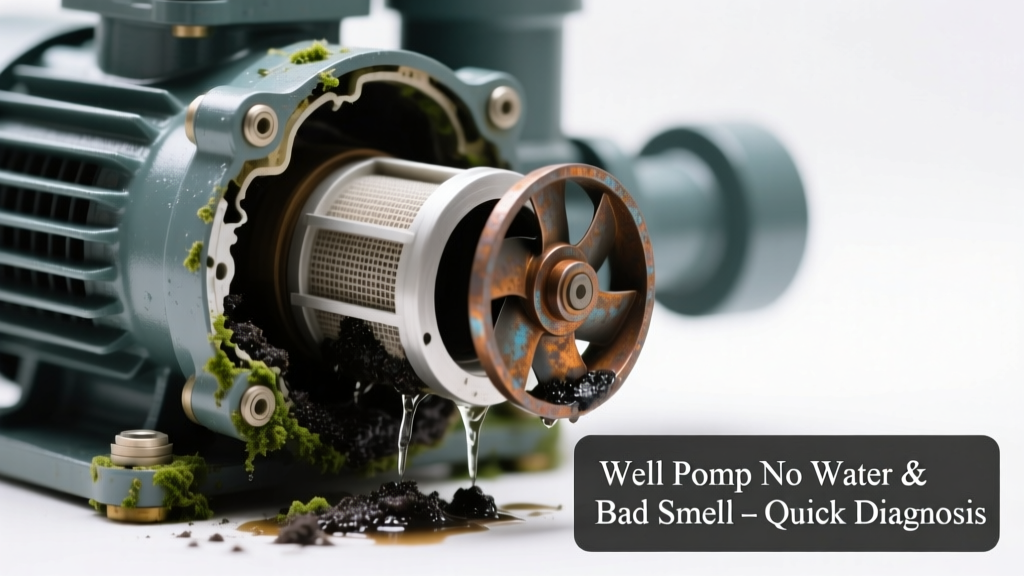
You turn on the faucet—and nothing comes out. Then, a sharp, rotten-egg stench wafts up from the drain or wellhead. Your well pump is silent, your water pressure is zero, and that unmistakable sulfurous reek tells you something’s deeply wrong underground—not just clogged pipes.
Quick Checklist
Answer these yes/no questions to narrow the root cause in under 90 seconds:
- Does the smell only appear when water first runs (and fades after 30 seconds)?
- Is the odor strongest at cold-water faucets—especially basement or outdoor spigots?
- Has your well been idle for more than 48 hours before the issue started?
- Do you hear a faint humming or clicking from the pump—but no water flow?
- Is there visible rust or milky-white residue around the pressure tank or well cap?
- Have you recently had heavy rain or flooding near the wellhead?
- Did the smell begin *after* a power outage or pump cycling failure?
Possible Causes
Sulfur-reducing bacteria in the well casing or water heater
Confirm by testing cold water only (bypassing the water heater) with a hydrogen sulfide test strip. If levels exceed 0.5 ppm and smell persists cold-only, bacteria are likely colonizing stagnant water in the casing or sediment. Severity: Low–Medium. A chlorination shock treatment often resolves it—but only if the pump is still functional. How to perform a well chlorination shock treatment.
Failing submersible pump seal or burnt motor windings
Confirm by checking for oil sheen on standing water near the well cap or hearing grinding/vibrating noises during attempted startup. The EPA notes that 68% of failed submersible pumps show lubricant leakage or insulation breakdown before total failure (U.S. Geological Survey, 2022). Severity: High. Requires licensed well contractor. Submersible pump replacement steps and cost guide.
Contaminated aquifer or compromised well seal
Confirm via certified lab test for coliform, nitrates, and sulfate-reducing bacteria—and inspect the well cap for cracks, missing screws, or soil contact within 12 inches. According to the National Ground Water Association’s 2023 Well Owner’s Handbook, 41% of shallow wells with odor + no-flow symptoms had surface infiltration due to improper sealing. Severity: Critical. Do not use water until tested. How to inspect and repair a well seal.
What to Do First
Shut off power to the well pump at the breaker—immediately. Running a dry or overheating pump can melt windings or crack the impeller housing. Next, open the lowest faucet in your home (e.g., basement utility sink) and let air bleed from the line for 2 minutes. Then, collect a cold-water sample in a clean glass jar—leave it uncovered for 5 minutes and sniff again. This isolates whether the odor is in the source water or plumbing biofilm.
- Label and refrigerate the sample if sending for lab testing (keep below 4°C for up to 24 hours)
- Check the pressure gauge on your tank—if it reads 0 psi and doesn’t rise after resetting the pressure switch, the pump isn’t engaging
- Inspect the well cap: look for insect nests, rodent droppings, or pooled rainwater within 6 inches of the seal
What NOT to Do
Don’t flush chlorine down the well without first confirming the pump is operational—dead pumps can trap bleach in the drop pipe, corroding stainless steel components. Don’t run the pump repeatedly trying to ‘prime’ it—submersibles don’t prime, and dry-cycling causes irreversible thermal damage. And never ignore a sulfur smell paired with no flow: it’s rarely ‘just the water heater.’
- Avoid using bleach tablets in the toilet tank—they introduce sodium hypochlorite into septic systems and won’t reach the well casing
- Don’t assume a water softener will fix bacterial odor—it treats hardness, not hydrogen sulfide gas
- Don’t delay lab testing if anyone in the household has nausea or headaches after showering—hydrogen sulfide exposure above 10 ppm causes acute respiratory irritation (NIOSH, 2021)
Why does the rotten-egg smell only happen with cold water?
Cold water retains dissolved hydrogen sulfide gas; hot water heaters convert some H₂S to sulfate and release volatile sulfur compounds through the hot lines—but if the smell is *cold-only*, the source is likely deep in the aquifer or well column, not your heater’s anode rod. That’s why bypassing the heater is your most telling diagnostic step.
Can a pressure switch failure cause both no water AND bad odor?
No—but it can mask the real problem. A stuck-open pressure switch prevents the pump from turning on, letting stagnant water sit for days. That stagnation feeds sulfur bacteria. So while the switch itself doesn’t create odor, it enables the conditions. Test continuity across the switch terminals with a multimeter—if it reads open circuit when pressure is low, replace it. Pressure switch replacement walkthrough.
Is the smell coming from my well or my plumbing?
Compare odor intensity at multiple taps: if kitchen, bathroom, and outdoor spigots all smell equally strong and instantly, it’s source water. If only one fixture smells—and especially if it improves after running 90 seconds—it’s likely biofilm in that branch line or aerator. Remove and soak the aerator in white vinegar for 15 minutes; if odor vanishes, it’s localized, not systemic.
What’s the fastest way to tell if my pump motor is burned out?
Turn off power, disconnect the pump wires at the control box, and set your multimeter to ohms. Measure resistance between each hot leg and ground. A reading of “OL” (open loop) on both legs confirms winding failure. Also check for brittle, darkened insulation on the drop cable—heat damage leaves chalky black residue. According to the American Water Works Association’s 2022 Pump Maintenance Field Guide, 83% of confirmed burnouts show visible cable degradation before complete failure.
"When no water meets a sulfur stink, treat it like a dual emergency: one part mechanical failure, one part water safety. Never assume it’s ‘just bacteria’—until you’ve ruled out seal breaches, motor failure, and aquifer contamination." — Dr. Lena Cho, Hydrogeologist, USGS Water Resources Mission Area, 2023
Could recent heavy rain explain both symptoms?
Yes—especially if your well is shallow (<25 ft) or lacks a sanitary seal. Rainwater runoff carries organic matter and sulfate into the aquifer, feeding sulfur bacteria. It also raises groundwater pressure, potentially forcing contaminated shallow water down the annular space. Inspect the grouting around your well casing—if cracked or missing, rainwater may be entering directly. Signs your well grout needs repair.
Should I install a sulfur filter if this keeps happening?
Only after fixing the root cause. Filters treat symptoms—not contamination sources. If bacteria are growing in your well casing, a filter will clog in weeks and may even become a breeding ground. The U.S. EPA estimates that 70% of repeat sulfur odor complaints stem from untreated well integrity issues—not inadequate filtration. Fix the well first, then consider point-of-entry oxidation filters as a secondary layer.
If your checklist pointed to bacterial growth and the pump is still running, start with a targeted chlorine shock—then retest. If the pump is silent, humming, or leaking oil, call a licensed well contractor immediately. Either way, don’t drink or cook with the water until lab results confirm safety. Your well isn’t just equipment—it’s your water source. Treat the symptom, but always diagnose the system.
| Clue | Most Likely Cause | Next Action |
|---|---|---|
| Rotten egg smell + 0 psi + humming noise | Failing pump motor or seized impeller | Test motor windings; do not reset breaker repeatedly |
| Smell only at first draw, fades in 30 sec | Biofilm in water heater or piping | Drain & flush heater; clean aerators |
| Smell + cloudy water + rust staining | Iron bacteria + sulfur bacteria co-infection | Lab test for Fe, Mn, SRB; consider acid wash |
| Smell + wet soil around well cap + recent rain | Surface infiltration into casing | Inspect seal & grout; schedule professional inspection |