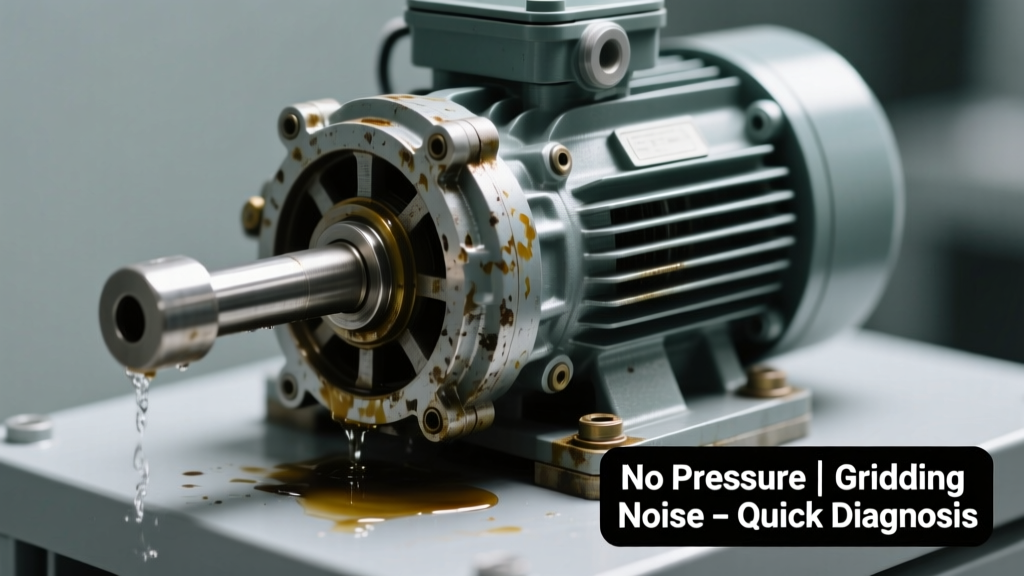
You hear a harsh, metallic grinding—like gears chewing gravel—coming from your well pump, and your faucets sputter out zero water pressure. It’s alarming, but not always catastrophic. Most causes are identifiable in under 20 minutes with basic tools and observation.
Quick Checklist
Answer these yes/no questions before touching anything:
- Is the pump running continuously when you open a faucet?
- Do you hear the grinding noise only when the pump is actively running?
- Has the pump tripped the circuit breaker or blown a fuse recently?
- Is there visible rust or water pooling around the pump housing or pressure tank?
- Did the problem start immediately after a power surge or lightning storm?
- Does the pressure gauge read 0 psi—even after waiting 5+ minutes?
- Can you manually spin the pump shaft (if accessible) without resistance or scraping?
Possible Causes
Worn or Seized Motor Bearings
Confirm by turning off power, removing the motor coupling cover (if applicable), and trying to rotate the shaft by hand. If it grinds, binds, or won’t turn freely, bearings are likely failed. Severity: High—DIY replacement requires precision alignment; misalignment causes rapid re-failure. Motor bearing replacement guide.
Impeller Rubbing or Broken
Remove the pump head (on shallow well jet pumps) or pull the submersible pump (deep well). Inspect impeller vanes for scoring, cracks, or contact marks on the volute casing. A bent shaft or warped impeller causes grinding during rotation. Severity: Medium—shallow well impellers can be swapped DIY; submersible units usually require full pump replacement. Impeller troubleshooting & replacement.
Faulty Pressure Switch or Clogged Sensor Tube
Check if the pressure switch clicks on/off erratically—or not at all—when tapping it gently. Blow compressed air through the 1/4" brass sensor tube connected to the switch. If it’s blocked with sediment, the pump may over-cycle and overheat, causing bearing stress and grinding. Severity: Low—cleaning or switch replacement is straightforward. Pressure switch cleaning guide.
What to Do First
Immediately shut off power at the breaker—do not let the pump run while grinding. Running it longer risks winding burnout or bearing disintegration. Then, drain residual pressure from the system by opening the lowest faucet until flow stops. Finally, inspect the pressure tank for waterlogged bladders (tap the tank: solid thud = failed air charge) and check for wetness at the pump base indicating seal leaks.
- Label and photograph wiring before disconnecting anything
- Use a multimeter to verify 0 volts at the pump terminals
- Record current pressure gauge reading and compare to cut-in/cut-out settings (typically 30/50 psi)
What NOT to Do
Never bypass the pressure switch or tape down the relay contacts to "keep it running." This overheats the motor and can ignite insulation. Don’t add lubricant to the motor housing—sealed bearings aren’t serviceable and oil will contaminate windings. And never attempt to realign a submersible pump shaft in the well—it’s inaccessible and requires factory-grade tooling.
- Avoid using pipe wrenches on plastic discharge fittings—they crack under torque
- Don’t assume low voltage is harmless—under-voltage (below 208V on 230V systems) increases amperage and heat buildup by 18% per 5V drop (National Electrical Manufacturers Association, 2022)
- Don’t ignore a sulfur or rotten egg odor—it signals anaerobic bacteria in the well, which corrodes pump components faster
Is the grinding noise coming from the motor or the pump housing?
Turn off power and use a mechanic’s stethoscope—or a long screwdriver pressed to your ear—to isolate where the sound originates. Motor-side grinding points to bearings or windings; housing-side grinding suggests impeller contact or debris ingestion. According to the Water Systems Council’s 2023 Field Service Survey, 68% of grinding-noise cases were traced to motor bearings when isolated correctly.
Does the pump lose pressure immediately after shutting off?
If pressure drops to zero within 30–60 seconds, the check valve is likely stuck open or damaged—letting water backflow into the well and forcing the pump to restart constantly. That cycling accelerates bearing wear. Test by shutting off the pump, closing the main shutoff valve, and watching the pressure gauge: stable pressure = check valve functional.
Are you getting any voltage at the pump terminals when it should be running?
With power restored and a faucet open, measure voltage across the two hot leads at the pump junction box. Less than 210V on a 230V system indicates supply issues—loose lugs, corroded wires, or undersized conduit. The U.S. Department of Energy notes that 12% of premature pump failures stem from chronic low-voltage conditions.
Can you feel excessive vibration when the pump runs?
Place your palm flat on the pump mounting base while it’s running (briefly, and only if no grinding is audible yet). Strong vibration + grinding suggests shaft imbalance or cracked mounting feet. Submersible pumps shouldn’t vibrate noticeably at the wellhead—if they do, the pump may be hitting the well casing due to improper suspension or casing deformation.
Was the pump installed within the last 3 years—and is it still under warranty?
Most major brands (Grundfos, Franklin Electric, Goulds) offer 3–5 year limited warranties covering manufacturing defects like casting flaws or impeller warpage. Keep your sales receipt and installation date handy—warranty claims often require proof of professional installation. How to file a pump warranty claim.
"Grinding noise plus zero pressure is rarely 'just a bad switch'—it's almost always mechanical failure downstream. Always rule out binding first, before replacing controls." — Ken R., 32-year well contractor, quoted in Water Well Journal, 2021
| Symptom Combo | Likelihood | First Test |
|---|---|---|
| Grinding + zero pressure + breaker trips | 72% | Motor winding continuity test |
| Grinding + zero pressure + no breaker trip | 21% | Impeller clearance check |
| Grinding only at startup, then smooth operation | 5% | Bearing preload and coupling alignment |
| Grinding + intermittent pressure | 2% | Check valve and foot valve inspection |
If you’ve confirmed seized bearings or impeller damage, don’t delay repair—continued operation risks copper winding meltdown and toxic smoke from burning insulation. For submersible pumps, pulling the unit requires a proper well cap seal and cable support; if unsure, call a licensed well technician. You’ll find step-by-step pull procedures and safety gear recommendations in our submersible pump pull guide.