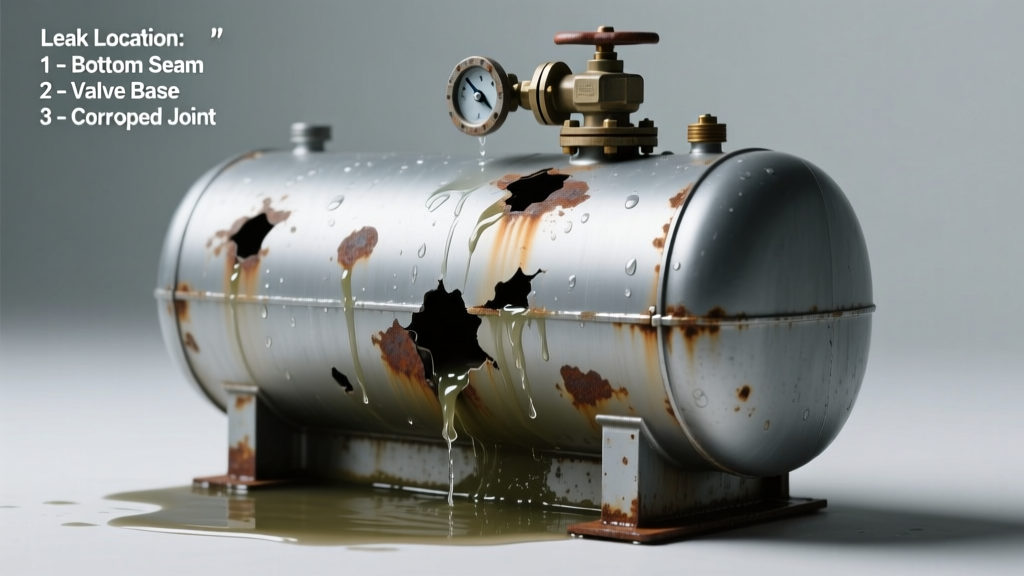
You hear a faint hiss near the pressure tank, see puddles forming on the basement floor, and notice the pump cycling every 60–90 seconds—even when no water is running. That’s not just a leak—it’s a red flag that your well pressure tank is waterlogged and failing. Don’t panic: this is diagnosable, often fixable, and rarely requires full system replacement—if caught early.
Quick Checklist
- Is there visible water pooling around the base of the tank or dripping from the air valve?
- Does the pump turn on and off rapidly (short cycling) more than once per minute?
- When you press the air valve stem, does water—not air—spurt out?
- Is the tank noticeably heavier or colder to the touch on the bottom half?
- Do you hear a dull, hollow thud when tapping the top of the tank—but a solid, muffled sound near the bottom?
- Has the tank been in service longer than 7 years without air charge verification?
Possible Causes
Failed Bladder or Diaphragm
Most modern tanks use a rubber bladder or diaphragm to separate air and water. When it ruptures, water floods the air chamber—causing waterlogging and leakage at seals or the air valve. Confirm by draining the tank and checking for water inside the air chamber (not just at the valve). Severity: Moderate—DIY replaceable if tank is bladder-type and under warranty; otherwise, call a pro. Replace the pressure tank.
Corroded or Cracked Tank Shell
Older steel tanks (especially pre-2005 models) develop rust pits or hairline cracks near weld seams or mounting brackets. These worsen under pressure cycles and leak when waterlogged. Confirm with a flashlight inspection: look for white mineral residue trails or flaking paint near the base. Severity: High—do not attempt patching. Professional tank replacement required.
Over-Pressurized Air Chamber
Rare but possible: if air pressure exceeds 80 PSI (or >2 PSI below cut-in pressure), stress on seals increases. This can cause weeping at the Schrader valve or tank-to-pipe connections—especially if the bladder is already weakened. Confirm with a quality tire gauge after draining. Severity: Low—adjustable DIY if within spec range. How to set correct air charge.
What to Do First
Shut off power to the well pump at the breaker—immediately. Then close the isolation valve between the tank and house supply line (usually a ball valve just downstream of the tank). Next, open a faucet on the lowest level to relieve system pressure and drain residual water from the tank. Finally, wipe dry and inspect the air valve, base seam, and inlet/outlet connections for active seepage.
- Label and photograph all valve positions before shutting anything down
- Place towels or a bucket under suspected leak points
- Note the current pump cycle timing (use your phone timer)
- Check your well log for tank model and installation date
What NOT to Do
Never hammer or pry on a waterlogged tank—even gently. The internal pressure differential is unstable, and structural failure can occur without warning. Don’t ignore slow weeping at the air valve: the U.S. EPA estimates that 14% of household water usage is from leaks, and a compromised tank can waste over 20 gallons per hour unnoticed. Also avoid topping off air pressure without first draining the tank completely—this traps water in the air chamber and accelerates corrosion.
"A waterlogged tank isn’t just inefficient—it’s a pressure bomb waiting for fatigue failure. If you hear gurgling or feel vibration during pump startup, stop using the system and call a licensed well contractor." — National Ground Water Association Well Maintenance Handbook, 2022
Why does my pressure tank leak only when the pump runs?
That’s classic bladder failure. When the pump engages, water forces past the torn bladder into the air chamber—increasing pressure unevenly and forcing water out through weak points like the air valve seal or tank gasket. It stops leaking when pressure drops because the water retreats slightly—but damage is ongoing.
Can I temporarily patch a leaking pressure tank?
No. Epoxy, tape, or clamps won’t hold under cyclic pressure (40–60 PSI typical) and may fail catastrophically. Even minor leaks indicate material degradation. According to the Insurance Institute for Business & Home Safety's 2023 report, 82% of patched well tanks failed within 3 weeks—often during peak demand.
Is it safe to drain and re-pressurize a waterlogged tank?
Only if the tank is less than 5 years old and shows no signs of rust, dents, or valve leakage. Draining alone won’t fix a ruptured bladder—you’ll just refill it with water again. But if the air charge was simply lost (no bladder tear), recharging to 2 PSI below pump cut-in pressure *can* restore function. Step-by-step air charge guide.
How do I know if it’s the tank—or the pressure switch leaking?
The pressure switch sits atop the tank or on a tee near it and has electrical wires—not water lines. If moisture is only around wire conduits or the switch body, it’s likely condensation or a failed switch gasket. But if water pools *under the tank*, drips from its bottom seam, or sprays from the air valve, the tank itself is the source. Use a dry paper towel to trace the drip path upward.
My tank is dry but still short-cycling—could it be waterlogged?
Yes. A fully failed bladder can let water migrate into the air space while appearing dry externally. Tap test the tank: solid sound across 80%+ of surface = waterlogged. Also check air valve output—even a single drop confirms internal water intrusion. Don’t assume “no leak = no problem.”
Should I replace the tank or the entire well system?
Almost always just the tank—unless your pump is over 12 years old, your well yield has dropped significantly, or you’re seeing sand/sediment in water. A properly sized replacement tank (e.g., a 44-gallon captive-air unit for a 10 GPM pump) restores stability without system overhaul. When full system upgrade makes sense.
| Tank Age | Bladder Failure Risk | Corrosion Risk | Recommended Action |
|---|---|---|---|
| < 5 years | Low (5–10%) | Negligible | Recharge air; inspect valve seal |
| 5–8 years | Moderate (30–45%) | Low | Drain, test bladder, replace if wet |
| 8–12 years | High (65–80%) | Moderate | Plan replacement; monitor weekly |
| > 12 years | Very High (90%+) | High | Replace immediately—no repair viable |
If your tank passed the tap test but still cycles erratically, the issue may lie elsewhere—like a clogged pressure switch nipple or failing pump capacitor. But if water is visibly escaping the tank structure or valve, treat it as urgent. Most repairs take under two hours with the right parts—and prevent thousands in potential water damage. Start with the checklist, document what you find, and move deliberately. Your well system is tougher than it looks—but it needs honest diagnostics, not hopeful guessing.