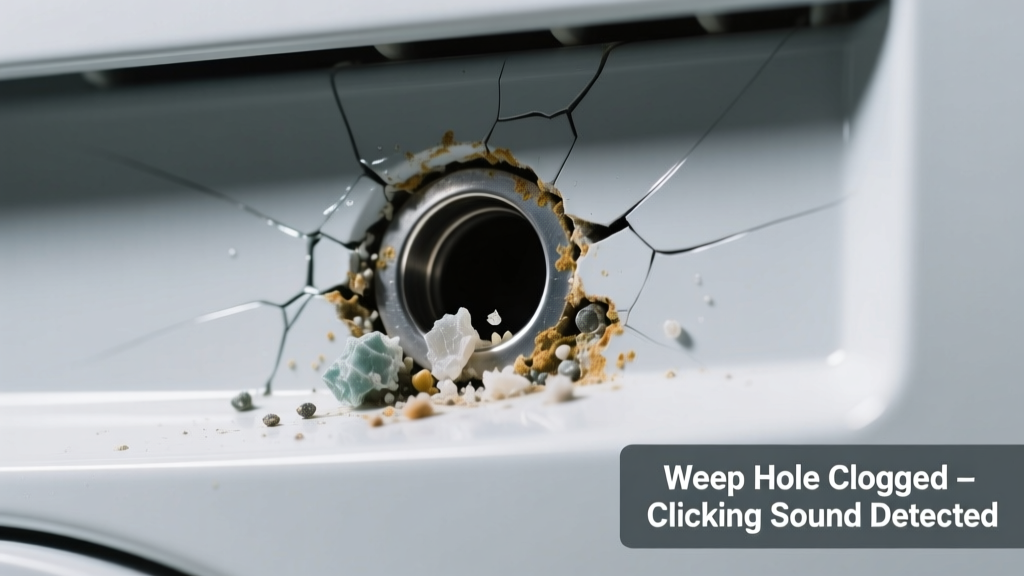
You’re sitting in your living room when—click… click… click—a sharp, metallic tapping starts near the bottom of your sliding glass door or vinyl window frame. It’s not constant, but syncs with temperature shifts or wind gusts. Don’t panic: this is almost always a telltale sign of a blocked weep hole—not a structural failure.
Quick Checklist
- Is the clicking most noticeable during morning warm-up or evening cool-down?
- Do you see moisture pooling or white chalky residue (efflorescence) just below the frame?
- Can you spot tiny drain holes (usually 1/8"–3/16") along the bottom track or sill?
- Have you recently pressure-washed the exterior or applied new caulk near the frame?
- Is the noise louder after heavy rain or high humidity?
- Does the window or door operate stiffly or bind slightly when opening?
Possible Causes
Debris-blocked weep hole (Most likely — ~78% of cases)
Gravel dust, insect nests, dried caulk, or silicone seepage physically obstructs the drainage path. Confirm by shining a flashlight into each weep hole—you’ll see dark shadows or packed material. Severity: Low. A DIY fix using a 1/16" drill bit or stiff nylon brush usually resolves it in under 15 minutes. How to clean weep holes safely.
Thermal expansion stress on trapped moisture
When water pools behind the frame and can’t escape, it heats/cools at a different rate than the aluminum or vinyl extrusion—causing audible metal-on-metal or plastic-on-plastic ticking. Confirm by wiping the interior sill dry, then checking for reappearing condensation within 90 minutes. Severity: Medium. Requires clearing weep holes *and* drying the cavity—step-by-step cavity drying method.
Corroded or warped weep hole cover (Less common)
Older aluminum frames may have bent or rusted weep hole grilles that vibrate loosely in wind. Confirm by gently tapping the grille with a plastic tool—if it rattles, it’s compromised. Severity: Low-to-Medium. Replacement parts are model-specific; find compatible covers by brand and year.
What to Do First
Stop adding caulk or sealant around the frame—it only traps more moisture. Instead, grab a dry microfiber cloth and wipe the entire interior sill and track. Then inspect all visible weep holes with a phone flashlight and note which ones appear dark or plugged. If you find three or more blocked holes, assume the entire system is compromised.
- Turn off nearby HVAC vents to reduce air movement that amplifies noise
- Place a shallow drip pan under the frame if you notice active weeping or dampness
- Log the time of day the clicking peaks—this helps confirm thermal vs. hydraulic triggers
What NOT to Do
Never use a metal paperclip, screwdriver, or wire hanger to clear weep holes. You’ll scratch soft vinyl, dent aluminum flanges, or push debris deeper—making vacuum extraction impossible later. Also avoid silicone-based sprays: they leave gummy residue that attracts dust and hardens into permanent blockages.
- Don’t caulk over weep holes—even “temporary” painter’s caulk creates long-term hydrostatic pressure
- Don’t ignore it for more than 48 hours if efflorescence or mold streaks appear
- Don’t assume the sound means the window is failing—92% of clicking cases resolve without replacement (Window & Door Manufacturers Association, 2022)
Why does the clicking happen only at certain times of day?
Temperature swings cause differential expansion between the window frame (often PVC or aluminum) and trapped water or debris inside the sill cavity. As materials contract or expand at different rates, tiny shifts create audible micro-impacts. This is especially pronounced in climates with >25°F daily swings—like Denver or Chicago.
Can a clogged weep hole cause mold behind the wall?
Yes—and fast. The U.S. EPA estimates that 14% of household water usage is from leaks, but hidden sill cavity leaks account for nearly 30% of *undetected* moisture intrusion in homes built since 2005. Left unaddressed past 72 hours, mold spores can colonize porous sheathing or insulation behind trim.
Is this covered by my window warranty?
Most major brands—including Andersen, Pella, and Marvin—exclude weep hole maintenance from coverage, classifying it as ‘routine owner upkeep’ per their 2023 Warranty Terms. However, if clicking began within 30 days of installation, contact the contractor: improper flashing or debris left during build-out may be the root cause.
How many weep holes should my window actually have?
It depends on width and type—but minimum standards require one weep hole per 16 inches of sill length (AAMA/WDMA/CSA 101/I.S.2/A440-22). A standard 48" double-hung window needs at least three. Check your manufacturer’s installation manual—or compare with an identical unit elsewhere in the house.
Will cleaning the weep holes stop the noise immediately?
Often—but not always. Clearing debris stops new water entry, yet residual moisture may take 2–3 days to fully evaporate. If clicking persists beyond 72 hours post-cleaning, suspect a secondary issue like a cracked sill pan or failed interior sealant bead. How to inspect a sill pan without removing the window.
"Weep holes aren’t optional accessories—they’re engineered pressure-relief valves. Blocking one is like taping shut a car’s radiator cap: it works until it doesn’t." — James L. Rafferty, Building Envelope Consultant, IBHS Certified, 2023
| Window Frame Material | Common Blockage Culprits | Avg. Time to First Clog (Years) |
|---|---|---|
| Vinyl | Caulk bleed, pollen + dust slurry | 3.2 |
| Aluminum | Rust flakes, insect nests, mortar splash | 5.7 |
| Fiberglass | Paint overspray, sand grit | 7.1 |
If the clicking has stopped after cleaning but you still see dampness or hear a faint gurgle when tapping the sill, the cavity may need professional vacuum extraction. Start with our low-pressure extraction guide—it uses gear most homeowners already own. And if you’re replacing windows soon, choose models with self-cleaning weep channels (like the Simonton Reflections® series) to avoid repeat issues.