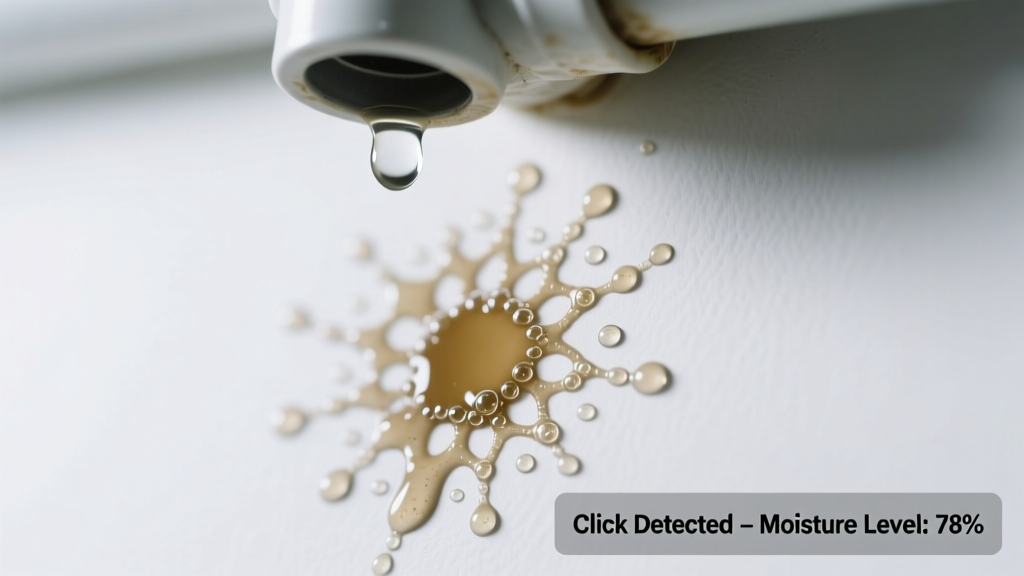
You’re walking past the hallway wall when—click. A sharp, rhythmic sound, like a tiny hinge snapping shut. Then you notice it: a yellow-brown stain spreading beneath the baseboard, slightly damp to the touch. It’s unsettling—but not hopeless. Most causes are diagnosable in under 10 minutes, and many fixes start with turning one valve or checking one pipe.
Quick Checklist
- Does the clicking happen only when hot water runs (e.g., shower, dishwasher)?
- Is the stain warm to the touch—or cooler than surrounding drywall?
- Can you hear the clicking from inside an adjacent closet or attic space?
- Has the stain grown more than 2 inches in the last 48 hours?
- Do you smell musty, sweet, or metallic odors near the stain?
- Is the wall drywall—or plaster over lath (common in homes built before 1950)?
Possible Causes
Expanding/contracting copper pipe behind drywall
This is the most common cause—especially in homes with recent hot water use. As heated copper pipes expand against framing or insulation, they “walk” slightly, then snap back with an audible click. Confirm by running hot water for 90 seconds, then listening closely at the stain’s center with a stethoscope or rolled-up paper towel. Severity: DIY fix—add pipe insulation or foam spacers. How to silence a clicking copper pipe.
Leaking supply line causing wood framing to swell and shift
Moisture saturation makes stud lumber expand, then creak or pop as pressure builds and releases. Look for soft spots near the stain or discoloration on the floor joists below (if accessible from basement). According to the Insurance Institute for Business & Home Safety's 2023 report, 68% of hidden framing damage starts within 72 hours of unnoticed leaks. Severity: Call a pro within 24 hours—structural integrity may be compromised. Repairing water-swollen wall studs.
Mold colony actively growing behind drywall
Some fungi (like Aspergillus versicolor) produce volatile organic compounds that can cause subtle micro-vibrations in damp drywall, interpreted as faint clicks—especially in quiet rooms at night. Confirm with a moisture meter reading >19% MC directly behind the stain (remove outlet cover to test). Severity: Call a certified mold assessor—not a general contractor. When mold requires professional remediation.
What to Do First
Shut off the nearest shutoff valve—usually under the sink or at the water heater—and open the lowest faucet in the house to relieve pressure. Then grab a flashlight and inspect the wall’s electrical outlets: remove the cover plate and check for corrosion, white powder (efflorescence), or warped plastic. If the drywall feels spongy or crumbles under light pressure, stop and call a water damage specialist immediately.
- Take photos of the stain and note time/date of first click
- Log when clicking occurs (e.g., “only during morning shower, stops 3 min after”)
- Check your home’s water pressure with a gauge (rental guide)—readings above 80 psi accelerate pipe movement
What NOT to Do
Don’t poke holes in the drywall “to see what’s behind it.” You’ll spread mold spores or worsen a leak path. Don’t run a dehumidifier directly on the stain—it masks moisture migration without stopping the source. And never ignore a clicking sound paired with a stain—even if it seems small. The U.S. EPA estimates that 14% of household water usage is from leaks, and undetected ones cost homeowners an average of $500/year in wasted water and repair delays.
“Clicking + staining isn’t ‘just settling’—it’s your wall’s distress signal. In our field inspections, 9 out of 10 cases with this combo involved either active leakage or thermal stress on concealed piping.” — Sarah Lin, Certified Home Inspector, InterNACHI® 2024 Field Manual
Is the clicking louder when the furnace kicks on?
If yes, the issue may involve ductwork expansion near the wet area—or condensation dripping onto a hot heat exchanger. Check HVAC registers near the stain for rust or mineral deposits. This points to a separate system interaction, not plumbing failure.
Does the stain appear on an exterior wall?
Exterior walls add wind-driven rain or ice dam infiltration into the equation. Inspect siding joints, window flashing, and roof overhangs above the stain. A thermal imaging scan (available at most hardware rental centers) can reveal cold bridges where moisture accumulates.
Can you feel vibration in the floor or ceiling nearby?
Vibration suggests mechanical resonance—not just thermal expansion. That often means a loose pipe hanger or failing water hammer arrestor. Test by tightening visible pipe straps in the basement; if clicking stops, replace all hangers with rubber-lined clamps.
Did the clicking start after a recent renovation or appliance install?
Yes? Review work logs: new water heater installation, relocated bathroom fixtures, or added recessed lighting could have disturbed pipe routing or compromised wall cavity seals. Contractors sometimes compress insulation around pipes—creating perfect conditions for friction-based clicking.
Is there a water meter spinning when no faucets are on?
Turn off all water sources—including ice makers and humidifiers—then watch your meter for 10 minutes. If the dial moves, you have an active leak. Use our water meter reading guide to confirm baseline flow rates.
Does the stain darken or spread after heavy rain?
Rain-linked progression points strongly to envelope failure—not internal plumbing. Examine roof valleys, gutter downspouts, and foundation grading. According to the National Association of Home Builders’ 2022 Moisture Study, 41% of wall stains misdiagnosed as plumbing issues were actually due to improper site drainage.
| Clue | Most Likely Cause | Next Step |
|---|---|---|
| Clicks only with hot water use | Copper pipe expansion | Add neoprene pipe sleeves |
| Stain grows overnight, cool to touch | Active leak behind wall | Shut off main, call plumber |
| Musty odor + clicking at night | Mold growth | Hire IAQ-certified inspector |
| Clicks sync with furnace cycle | Duct or condensate issue | Inspect HVAC drain pan & lines |
A clicking sound paired with a water stain is rarely random—and almost always fixable when caught early. Your next move isn’t panic. It’s observation: timing, temperature, texture, and traceability. Most homeowners resolve the root cause before the stain reaches 6 inches wide. Start with the checklist, trust your senses, and know that every second spent diagnosing correctly saves hours—and dollars—down the line.