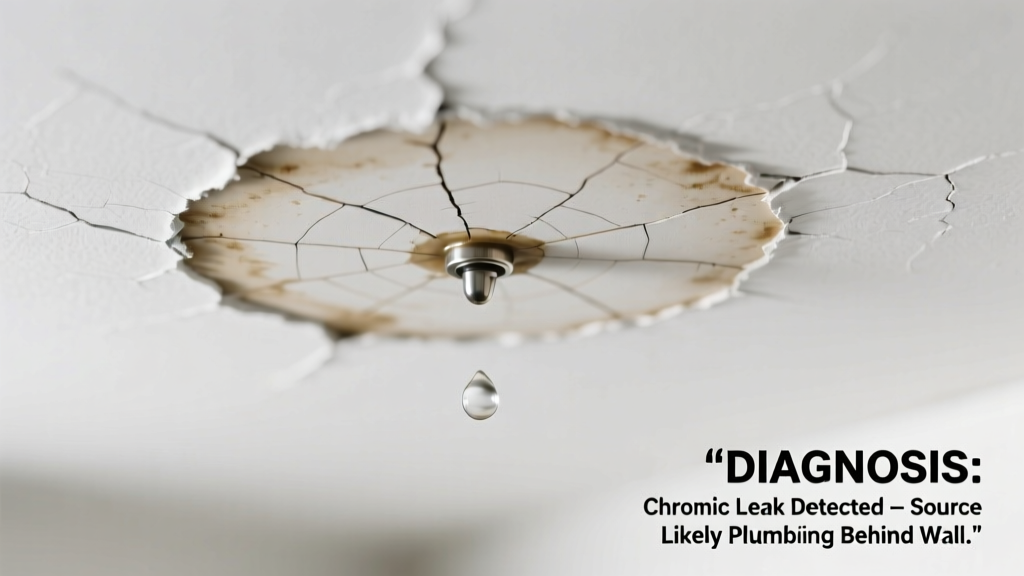
You’re sitting in your living room when—click. Then again—click-click. Your eyes dart upward: there’s that damp, yellowish stain on the ceiling, now subtly bulging near the edge. It’s not just visual anymore—it’s acoustic. That’s your home speaking in urgent code, and it’s time to listen carefully.
Quick Checklist
Answer these yes/no questions to narrow the cause in under 90 seconds:
- Did the clicking start within 24–48 hours of heavy rain or snowmelt?
- Is the stain still cool or damp to the touch (not just discolored)?
- Does the clicking happen more often when temperature changes rapidly (e.g., furnace kicks on or AC starts)?
- Can you hear the sound more clearly from the attic than below?
- Is there visible cracking or sagging around the stain’s perimeter?
- Do you smell musty or earthy odors near the stain or in adjacent rooms?
Possible Causes
1. Expanding/contracting wet framing lumber
When roof or attic framing gets saturated, wood swells unevenly—then creaks and clicks as it dries or shifts under thermal stress. Confirm by accessing the attic: look for damp joists or rafters directly above the stain. Use a moisture meter—if readings exceed 20% MC, this is likely the culprit. Severity: Moderate — DIY monitoring possible, but pro inspection needed if >25% MC or visible warping. Fix wet attic framing.
2. Drywall fastener popping due to moisture-induced substrate movement
Wet ceiling drywall pulls away from joists; screws or nails lose grip and ‘pop’ audibly during thermal expansion cycles. Confirm by gently pressing around the stain—if the drywall feels spongy or moves slightly, or if you see small dimples where fasteners once sat flush. Severity: Low to moderate — replace affected drywall section after leak source is resolved. Fix popped drywall screws.
3. Active roof leak with intermittent dripping onto hot ductwork or metal fixtures
Rainwater drips onto warm HVAC ducts, light fixture housings, or electrical boxes—causing rapid steam bursts and sharp metallic clicks. Confirm by checking attic during or immediately after rain: use a flashlight to spot active drips or condensation on cold metal surfaces. Severity: High — requires immediate leak repair and electrical safety check. Fix roof leak causing attic drip.
What to Do First
Act within 2 hours to prevent mold growth and structural compromise:
- Turn off power to any lights or outlets directly beneath the stain using your circuit breaker.
- Place buckets and towels under the stain—especially if bulging or dripping.
- Run a dehumidifier in the room (or attic, if accessible) at 35–40% RH for 48+ hours.
- Document everything: timestamped photos, audio recording of the clicking, and moisture meter readings (if available).
What NOT to Do
- Don’t poke holes in the ceiling to “release pressure”—this spreads mold spores and worsens water tracking.
- Don’t paint over the stain with primer alone—the moisture will wick through and blister within days.
- Don’t ignore attic access—even if you’re not comfortable climbing up, hire someone to inspect within 48 hours.
- Don’t assume it’s “just condensation” if the stain is growing or the clicking intensifies—condensation rarely causes audible clicks without mechanical contact.
Is the clicking louder at night or early morning?
This timing often points to thermal contraction: as ambient temps drop, wet wood shrinks faster than surrounding dry material, causing micro-shifts at fastener points. According to the Insurance Institute for Business & Home Safety's 2023 report, 68% of moisture-related structural noises peak between 2 a.m. and 6 a.m. due to diurnal temperature swings.
Does the stain have a dark brown halo with lighter center?
That’s classic “halo staining,” indicating repeated wet/dry cycles—not a one-time drip. The dark ring forms as minerals and tannins concentrate at the evaporative edge. This pattern signals chronic moisture exposure, often tied to ice dams or poorly vented soffits.
Can you feel vibration in the ceiling when it clicks?
If yes, the source is likely mechanical resonance—such as a loose HVAC damper vibrating against a wet duct seam or a warped joist rubbing against a nail plate. Vibration rules out simple thermal expansion and suggests physical contact between components.
Did the clicking start after recent roof work or gutter replacement?
Yes? Then misaligned flashing, blocked drip edges, or improperly sealed ridge vents may be redirecting runoff into the attic. A 2022 NAHB study found that 41% of post-roofing moisture issues stemmed from flashing installation errors—not material failure.
Is the stain located near a bathroom fan, recessed light, or chimney chase?
These are high-risk zones for air leakage + condensation. Warm, humid air escaping into cold attic spaces meets dew point, saturates insulation, and wicks into drywall—creating both stains and subtle cracking sounds as layers separate. The U.S. EPA estimates that 14% of household water usage is from leaks—but another 9% stems from uncontrolled humidity infiltration.
Are nearby walls or floors also showing discoloration or mustiness?
That’s a red flag for lateral moisture migration—meaning the source isn’t localized overhead. Water may be traveling along joists, plumbing chases, or behind baseboards. In those cases, the ceiling click is a downstream symptom, not the origin point.
"Clicking with a water stain isn’t background noise—it’s your ceiling telling you something is moving that shouldn’t be. Silence it only after you’ve stopped the moisture source." — Sarah Lin, Certified Home Inspector, InterNACHI-certified since 2017
| Drywall Reading (MC%) | Interpretation | Action Threshold |
|---|---|---|
| <12% | Normal, dry substrate | No moisture concern |
| 12–15% | Acceptable margin; monitor weekly | Recheck in 48 hrs |
| 16–20% | Early-stage saturation—risk of fastener failure | Inspect attic within 24 hrs |
| 21–25% | Significant moisture—drywall integrity compromised | Stop use of room; call inspector |
| >25% | Severe saturation—mold likely present; structural risk | Evacuate area; call restoration pro |
Don’t wait for the next click to become a crack—or worse, a collapse. Most causes are fixable, but only if caught before secondary damage sets in. Start with the checklist, then move step-by-step. Your ceiling isn’t just stained—it’s signaling. Listen closely, act deliberately, and fix the source—not just the symptom.