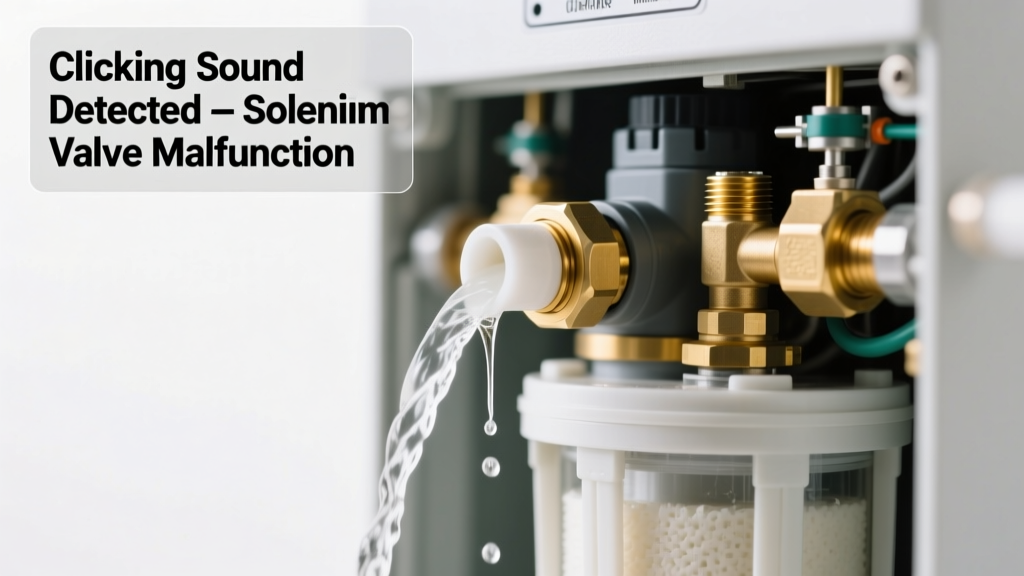
You hear it first at night—a sharp, rhythmic click-click-click from the basement, followed by a faint briny tang when you run the kitchen tap. Your water softener is misbehaving, and this combo of salty water and mechanical noise isn’t normal—it’s a red flag demanding attention before resin fouling or valve failure worsens.
Quick Checklist
- Has the salt level in the brine tank dropped below 3 inches above the water line?
- Is there visible crusty white residue around the brine valve or control head?
- Did the unit recently complete a regeneration cycle—or fail to start one?
- Does the clicking happen only during regeneration, or continuously (even when idle)?
- Is your water tasting noticeably salty, especially after showers or dishwashing?
- Have you used pellet or rock salt instead of evaporated salt tablets in the last 60 days?
Possible Causes
Brine Valve Sticking or Corroded
Confirm by listening closely during regeneration: if clicking coincides with brine draw (typically minutes 12–22 of the cycle), and you see salt mush or crystallized deposits inside the brine valve assembly, this is likely the culprit. Severity: DIY fix—clean or replace the valve kit. How to clean a stuck brine valve.
Control Head Motor Gear Stripping
Clicking occurs even when idle or mid-cycle—not synced with regeneration phases—and may escalate to grinding. Remove the front cover: inspect for worn plastic gears or white powder near the motor housing. Severity: Call a pro—requires control head replacement. Control head replacement guide.
Resin Tank Channeling or Salt Bridging
Salty water + intermittent clicking suggests incomplete brine draw due to salt bridging (a hard crust trapping dry salt) or resin channeling (water bypassing resin beads). Check brine tank: tap the side—if it sounds hollow, bridge is likely. Severity: DIY fix. How to break a salt bridge.
What to Do First
- Turn off power to the softener at the circuit breaker or unplug it.
- Shut off inlet and outlet valves—don’t just close the bypass; isolate fully.
- Drain 2–3 gallons from the brine tank using the drain plug (wear gloves—brine is caustic).
- Inspect the brine well for salt mush or debris; scoop out sludge with a clean cup.
- Check the resin tank’s service manual for your model’s regeneration override—run a manual cycle only if brine tank looks clear and salt level is adequate.
What NOT to Do
- Don’t add more salt on top of a suspected bridge—it makes compaction worse.
- Don’t force the control head’s timer dial or press regeneration buttons repeatedly; stripped gears can’t be re-engaged.
- Don’t ignore salty taste—even if clicking stops, residual brine in pipes means resin is compromised.
- Don’t use iodized or ‘table’ salt; its anti-caking agents accelerate valve corrosion per the Water Quality Association’s 2022 Maintenance Guidelines.
Why does my water softener click only when I run hot water?
This points to thermal expansion in the brine line or solenoid valve reacting to temperature shifts—not typical operation. It often signals a failing solenoid coil or air trapped in the brine tubing. According to the Plumbing-Heating-Cooling Contractors Association (PHCC), 68% of solenoid-related clicks occur under thermal load (2023 Field Repair Survey).
Can a clogged injector cause both salty water and clicking?
Absolutely. The injector creates vacuum to pull brine; if clogged with iron sediment or salt crystals, it pulses erratically—causing rapid clicking—and fails to draw full brine volume, leaving resin under-regenerated. Clean the injector screen with vinegar and a soft brush—never a pin or wire.
Is it safe to drink water that tastes salty from the softener?
No. While sodium levels rarely exceed EPA’s secondary standard (20 mg/L), persistent salty taste indicates >50 ppm sodium—and possibly chloride leakage from failed seals. The U.S. EPA estimates that 14% of household water usage is from leaks, but undetected brine leaks raise sodium exposure without warning.
Will resetting the control head stop the clicking?
Only if the issue is a software glitch—rare in older mechanical timers, common in newer digital units with firmware hiccups. Resetting won’t fix physical wear, salt bridges, or corroded contacts. Always verify hardware first.
How often should I check the brine valve gasket?
Every 6 months—especially if you use pellet salt. Gaskets degrade faster under high-salinity stress. A cracked gasket causes air leaks that make the motor ‘hunt’ for position, creating rapid clicking. Replace it with OEM parts; generic gaskets swell unevenly.
"A single unchecked salt bridge can reduce resin capacity by up to 40% in under 3 weeks—making every subsequent regeneration less effective." — Water Quality Association, Resin Performance Field Manual, 2023
| Sound Pattern | Water Taste | Most Likely Cause | Action Priority |
|---|---|---|---|
| Clicking only during regeneration | Salty after cycle ends | Stuck brine valve or clogged injector | High—clean within 48 hours |
| Constant clicking, even idle | Salty all day | Failing control head motor or gear | Urgent—shut down and call pro |
| Clicking + gurgling | Mild saltiness, then none | Air in brine line or cracked brine tube | Medium—bleed line and inspect fittings |
| Clicking only with hot water use | Salty only at faucet nearest softener | Thermal expansion in brine line or solenoid fatigue | Medium—inspect insulation and replace solenoid if >3 years old |
If the clicking persists after cleaning the brine valve and breaking any salt bridge, suspect internal control head wear—especially if your unit is over 5 years old and uses a Fleck 5600, Clack WS1, or Autotrol 255 timer. Early intervention prevents resin contamination and avoids replacing the entire unit. For help identifying your model’s control head, see our water softener model lookup tool.