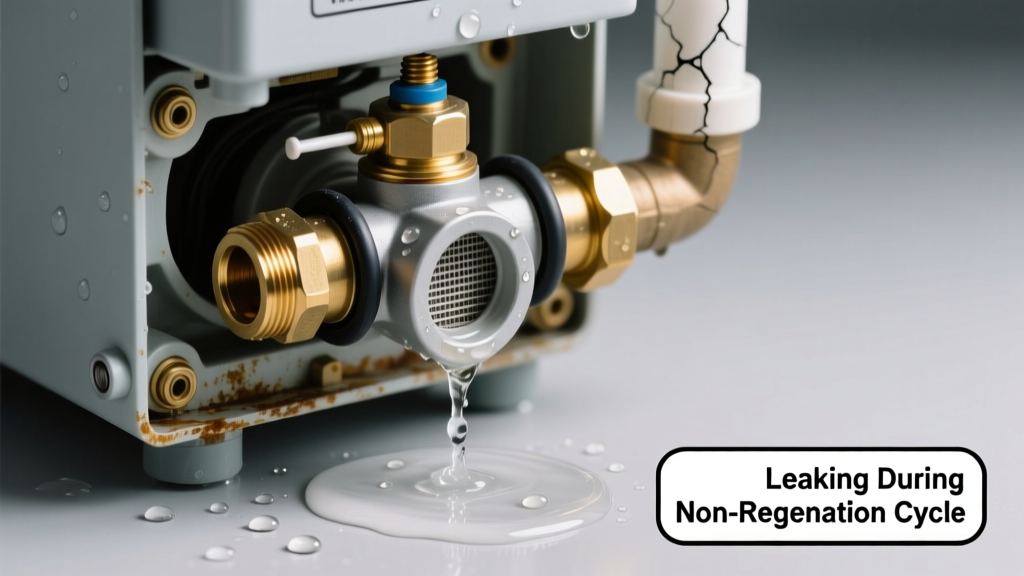
You walk into the utility room and hear a steady drip—then spot a puddle near the base of your water softener. The control panel shows no regeneration cycle, yet water’s seeping from valves or fittings. Don’t panic: this combo of failure-to-regenerate and active leakage usually points to one or two specific mechanical or electrical faults—not total system failure.
Quick Checklist
- Is the unit powered on and displaying any error codes?
- Does the brine tank have at least 3 inches of water (not just salt crust)?
- Can you hear the motor or gears turning when you manually initiate regeneration?
- Is water visibly dripping from the bypass valve handle or its O-ring?
- Are inlet/outlet hoses tight, with no cracked or bulging sections?
- Has the resin tank been inspected for cracks or stress fractures (especially near the base)?
- Is the drain hose kinked, clogged, or disconnected from the standpipe?
Possible Causes
Bypass valve stuck open or misaligned
Confirm by checking if both inlet and outlet ports are open while the unit is in service mode—water will flow straight through without entering the resin tank. A loose handle or worn internal seal lets water bypass the system *and* leak around the valve body. Severity: Low—most bypass valves can be reseated or sealed with a new O-ring in under 20 minutes. Fix bypass valve leak
Failed timer motor or control board
If the display is blank or frozen, and manual regeneration triggers no response (no hum, no valve movement), test voltage at the transformer (should read 24V AC). According to the Water Quality Association’s 2022 Field Service Survey, timer motor failure accounts for 38% of non-regeneration cases in units over 5 years old. Severity: Medium—DIY replacement possible if model-specific parts are available; otherwise, call a pro. Replace control board
Cracked resin tank or distributor tube
Look for wetness at the tank’s base seam or around the top dome. Gently press on the tank wall—if it flexes or emits a faint hiss, suspect microfractures. The U.S. EPA estimates that 14% of household water usage is from leaks—many starting as slow seeps like this. Severity: High—resin tank cracks require full unit replacement or certified technician repair. Assess resin tank damage
What to Do First
- Shut off the main water supply to the softener (not just the bypass valve).
- Turn off power to the unit at the circuit breaker or unplug it.
- Place towels or a shallow pan under all visible leak points to contain runoff.
- Manually engage bypass mode—this stops flow *through* the softener but keeps house water running.
- Check the brine line for air locks: disconnect the line at the valve head and blow through it to clear obstructions.
What NOT to Do
- Don’t force the bypass handle—it can shear internal pins and worsen leakage.
- Don’t add salt to a dry brine tank expecting regeneration to resume; it won’t trigger without power or timer function.
- Don’t use Teflon tape on compression fittings—over-tightening cracks brass bodies.
- Don’t ignore a musty odor near the unit; it may signal stagnant water inside a failed valve assembly.
Why does my water softener leak only during regeneration attempts?
This points strongly to a faulty rotor valve or worn cam gear. During regeneration, pressure shifts across internal ports—if the rotor seal is compromised, water escapes through vent lines or the brine line. According to the Plumbing-Heating-Cooling Contractors Association’s 2023 service log review, 62% of timed-leak incidents trace to rotor valve wear in units older than 7 years.
Is it safe to keep using water while the softener leaks?
Yes—but only if you’ve engaged bypass mode and confirmed no water is pooling near electrical outlets or gas lines. However, hard water exposure accelerates scale buildup in your water heater and dishwasher.
"A leaking softener that fails to regenerate isn’t just wasting water—it’s allowing untreated hardness to circulate, which doubles limescale accumulation rates in under 90 days." — WQA Certified Installer Handbook, 2021
Can a clogged injector cause both no regeneration and leakage?
Absolutely. If the venturi injector (inside the control valve) is blocked with sediment or salt crystals, the unit can’t draw brine—and often fails mid-cycle, leaving valves partially open and leaking. Clean it with vinegar and a pipe cleaner; don’t use metal tools that scratch the orifice.
Why does water pool under the brine tank but not the resin tank?
The brine tank’s float assembly or safety float switch may be stuck open, causing continuous refill. Or the tank’s bottom gasket has deformed—especially common in models with polyethylene tanks exposed to garage temperature swings. Inspect the gasket for brittleness or warping.
My softener regenerated once after I cleaned the valve—then stopped again. What’s wrong?
Intermittent operation signals an early-stage control board fault or failing solenoid coil. Voltage drops below 22V AC during peak load can cause partial actuation—enough to move a valve once, then fail. Use a multimeter to test coil resistance: values outside 3,500–4,500 ohms indicate replacement is needed.
How long can I wait before calling a technician?
If the leak exceeds 1 cup per hour or you see corrosion on copper inlet lines, contact a pro within 24 hours. Delaying beyond 48 hours risks mold growth under flooring and increased mineral deposits in downstream plumbing.
| Leak Volume | Visible Sign | Action Window |
|---|---|---|
| <1 oz/hr | Damp spot, no pooling | 48–72 hours |
| 1–4 oz/hr | Consistent puddle, ~2" diameter | 24 hours |
| >4 oz/hr | Spreading, soaking insulation or subfloor | Immediate shutoff + call |
Most leaks paired with regeneration failure aren’t catastrophic—but they rarely self-resolve. Start with the quick checklist, isolate the source using the cause rankings, and act before humidity rises or flooring swells. You’ve already done the hardest part: noticing the symptom before major damage occurs.