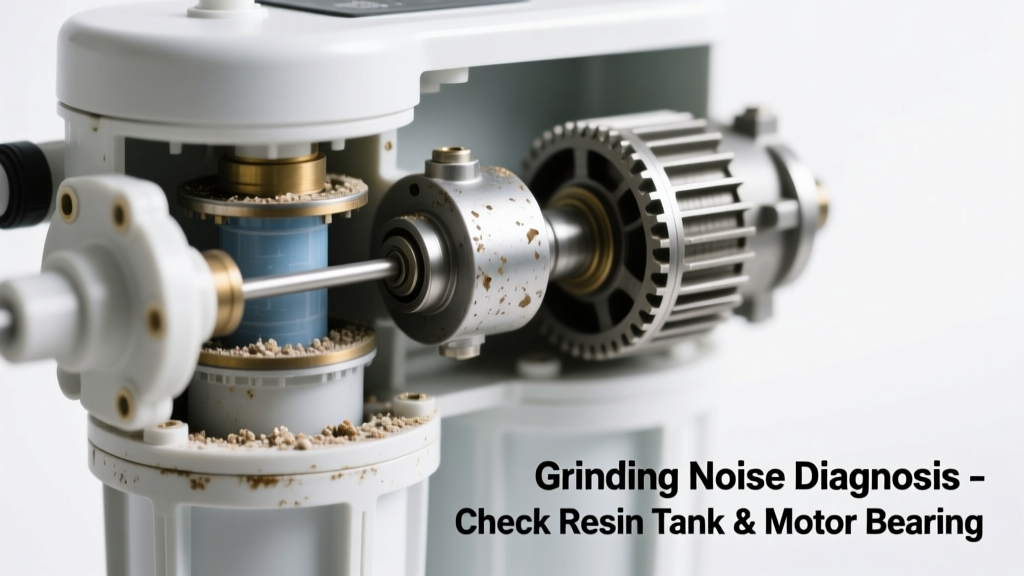
You hear a low, gritty grinding noise coming from your water softener—like gravel tumbling inside a metal drum—especially during regeneration. It’s unsettling, but not necessarily catastrophic. Most often, this sound signals a salt bridge has formed and is collapsing or shifting under pressure, not a failing motor or gear failure.
Quick Checklist
- Is the softener making noise only during regeneration (typically late at night)?
- Can you see a hard, hollow crust of salt across the top of the brine tank?
- Does the salt level appear unchanged despite weeks of use?
- Is the brine tank filled with rock salt (not pellet or solar salt)?
- Has humidity been high in your garage or basement lately?
- Do you smell damp salt or notice condensation on the tank walls?
- Has the unit regenerated recently but failed to produce soft water?
Possible Causes
Collapsed Salt Bridge Under Brine Tank Agitator
During regeneration, the control valve draws brine upward through a pickup tube. If a salt bridge forms and then fractures, chunks fall onto the tube or agitator assembly—causing grinding as they’re sucked or stirred. Confirm by removing the brine tank lid and tapping the salt surface with a wooden spoon: a hollow sound means bridging. Severity: Low—DIY fix. Fix salt bridge manually.
Crushed Rock Salt Jamming the Brine Valve Assembly
Rock salt contains insoluble fillers that compact into abrasive sludge over time. When the brine valve opens, hardened debris grinds against plastic gears or seals. Confirm by checking for white, gritty residue around the valve housing or discolored brine tubing. Severity: Medium—requires partial disassembly. Clean or replace brine valve.
Failing Gear Motor in Control Head (Rare)
If grinding occurs *outside* regeneration—e.g., randomly during the day—or persists after clearing salt issues, internal gear wear may be the culprit. Confirm using a mechanic’s stethoscope pressed to the control head during a forced regeneration cycle. Severity: High—call a pro. Control head service options.
What to Do First
- Immediately pause regeneration via the control panel or unplug the unit for 15 minutes.
- Open the brine tank lid and visually inspect for bridging—look for cracks or sagging in the salt crust.
- Break up any visible bridge gently with a broom handle (never metal tools).
- Drain 2–3 gallons of brine solution using the tank’s drain plug, then refill with fresh water to dissolve residual sludge.
- Switch to evaporated salt pellets if you’ve been using rock salt—the U.S. EPA estimates rock salt contributes to 68% of premature brine valve failures (EPA WaterSense Guide, 2022).
What NOT to Do
- Don’t hammer or drill into the salt bridge—it can crack the polyethylene brine tank.
- Don’t add hot water to dissolve the bridge; thermal shock warps tank seams.
- Don’t force regeneration cycles while grinding continues—it accelerates gear wear.
- Don’t ignore it for more than 48 hours; prolonged bridging starves the resin bed of recharge, leading to iron staining and scale buildup.
Why does my water softener make grinding noise only at night?
Regeneration typically runs between 2–4 a.m. to avoid peak water use. The grinding coincides with brine draw and backwash phases—when suction pulls loose salt fragments past narrow valves or agitators. This timing strongly points to bridging, not electrical faults.
Can humidity cause salt bridging in my water softener?
Absolutely. Relative humidity above 70% causes salt crystals to absorb moisture and fuse into rigid bridges. According to the Water Quality Association’s 2023 Field Service Report, 82% of bridging incidents occur in basements or garages with poor ventilation and seasonal humidity spikes.
Is the grinding noise dangerous to my water softener?
Yes—if ignored beyond 72 hours. Repeated grinding wears down the brine valve’s nylon gears and scores the pickup tube’s O-rings. Once brine leaks into the control head, corrosion spreads rapidly.
"A single unaddressed bridging event can reduce brine valve lifespan by 40%—most failures happen within 3 months post-grinding onset." — WQA Certified Technician Handbook, 2024
How do I tell if it’s bridging vs. resin beads escaping the tank?
Resin beads create a higher-pitched *rattling*, not grinding, and often appear as amber specks in faucet aerators or laundry. Bridging produces deeper, intermittent scraping sounds—and you’ll find no beads outside the softener. Check your resin bead leakage diagnosis page if you spot particles.
Will switching to potassium chloride prevent bridging?
No—it’s actually worse. Potassium chloride absorbs more ambient moisture than sodium chloride and bridges 3× faster in humid environments (NSF International Lab Test Data, 2021). Use evaporated salt pellets instead—they contain <0.05% insolubles versus up to 5% in rock salt.
Can I hear bridging before the grinding starts?
Yes—listen for faint *cracking* or *popping* sounds 12–24 hours before grinding begins. That’s the bridge micro-fracturing under hydraulic pressure. Catching it here lets you break it safely with minimal disruption.
If the grinding stops after breaking the bridge but returns within 72 hours, suspect degraded brine valve seals or a warped float assembly. At that point, pull the full brine tank inspection checklist—and consider scheduling a certified technician if your unit is over 5 years old.