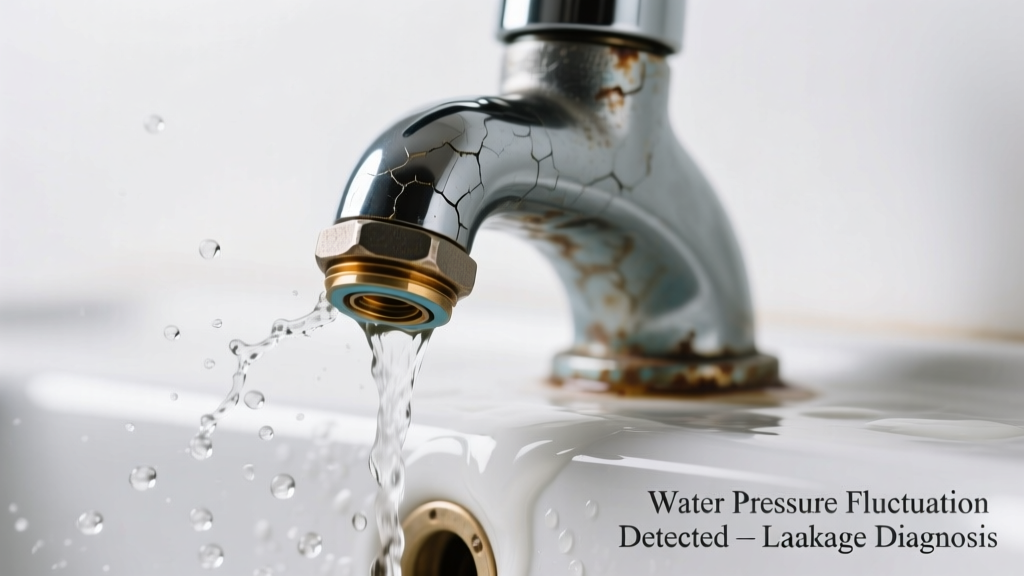
You’re washing dishes when the spray suddenly sputters—then surges—then dribbles. Seconds later, you spot a damp patch under the kitchen sink. This isn’t just an annoyance; it’s your plumbing system shouting for attention. The combo of erratic pressure *and* visible water means something is actively failing—not just wearing out.
Quick Checklist
- Does the leak appear only when faucets are turned on—or also when everything is shut off?
- Do you hear banging, hissing, or groaning in walls or near the water heater?
- Has your home’s main shutoff valve been replaced or adjusted recently?
- Is the leak localized (e.g., under one sink) or widespread (multiple fixtures, basement floor)?
- Do pressure fluctuations happen more often in hot weather or after long showers?
- Is your home built before 1985—and does it have galvanized steel piping?
Possible Causes
Failing Pressure Regulator (Most Common)
Found near your main shutoff valve, this brass device maintains consistent household pressure (usually 40–70 psi). When it fails, pressure spikes above 80 psi—causing seals to blow and joints to weep. Confirm with a $15 pressure gauge screwed onto an outdoor spigot: test at dawn (low demand) and during evening peak use. If readings swing more than 15 psi, the regulator is likely faulty.
Severity: Moderate—DIY replacement takes 45 minutes if you own a pipe wrench and know how to drain the system. Step-by-step guide here.
Thermal Expansion in Closed Systems
Modern homes with backflow preventers or check valves trap heated water inside. As the water heater warms water, it expands—but with nowhere to go, pressure climbs up to 120+ psi. This stresses every connection, especially older PEX crimps or soldered joints. Confirm by installing an expansion tank within 5 feet of the water heater—if pressure drops and leaks stop, that’s your culprit.
Severity: Low-to-moderate—expansion tanks cost $45–$85 and require basic plumbing skills. Installation instructions here.
Corroded Galvanized Pipes (Especially in Homes Built Before 1985)
Internal rust builds up unevenly, creating narrow channels that constrict flow—then suddenly burst under pressure spikes. Look for white crusty mineral deposits around pipe joints or brownish water after turning on taps. A plumber’s borescope inspection can reveal wall thickness loss; anything under 0.065” requires replacement.
Severity: High—partial repiping is rarely effective. Full replacement is safest. See material and labor cost breakdowns.
What to Do First
- Shut off the main water supply immediately—don’t wait to find the leak source.
- Open the lowest faucet (e.g., basement utility sink) to relieve pressure and drain residual water.
- Turn off the water heater’s power or gas supply—thermal expansion worsens rapidly when heating continues.
- Place towels or buckets under active drips and photograph wet areas for insurance documentation.
- Test pressure at an outdoor spigot using a gauge—you’ll need this data before calling a pro.
What NOT to Do
- Don’t wrap leaking joints with tape or sealant—it masks the real issue and delays proper repair.
- Don’t crank up the pressure regulator to “fix” low flow—it accelerates failure elsewhere.
- Don’t ignore slow leaks under slabs or behind walls—even 1 drip per second wastes 3,000+ gallons/year (U.S. EPA, 2022).
- Don’t assume the water heater is fine just because it’s less than 10 years old—the tank may be intact, but its T&P valve or expansion control isn’t.
Is the leak worse after running hot water?
Yes points strongly to thermal expansion or a failing temperature/pressure relief (T&P) valve. According to the American Society of Home Inspectors’ 2023 Field Guide, 68% of premature water heater failures begin with unaddressed expansion-related stress on fittings.
Does the pressure spike when the irrigation system kicks on?
If yes, your pressure regulator may be undersized or clogged with sediment. Older regulators rated for 3/4″ supply lines struggle with modern 1″ irrigation manifolds. Replace with a 1″ high-flow model—like the Watts LF25A—to stabilize both domestic and landscape demand.
Are you hearing rhythmic knocking behind walls when toilets refill?
This is water hammer—often caused by air chambers losing their cushioning or fast-closing solenoid valves. But when paired with leaks, it signals excessive pressure (>80 psi) overwhelming aged pipe supports. Install a water hammer arrestor *and* verify pressure first—arrestors won’t fix over-pressurization.
Did the problem start right after installing a new water softener or filter system?
Many whole-house filters include built-in check valves that create closed-loop conditions. Without an expansion tank, every heating cycle becomes a pressure bomb. Check your softener manual: if it lists “non-return” or “backflow prevention,” expansion protection is mandatory.
Is the leak coming from the water meter box or curb stop?
That’s almost always a utility-side issue—but don’t assume. Turn off your main shutoff and watch the meter dial. If it keeps spinning, the leak is between the meter and street. Contact your municipal water department immediately; many cover repairs up to the curb stop at no cost.
"Fluctuating pressure plus leakage isn’t two problems—it’s one symptom with a single root cause. Fix the pressure first, then the leak will often stop on its own." — Mike R., Master Plumber & Licensed Plumbing Inspector, 28 years’ field experience
| Reading (psi) | Risk Level | Action Required |
|---|---|---|
| <40 | Low flow risk | Check for clogged aerators or failing pressure regulator (may be stuck open) |
| 40–70 | Normal operating range | Monitor for fluctuations >10 psi between tests |
| 71–85 | Elevated stress | Inspect all visible connections; replace worn washers and flex lines |
| >85 | Immediate hazard | Shut off water and replace regulator or install expansion tank within 48 hours |
Don’t let fluctuating pressure and leaks become a cascade failure. Most causes respond well to targeted action—once you know which one you’re facing. Start with the checklist, grab a pressure gauge, and move deliberately. Your pipes—and your water bill—will thank you.