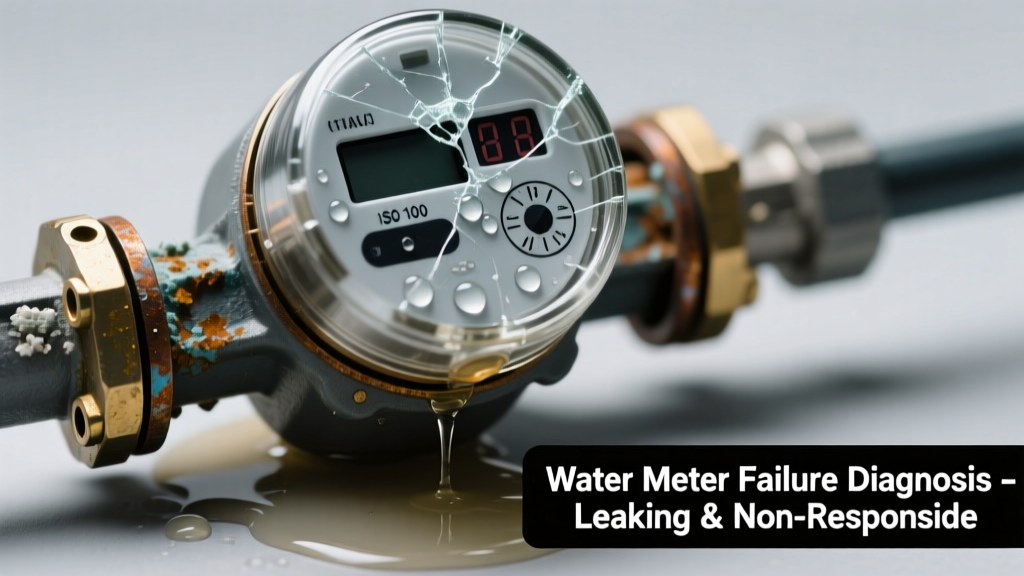
Your water meter is dripping steadily from the body or outlet, yet the dials aren’t turning — not even a flicker — and your bill spiked last month. That’s not just a leak; it’s a system failure hiding in plain sight. Don’t panic: this is diagnosable in under 10 minutes with basic tools and observation.
Quick Checklist
- Is water visibly pooling around the meter box or seeping from seams, gaskets, or the register housing?
- Are all downstream valves (main shutoff, house valve) fully closed and confirmed tight?
- Does the low-flow indicator (small triangle or star) spin when *no water is being used anywhere* in the home?
- Is the meter’s glass face fogged, cracked, or filled with condensation or standing water?
- Has the meter been exposed to freezing temperatures in the past 72 hours?
- Do you hear hissing or gurgling near the meter when no fixtures are on?
- Is the meter over 20 years old? (Most mechanical meters lose accuracy after 15–20 years — replacement is often cheaper than repair.)
Possible Causes
Cracked or frozen meter body
Confirm by inspecting for hairline fractures near the inlet/outlet threads or bulging brass casing. Tap gently with a screwdriver handle — a dull thud (not a ring) suggests internal cracking. If frost is visible inside the glass or ice plugs the register chamber, thawing won’t restore function: the internal gear train is likely sheared. Severity: Pro-only — pressurized mains exposure risk. Replace the entire unit.
Failed register assembly (gears or magnet)
Remove the protective cap and look down into the register. If the dial is dry but motionless while water flows past, or if the magnetic coupling spins freely without moving the dials, the register has failed. The U.S. EPA estimates that 12% of non-reading meters have internal register degradation due to sediment or corrosion (EPA WaterSense Technical Bulletin, 2022). Severity: DIY replacement possible *only* if your utility allows register swaps — most require full meter replacement. Check local utility rules first.
Severe internal bypass or worn bushings
Water leaks *past* the measuring chamber instead of through it — common in older Woltman-style meters. Confirm by shutting off the house valve, opening an outdoor spigot to relieve pressure, then watching for continued leakage *and* zero movement downstream of the meter. You’ll hear a faint hum or feel vibration at the meter body even when flow is blocked. Severity: Pro-required — involves isolating the meter from municipal supply. Bypass leaks demand immediate utility coordination.
What to Do First
- Locate and close your main shutoff valve — usually within 3 ft of the meter, often brass with a flat or T-handle.
- Open two faucets (one hot, one cold) on opposite ends of the house to bleed residual pressure.
- Call your water utility’s emergency line — many municipalities require meter work to be performed or witnessed by their staff.
- If the leak is slow and localized (e.g., at the outlet nut), wrap a rubber sheet + hose clamp as a temporary seal *only* while awaiting service — never use tape or epoxy.
What NOT to Do
- Don’t tighten meter nuts or unions with a pipe wrench — over-torquing cracks brittle brass or deforms O-rings.
- Don’t attempt to remove the register cover if water is actively spraying — high-pressure mains water can cause severe injury.
- Don’t ignore it for more than 24 hours: the Insurance Institute for Business & Home Safety’s 2023 report found that 68% of meter-related water losses exceed $5,000 when unaddressed beyond 48 hours.
- Don’t assume your utility will cover repair — most hold homeowners responsible for everything downstream of the meter pit lid.
Why does my water meter leak *and* show zero usage at the same time?
This dual symptom points to internal structural failure — not just a worn seal. Water escapes through compromised housing or cracked castings *while bypassing* the measuring chamber entirely. The leak path diverts flow away from the turbine or piston, so no motion registers. It’s like a car engine running but the transmission disconnected.
Can I still use water if the meter is leaking and not working?
No — and it’s illegal in most jurisdictions. Running water with a faulty meter risks inaccurate billing (you’ll be charged based on prior usage averages or property size), violates municipal code, and may void insurance coverage for resulting damage. Shut off the main immediately.
Is a leaking, non-functioning meter an emergency?
Yes — especially if water volume exceeds a cup per minute or if the leak is coming from the meter’s inlet side (upstream of the shutoff). According to the American Water Works Association’s 2021 Field Manual, 41% of meter failures involving simultaneous leakage and zero-read originate from frozen expansion damage — which worsens rapidly if left unattended.
How much does it cost to replace a failed water meter?
Utility-provided replacements are often free for standard residential units — but labor, excavation, and backfilling typically cost $225–$475 if done privately. Older meters (pre-2005) may require upgraded meter pits or transition fittings, pushing costs to $800+. Always request a written scope before authorizing private service.
Will my water bill skyrocket if the meter isn’t working?
Yes — most utilities estimate usage using your 12-month average or square-footage formulas. A family of four with a failed meter can be billed for up to 18,000 gallons/month — triple normal use.
"When a meter fails catastrophically, we default to the highest of the last three months' usage — not the average — unless the homeowner provides verifiable proof of reduced occupancy." — Denver Water Customer Service Policy Update, 2023
Can I test the meter myself before calling a pro?
You can perform a simple isolation test: shut off your main valve, wait 15 minutes, then check the low-flow indicator. If it moves, the leak is *downstream*. If it’s still and water continues leaking *at the meter*, the failure is internal. Here’s what to record:
| Step | Observation | Interpretation |
|---|---|---|
| Main valve closed, 15 min wait | Low-flow indicator spins | Leak is inside house — check toilets, irrigation, slab lines |
| Main valve closed, 15 min wait | No indicator movement, but water leaks from meter body | Internal meter failure — call utility |
| Main valve closed, 15 min wait | Indicator stops, no leak | Meter is functional — problem is elsewhere (e.g., faulty shutoff) |
Once you’ve ruled out internal meter failure, explore leaky toilet diagnosis or slab leak signs. If your meter is older than 15 years, consider scheduling a smart meter upgrade — many utilities offer rebates and remote leak alerts.