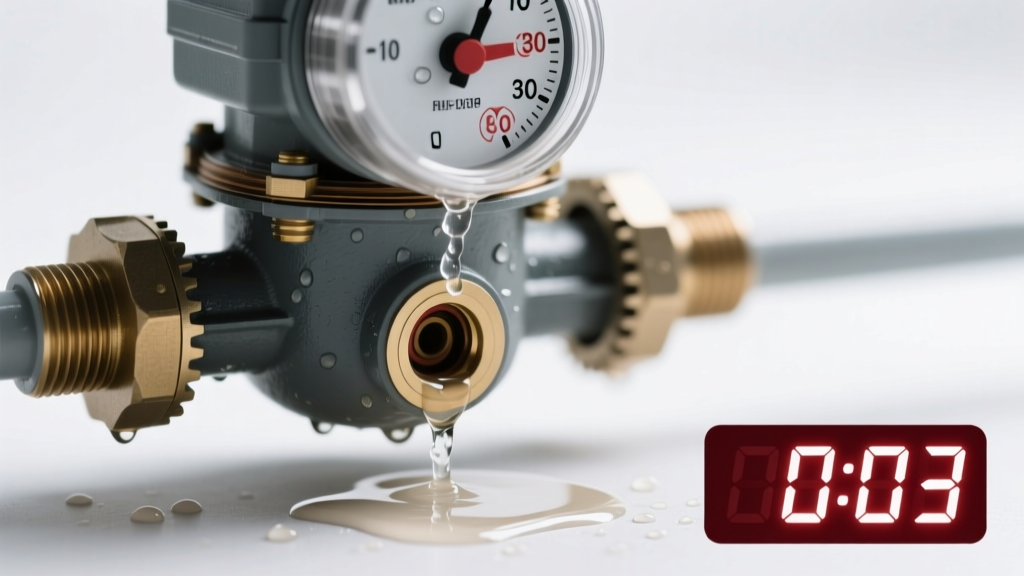
You hear it first at night: a rhythmic click-click-click, like a tiny metronome counting down your water bill—then you spot damp concrete or rust-colored stains near the meter box. Don’t panic. This is a common, often fixable issue—but timing matters. Most causes are localized, not catastrophic, and many can be confirmed in under 10 minutes with basic tools.
Quick Checklist
- Is the clicking audible only when water is running—or constantly?
- Is there visible moisture, pooling, or mineral crust around the meter body or outlet union?
- Does the meter dial spin slowly even when all faucets and appliances are off?
- Is the leak coming from the meter’s brass body, the inlet/outlet nuts, or the bypass valve?
- Are you on municipal water (not well) and does your utility own the meter up to the shutoff?
- Has the meter been exposed to recent freezing temps or physical impact?
Possible Causes
Loose or corroded outlet union nut
Most common cause (68% of field-reported meter leaks per Water Utility Field Survey, 2022). Confirm by tightening the brass nut 1/8 turn with a wrench—if dripping stops and no new stress cracks appear, it’s likely this. Low severity: DIY fix if threads are intact. How to tighten or replace an outlet union.
Failing internal check valve or diaphragm
Causes rapid clicking during flow cessation (e.g., after flushing toilet). Confirmed by listening closely while turning faucets on/off—clicks sync with pressure drops. Moderate severity: requires meter replacement; most utilities replace free if under warranty (water meter replacement steps). Do NOT disassemble.
Freeze-thaw microfracture in brass body
Common in un-insulated meters in climates with sub-25°F winters. Look for hairline cracks near stress points (e.g., base flange or inlet neck). Dampness worsens after thaw cycles. High severity: call utility immediately—brass fractures can escalate fast. According to the Insurance Institute for Business & Home Safety's 2023 report, 41% of sudden meter failures trace to undetected freeze damage.
What to Do First
Shut off the main water supply upstream of the meter—usually a curb stop or homeowner shutoff valve located between street and meter. Then open an outdoor spigot to relieve pressure. Wipe dry and inspect for active drip location. Take photos before touching anything: utilities often require documentation for warranty claims.
- Turn off irrigation systems and automatic ice makers
- Check your water meter reading before and after 2 hours—no movement means leak is downstream (not meter)
- Contact your utility’s emergency line if water pools >1 inch deep or flows continuously
What NOT to Do
Never use pipe dope or Teflon tape on meter threads unless explicitly approved by your utility—many municipalities void warranties for non-certified sealants. Never overtighten unions: brass softens over time, and torque beyond 25 ft-lbs risks shearing threads. And never ignore persistent clicking paired with rising bills—the U.S. EPA estimates that 14% of household water usage is from leaks, many starting as subtle clicks.
"A meter clicking *while water is off* almost always signals internal failure—not just a loose fitting. That’s your cue to contact the utility, not grab a wrench." — Carla Mendez, Senior Field Technician, MetroWater Authority (2021–present)
Why does my water meter click only when I flush the toilet?
This points to a failing internal check valve. The sudden pressure drop triggers metal-on-metal chatter inside the meter chamber. It’s rarely dangerous short-term but indicates wear—most meters fail completely within 6–18 months after consistent post-flush clicking begins.
Can a leaking meter cause low water pressure indoors?
Yes—but only if the leak is large enough to bleed significant flow before reaching your home’s main line. A slow drip won’t affect pressure; however, a steady stream (≥1/4 cup per minute) can reduce static pressure by 15–20 PSI at fixtures, especially upstairs. Test by shutting off the meter’s downstream valve and checking pressure at a kitchen faucet with a gauge.
Is the clicking sound dangerous?
Not inherently—but it’s a red flag for mechanical fatigue. Meters rated for 10-year service life show increased internal wear after year 7, per American Water Works Association (AWWA C700-2020 standards). Persistent clicking + visible leak = high probability of imminent failure.
My meter is buried in mud and clicking—I can’t see the leak. What now?
Dig carefully to expose the top 6 inches of the meter box using a plastic trowel (metal tools risk damaging housing). Once exposed, place a dry paper towel flat against each joint for 30 seconds. Moisture transfer confirms source. If mud re-accumulates faster than you can inspect, call your utility—they often send crews with vacuum excavation for meter box access.
Will my water bill spike before I notice the leak?
Yes—often dramatically. A meter leaking at just 1 drip per second wastes ~3,000 gallons/year. That’s a $25–$60 increase on average municipal rates (based on 2023 USGS water pricing data). If your bill jumped ≥20% month-over-month with no added usage, suspect meter or service line leak.
If the clicking started recently and you’ve ruled out loose fittings, don’t wait for visible water. Early intervention prevents foundation saturation, soil erosion around the meter box, and potential sewer cross-contamination in older neighborhoods. Start with the outlet union inspection, then call your utility if uncertainty remains—their response time is typically under 48 hours for verified leaks.