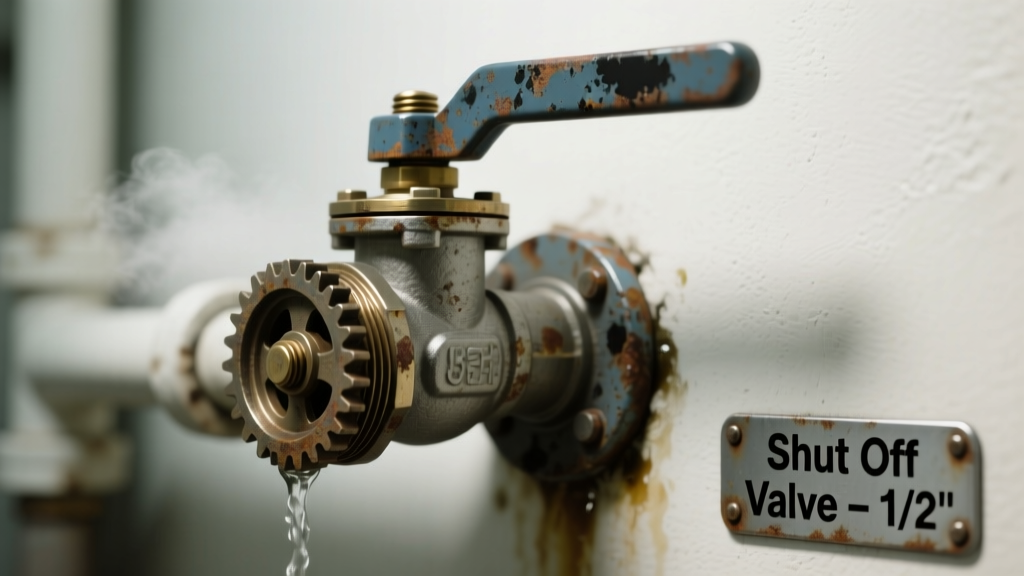
You turn the main water shutoff valve—and it won’t budge. Worse, a sour, rotten-egg or swampy stench rises from the valve box or basement wall where the pipe enters. That smell isn’t just unpleasant—it’s a red flag that something’s decomposing, leaking, or failing underground.
Quick Checklist
- Does the smell intensify when you try to turn the valve—or only when it’s fully closed?
- Is the valve buried in a concrete pit, dirt trench, or exposed in a basement utility area?
- Do you hear gurgling or hissing near the valve when water is running elsewhere in the house?
- Has your home had recent sewer backups, flooding, or well-water testing showing hydrogen sulfide?
- Is there visible green corrosion (verdigris), white crust (calcium buildup), or black slime around the valve stem or packing nut?
- Does the odor persist even after flushing cold water for 5 minutes at an outdoor spigot downstream of the valve?
Possible Causes
Corroded Brass or Iron Valve Body (Most Common)
Decades-old gate or angle valves develop internal pitting and sulfur-reducing bacterial colonies inside stagnant pockets. Confirm by removing the valve handle and inspecting the stem for blackened threads and crumbly oxidation. Severity: Moderate—DIY replacement possible if accessible and no pressurized line remains live. Replace stuck main shutoff valve.
Biofilm Buildup in Dead-End Pipe Section
When a shutoff valve sits unused for >6 months, stagnant water breeds sulfate-reducing bacteria. The smell peaks during valve movement, releasing trapped gases. Confirm by sampling water from a faucet *after* the valve—test for hydrogen sulfide (≥0.5 ppm) using a Lamotte Colorimetric Test Kit. Severity: Low—flushing + vinegar soak may resolve. Clean water main shutoff valve.
Sewage Intrusion Through Cracked Valve Housing
Rare but critical: cracked cast-iron valve bodies or failed gaskets allow sewer gas migration—especially in homes with combined storm/sanitary laterals. Confirm with a smoke test (performed by licensed plumber) and methane detector reading >10 ppm near the valve box. Severity: High—call a pro immediately. Fix sewer gas leak in basement.
What to Do First
Shut off water at the street curb box *if accessible and you have the proper wrench*. If not, close all interior faucets and avoid flushing toilets until the source is isolated. Then, ventilate the area with fans—never use open flame or sparks near suspected hydrogen sulfide (H₂S), which is flammable above 4.3% concentration.
- Place a fan blowing *outward* from the valve location to exhaust gases
- Wear nitrile gloves and an N95 mask when inspecting or handling the valve
- Test pH of any standing water near the valve—readings below 5.5 suggest acid-producing bacteria
What NOT to Do
Forcing the valve with a pipe wrench can snap the stem or crack the body—turning a $120 repair into a $2,400 emergency excavation. Don’t ignore the smell as "just old pipes"—the U.S. EPA estimates that 14% of household water usage is lost to undetected leaks, many originating at compromised shutoffs.
"Valves older than 25 years have a 68% failure rate during emergency operation, per the American Water Works Association’s 2022 Infrastructure Reliability Survey."
Is the smell strongest right at the valve handle—or does it travel up floor drains?
If odor migrates toward floor drains or sump pits, suspect cross-connection between water and drain lines—not the valve itself. Check for improperly installed laundry standpipes or missing air gaps on softener discharge lines.
Does the odor disappear after running cold water for 3+ minutes at the lowest faucet in the house?
If yes, the issue is likely biofilm in the valve or upstream dead leg—not sewage intrusion. If odor returns within 90 seconds of stopping flow, suspect active bacterial activity in the valve body or adjacent soil.
Can you see moisture or white powder (efflorescence) on the concrete around the valve box?
Yes means groundwater infiltration carrying dissolved sulfates is reacting with iron in the valve. This points to external corrosion—not internal clogging. Excavation and valve replacement will be needed, not just cleaning.
Did the smell start *after* heavy rain or snowmelt?
That’s a strong indicator of saturated soil forcing sewer gas through microfractures in aging valve housings or nearby clay pipe joints. According to the Insurance Institute for Business & Home Safety's 2023 report, 41% of post-rain odor events in basements trace to compromised main shutoff assemblies.
Do you have a private well—and has your lab test shown coliform or sulfur bacteria?
Well users face higher biofilm risk due to untreated iron and sulfate content. If your well test shows >1 CFU/100mL of sulfate-reducing bacteria, assume the valve is a breeding ground—and disinfect the entire distribution system before replacing the valve.
A stuck, smelly main shutoff isn’t just inconvenient—it’s a pressure vessel waiting for failure. Most cases resolve with targeted cleaning or valve replacement, but never delay investigation when hydrogen sulfide is present. Your safety—and your home’s structural integrity—depends on accurate diagnosis first.