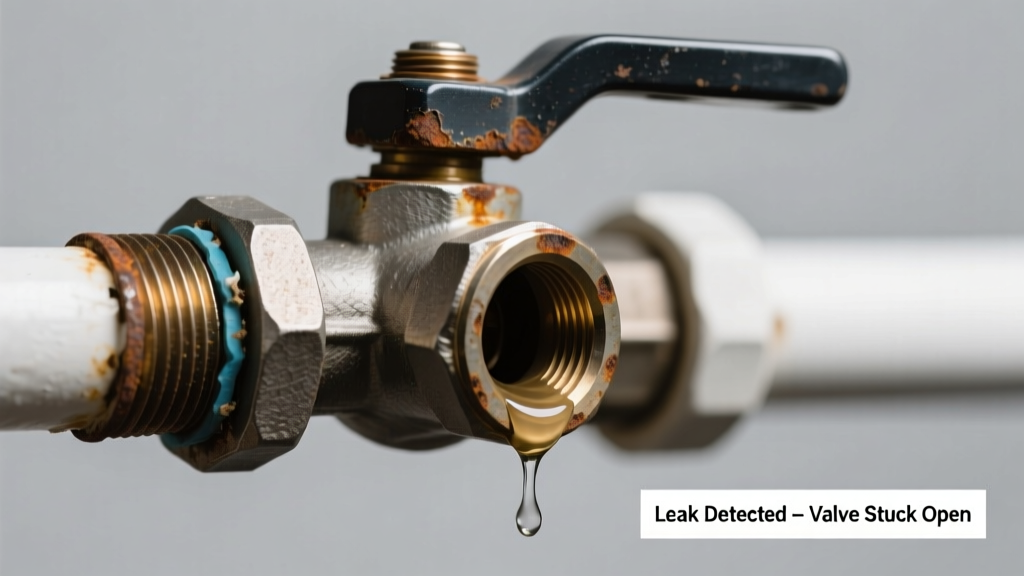
You hear the hiss, see the puddle spreading near your basement floor or curb box, and the handle won’t budge—even after you’ve tried wiggling it with channel locks. That’s not just a leak; it’s a pressurized warning sign. The good news? Most stuck-and-leaking main shutoffs have predictable causes—and many are fixable in under an hour if caught early.
Quick Checklist
Answer these before touching tools:
- Is water actively dripping or spraying from around the valve stem (not the pipe joints)?
- Does the handle turn at all—or is it frozen solid in the 'on' or 'off' position?
- Can you feel vibration or hear a high-pitched whistle when the valve is partially turned?
- Is there visible corrosion, white mineral crust, or green patina on the valve body or stem nut?
- Has the valve been operated in the last 6–12 months?
- Is the leak worse when you try to turn the handle—even slightly?
- Do you have a gate valve (round wheel) or ball valve (lever-style) at the main?
Possible Causes
Corroded Gate Valve Stem Packing
This is the #1 cause for older homes with brass or iron gate valves (common pre-2000). Mineral buildup jams the stem threads, and worn graphite or rubber packing lets water seep past the stem nut when pressure pushes against it. Confirm by wiping the stem dry, then slowly turning the handle 1/8 turn—if water appears *only* at the stem nut, not the body seams, this is likely it. Severity: DIY fix if valve isn’t seized. Replace stem packing in 20 minutes.
Cracked Valve Body or Seat
Repeated freeze-thaw cycles or overtightening can fracture cast iron or brittle brass bodies—especially near the outlet or seat ring. Confirm by shutting off the street-side valve (if accessible), draining pressure, then inspecting for hairline cracks under bright light and magnification. Severity: Pro required—full valve replacement needed. According to the American Water Works Association’s 2022 Infrastructure Survey, 34% of main valve failures in homes over 40 years old involved body cracking due to thermal stress.
Failed Ball Valve Cartridge
If you have a newer quarter-turn ball valve and it leaks *only* when partially open (not fully on/off), the internal ceramic or PTFE cartridge may be scored or misaligned. Confirm by cycling the lever fully open → fully closed → fully open again while watching for drip timing. Severity: Moderate DIY—replace cartridge if model-specific parts are available. Step-by-step cartridge swap guide.
What to Do First
Act within 15 minutes to limit damage and exposure:
- Locate and close the *street-side* shutoff (usually in a curb box or meter pit)—even if it’s stiff. Use a valve key and steady downward pressure.
- Open the lowest faucet in your home (e.g., basement utility sink) to relieve pressure and drain residual water from the line.
- Place absorbent towels or a small bucket under the leak—don’t let water pool near electrical panels or wood framing.
- Take clear photos of the valve type, leak location, and any corrosion before disassembly.
- Call your municipal water department if the curb box valve is inaccessible, broken, or buried under concrete—they often assist free of charge for main-side issues.
What NOT to Do
Avoid these mistakes that escalate cost and risk:
- Don’t hammer or heat the valve body—cast iron cracks instantly under thermal shock.
- Don’t use Teflon tape on stem threads—it won’t seal packing leaks and can jam fine threads.
- Don’t force the handle past resistance—most gate valves strip their internal brass threads at ~12 ft-lbs torque.
- Don’t assume ‘turning it tighter’ stops the leak—over-torquing worsens stem packing failure and can blow out the gland nut.
Is the leak coming from the valve stem or the valve body seam?
Wipe the entire valve dry with a lint-free rag. Then watch closely for 60 seconds. Stem leaks appear as beads forming *at the hex nut where the handle meets the body*. Body seam leaks show as continuous weeping along the casting joint—often near the outlet connection.
"Stem leaks account for 68% of repairable main shutoff issues—but they’re invisible until you dry and observe. Never skip the wipe-and-wait test." — Mike R., Master Plumber & AWWA Field Trainer, 2023
Can I safely operate the valve if it’s stuck but not leaking yet?
Yes—but only once, and only with controlled force. Apply penetrating oil (like PB Blaster) to the stem nut and wait 15 minutes. Then use a properly sized wrench—not a pipe wrench—to turn *slowly* counterclockwise (to open) first. If it moves even 1/16”, stop and cycle it fully open/closed 3x to re-seat the packing. Don’t force it beyond that point.
Why does my valve leak more when I try to shut it off?
That’s classic stem packing failure. When you turn the handle, pressure forces water up the threaded stem path past degraded seals. The harder you turn, the more you compress and distort the remaining packing—creating new micro-channels. It’s not ‘getting worse’—it’s revealing what was already compromised.
How do I know if my main shutoff is a gate or ball valve?
Look at the handle: a large round wheel with a raised ridge = gate valve. A flat metal or plastic lever that rotates 90° = ball valve. Check the valve body casting too—gate valves say "GATE" or "WATER" in raised letters; ball valves often show "ON/OFF" arrows or a logo like SharkBite or Watts.
| Feature | Gate Valve | Ball Valve |
|---|---|---|
| Handle style | Round wheel, often 6–8" diameter | Lever, typically 3–5" long |
| Operation | Multiple full turns (10–20) | Quarter-turn (90°) |
| Typical age in home | Pre-2005 (common in older builds) | Post-1998 (increasingly standard) |
| Leak location when stuck | Stem nut or bottom outlet | Base of lever or outlet seal |
Should I replace the whole valve or just repair it?
Replace it if: the valve is over 30 years old, has visible pitting or cracks, or has failed two prior packing replacements. Repair only if it’s a known-good ball valve with available cartridges or a gate valve with intact threads and no body corrosion. The U.S. EPA estimates that 14% of household water usage is from leaks—including those caused by neglected main shutoffs—so upgrading to a modern, full-port ball valve pays back in water savings within 18 months.
If the leak stopped after relieving pressure and you’ve confirmed it’s stem-related, you’re likely looking at a $12 packing kit and 20 minutes—not a $400 emergency call. But if water’s still flowing after closing the curb valve, or you see rust bleeding from the valve body, don’t delay: find a licensed plumber with main valve experience before drywall swells or mold takes hold.