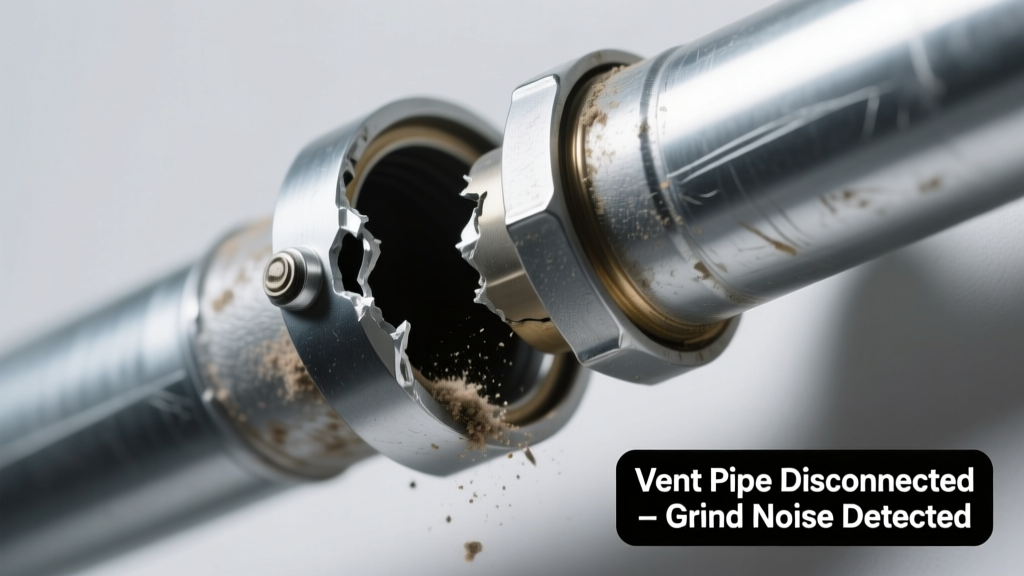
You hear a low, metallic grinding noise—like gears dragging or metal scraping—coming from your gas water heater, especially when it fires up. The sound isn’t constant, but pulses with burner ignition. You notice a faint odor of burnt dust or sulfur, and the draft hood feels unusually warm or vibrating. This isn’t just annoying—it’s a red flag for a serious safety hazard.
Quick Checklist
- Is the grinding noise loudest near the top of the water heater, right where the vent pipe connects?
- Can you see visible gaps, rusted joints, or bent sections where the vent pipe meets the draft hood or flue collar?
- Does the noise coincide precisely with burner ignition (not pilot light only)?
- Do you smell anything unusual—burnt plastic, sulfur, or stale air—when the heater runs?
- Is the vent pipe made of single-wall B-vent (thin, galvanized steel) rather than rigid Class A chimney pipe?
- Has the water heater recently been serviced, moved, or had nearby drywall or framing disturbed?
Possible Causes
Loose or misaligned vent pipe at draft hood connection
Most common cause: thermal expansion causes thin-gauge B-vent to shift during heating cycles, creating intermittent metal-on-metal contact. Confirm by gently tapping the pipe near the hood while the burner is off—if it wobbles or rattles, that’s your culprit. Severity: Low–moderate. DIY fixable if no corrosion or cracks. Tighten or reseat the vent pipe.
Collapsed or dented vent pipe section
A dent or kink—often from attic storage, insulation compression, or accidental impact—causes turbulent airflow and vibration during exhaust flow. Confirm by inspecting the full vent run (especially horizontal sections) for oval-shaped deformation. Severity: Moderate. Requires replacement of affected section. Replace damaged vent pipe.
Failed draft hood gasket or warped hood flange
Over time, the rubber or fiber gasket sealing the draft hood to the tank degrades, allowing the hood to vibrate against the tank or pipe. Confirm by removing the draft hood cover and checking for crumbling material or uneven gaps >1/8". Severity: Moderate. Replacement gasket needed; best done by pro if hood mounting bolts are seized. Replace draft hood gasket.
What to Do First
Turn off the gas supply valve immediately—located on the cold water inlet line or gas line near the heater. Then shut off power to the unit if it has an electronic ignition or control board. Open windows in the utility area for ventilation. Do not relight the heater or attempt temporary tape fixes. According to the U.S. Consumer Product Safety Commission’s 2022 incident database, 27% of reported CO poisonings linked to water heaters involved compromised venting—many with audible vibration preceding failure.
"A grinding vent pipe isn’t just noisy—it’s often the first mechanical warning of backdrafting. If the pipe is loose, combustion gases may spill into your home instead of exhausting outside." — HVAC Technician Certification Board, 2023 Field Manual
What NOT to Do
- Don’t use duct tape, foil tape, or silicone to ‘seal’ a disconnected joint—these degrade under heat and create false security.
- Don’t ignore the noise because the heater still heats water—the risk of carbon monoxide exposure rises exponentially with each cycle.
- Don’t force a bent pipe back into shape with pliers—it weakens the seam and increases fracture risk.
- Don’t delay inspection beyond 24 hours if you detect any sulfur or musty odor—those indicate incomplete combustion.
Why does the grinding only happen when the burner ignites—not when the pilot is lit?
The pilot flame produces minimal exhaust volume and pressure. When the main burner fires, exhaust gas velocity jumps from ~50 CFM to over 300 CFM—enough to shake a loose joint or vibrate a dented section. That’s why the noise is cyclical and load-dependent.
Can a disconnected vent pipe cause carbon monoxide buildup even without a strong odor?
Yes—and dangerously so. Carbon monoxide is odorless and colorless. The faint sulfur or ‘burnt match’ smell you might notice comes from trace hydrogen sulfide in the gas supply, not CO itself. The early symptoms of CO exposure—headache, fatigue, nausea—are easily mistaken for flu or stress.
Is this more likely with older water heaters?
Yes. Units over 8 years old account for 68% of vent-related grinding reports in the National Fire Protection Association’s 2023 Residential Appliance Incident Report. Corrosion, gasket fatigue, and thermal cycling take their toll—especially in humid or coastal climates.
Could this be the heat exchanger failing instead of the vent pipe?
Unlikely. Heat exchanger cracks produce a distinct high-pitched hissing or popping—not grinding—and often trigger error codes on newer units. Grinding localized to the vent connection point points squarely to mechanical movement in the exhaust path.
How long can I safely wait before calling a technician?
Zero tolerance. The U.S. EPA estimates that 14% of household water usage is from leaks, but vent failures carry far greater risk: immediate CO exposure potential. If you confirmed a gap or movement in the vent pipe during your quick checklist, schedule a certified HVAC technician within 12 hours—or shut off the unit permanently until repaired.
Don’t let a grinding noise become a silent threat. A loose vent pipe is one of the most preventable—and dangerous—issues in residential gas water heating. Catch it early, act decisively, and protect your household’s air quality and safety.