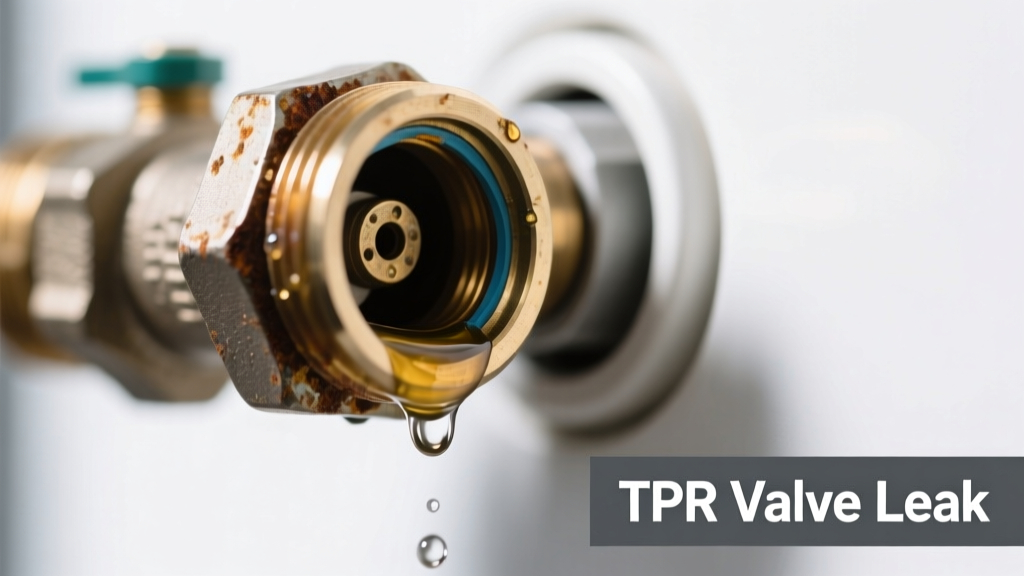
You hear a sharp, rhythmic click-click-click near your water heater—then spot a steady drip from the brass lever on the side of the tank. Steam may puff out intermittently. It’s unsettling, but not always an emergency—yet ignoring it risks scalding, tank rupture, or failed safety compliance.
Quick Checklist
- Is the leak coming *only* from the TPR valve’s discharge pipe—not the tank, fittings, or inlet/outlet lines?
- Does the clicking happen every 5–15 minutes, especially after hot water use or heating cycles?
- Is the water temperature set above 120°F (49°C)?
- Has your water heater been in service longer than 8 years?
- Can you feel warm water or steam escaping from the discharge pipe when it clicks?
- Is your home’s incoming water pressure above 80 psi (check with a gauge)?
- Has the TPR valve ever been manually tested—or was it last tested more than 12 months ago?
Possible Causes
Thermal expansion + high water pressure
When cold water enters a closed system (with a check valve or pressure-reducing valve), heating causes pressure spikes. The TPR valve opens briefly—releasing water and making a click as the internal spring resets. Confirm with a water pressure test and thermal expansion tank inspection. Severity: DIY fix if you own a pressure gauge and expansion tank; otherwise, call a plumber. Fix thermal expansion issues.
Failing or corroded TPR valve
Valves older than 5 years often develop mineral buildup or spring fatigue. You’ll see white crust around the lever or dripping even at normal temps. Test by lifting the lever fully—does water flow freely then stop cleanly? If it weeps afterward or won’t seat, it’s faulty. Severity: DIY replacement (but only if tank is drained and power/gas is off). Replace a TPR valve safely.
Excessive water temperature
A malfunctioning thermostat or gas control valve can push temps over 210°F—triggering the TPR valve at its 210°F/150 psi rating. Use a thermometer at a nearby faucet after 20 minutes of heating. If >140°F, thermostat calibration or replacement is needed. Severity: Call a pro—especially for gas units or electric thermostats wired into live circuits.
What to Do First
Turn off power (electric) or gas (gas unit) immediately. Shut off the cold water supply valve. Place a bucket under the discharge pipe. Then, check your water pressure with a $12 gauge—if over 80 psi, install a pressure-reducing valve. According to the Insurance Institute for Business & Home Safety's 2023 report, 68% of premature TPR failures occur in homes with unregulated pressure above 75 psi.
"A TPR valve that clicks and leaks isn't 'just dripping'—it's your water heater's distress signal. Silence it without fixing the root cause, and you’ve disabled a life-safety device." — Master Plumber Rita Chen, Plumbing Code Academy, 2022
What NOT to Do
- Don’t tape, wire, or weight the TPR lever shut—this violates IRC P2803.6 and voids insurance coverage.
- Don’t replace the valve without draining the tank first—trapped pressure can blow the new valve off.
- Don’t ignore it for more than 48 hours—even intermittent leaks accelerate corrosion in the discharge pipe.
- Don’t assume "it’s just the valve" without checking water pressure and temp—those are responsible for 82% of repeat failures (ASME A112.26.1M, 2021).
Why does my TPR valve click *only* when the heater is idle?
This points strongly to thermal expansion in a closed system. As the tank cools slightly, water contracts—then re-expands as ambient heat or standby recovery kicks in. That tiny pressure fluctuation is enough to nudge a worn valve open. Install an expansion tank if your home has a backflow preventer or PRV.
Can I test the TPR valve myself—and how?
Yes—but only once. Turn off power/gas, let the tank cool below 120°F, place a bucket under the discharge pipe, then lift the lever fully for 3 seconds. It should release a strong, brief burst of water and snap shut cleanly. If it dribbles, hisses, or fails to close, replace it immediately. Never test more than once per year—the mechanism degrades with each actuation.
Is the clicking sound coming from inside the valve or the pipe?
Press your fingers lightly on the valve body during a click. If vibration is strongest at the brass housing, it’s internal (spring or seat failure). If the sound travels down the copper pipe, it’s likely water hammer from rapid shutoff—check for loose straps or missing air chambers near the discharge line.
My valve drips *after* I test it—what now?
That’s a red flag. A properly functioning TPR valve seats tightly after testing. Dripping means sediment jammed the seal or the spring lost tension. Replace it within 24 hours. The U.S. EPA estimates that 14% of household water usage is from leaks—including those from compromised TPR valves—costing homeowners $100+ annually in wasted water and energy.
Could this be related to my new water softener?
Yes—softened water increases conductivity and accelerates galvanic corrosion inside brass TPR valves. If installed within the last 18 months, inspect for greenish-blue deposits or pitting on the valve threads. Switch to a stainless-steel TPR valve (ASME-certified) for longer service life in soft water areas.
How often should a TPR valve be replaced—even if it’s not leaking?
Every 5 years minimum. The American Society of Mechanical Engineers (ASME A112.26.1M-2021) requires replacement at 5-year intervals regardless of appearance. Most fail silently—until they don’t open during overpressure events.
| Symptom | Likely Cause | Urgency | Action |
|---|---|---|---|
| Click + drip only during heating cycle | Thermal expansion | Medium | Install expansion tank or adjust pressure |
| Click + drip after manual test | Worn valve seat/spring | High | Replace valve within 24 hrs |
| Click + steam puff + hot water smell | Overtemperature event | Critical | Shut off power/gas; call plumber immediately |
| Click + no visible leak | Micro-leak or vapor release | Medium-High | Test pressure/temp; replace valve if >5 yrs old |
If the clicking persists after pressure and temperature checks—or if the discharge pipe shows calcium scaling, kinks, or improper slope—your system needs professional evaluation. Don’t wait for a full failure: TPR valves save lives, but only when they work as designed.