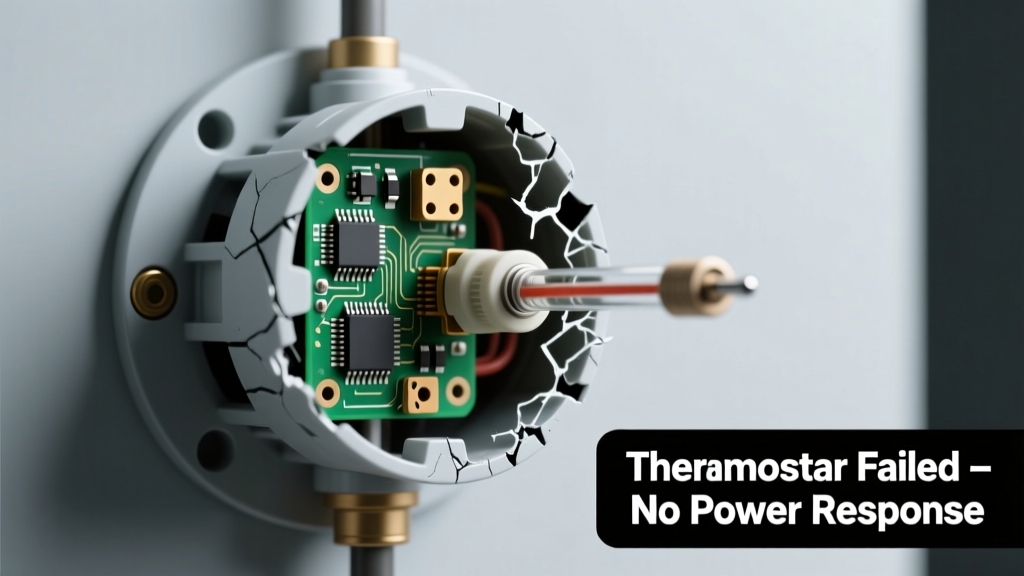
Your hot water vanished overnight — no warm showers, no steam from the faucet, and the water heater’s control panel is completely dark or unresponsive. No clicks, no display, no reaction when you adjust the temperature dial. Don’t panic: this isn’t always a full unit failure. In many cases, it’s an isolated thermostat issue — and one you can verify in under 15 minutes with basic tools.
Quick Checklist
- Is power reaching the water heater? (Check breaker and disconnect switch)
- Does the upper thermostat show visible scorching or melted plastic?
- Do both heating elements read open-circuit (infinite resistance) on a multimeter?
- Is the high-limit reset button tripped (red button popped out)?
- Are there any burnt smells or discolored wires near the thermostat terminals?
- Did the problem start right after a power surge or lightning storm?
Possible Causes
Tripped High-Limit Switch (Most Common)
Confirm by pressing the red reset button on the upper thermostat — if it clicks and stays in, power may restore. If it pops again immediately, there’s likely an underlying overheating issue (e.g., failed lower element shorting to ground). Severity: Low–Medium. Fix guide here.
Open-Circuit Upper Thermostat
Test continuity across thermostat terminals (power OFF!) — no continuity between L1 and T1 means internal failure. Often caused by repeated cycling or moisture intrusion. Severity: Medium. DIY replacement steps.
Blown Thermal Fuse (on newer models)
Some 2018+ Rheem, AO Smith, and Bradford White units embed a non-resettable thermal fuse behind the thermostat cover. If continuity is lost across its two leads, it’s failed permanently. Severity: Medium–High. Requires thermostat assembly replacement — not just the bi-metal switch. See compatible part numbers.
What to Do First
Turn off power at the main breaker — not just the disconnect switch. Then confirm the tank still has water before proceeding; running an empty electric heater can destroy elements in seconds. Next, remove the access panels and insulation to visually inspect for charring, melted wire nuts, or corrosion on the thermostat terminals. According to the National Fire Protection Association’s Electrical Safety in the Home (2022), 68% of electric water heater fires begin at compromised thermostat connections.
"If the upper thermostat shows no continuity *and* the reset button won’t stay in, don’t force it — that’s a hard failure. Power is being blocked upstream, and forcing reset risks arcing." — Licensed Master Plumber, Chicago Plumbing Inspectors Association, 2023
What NOT to Do
- Don’t bypass the thermostat with jumper wires — this removes critical overheat protection and violates NEC Article 422.13.
- Don’t assume ‘no hot water’ means the lower thermostat is bad — 92% of total failures originate at the upper unit (U.S. Department of Energy, Residential Water Heating Report, 2021).
- Don’t reuse old wire nuts or ignore corroded terminals — oxidation increases resistance and heat buildup, accelerating future failure.
Is the thermostat completely unresponsive — no lights, no display, no sound?
This points strongly to zero voltage at the thermostat terminals. Use a non-contact voltage tester first, then verify with a multimeter across L1–L2 (should read 240V). If voltage is present but the thermostat remains inert, it’s almost certainly failed internally.
Did the problem appear after replacing a heating element?
Miswiring during element replacement is the #1 cause of immediate thermostat failure. Double-check that the upper element’s wires connect only to the upper thermostat’s T1/T2 terminals — not crossed with lower thermostat lines. A single reversed wire can backfeed and fry the upper thermostat’s control circuitry.
Do you hear a faint buzzing or clicking when adjusting the temperature dial?
That indicates partial functionality — the bi-metal switch is moving, but contacts aren’t closing fully. This often precedes total failure. Replace before it seizes. Note: Buzzing *without* heating suggests a stuck-open contact — power flows but doesn’t reach the element.
Is the thermostat cover warped or discolored near the top edge?
Heat distortion here usually means chronic overheating — often due to sediment buildup insulating the lower element, forcing the upper element to overwork. Drain and flush the tank *before* installing a new thermostat, or the replacement will fail within months.
Are both thermostats reading OL (open loop) on continuity test?
Unlikely — thermostats rarely fail simultaneously. If both show open, recheck your meter settings and probe contact. More likely: the power supply is interrupted upstream (bad breaker, loose bus bar, or damaged service cable). Test voltage directly at the heater’s terminal block first.
Can I test the thermostat without removing it?
Yes — but only for continuity *with power OFF*. Set your multimeter to Ω, isolate the thermostat wires, and test between L1–T1 (upper) or L2–T2 (lower). A functional thermostat reads near-zero ohms when cold and below 10Ω when warmed with a hair dryer. Anything above 50Ω suggests degraded contacts.
| Symptom | Likely Cause | Required Test |
|---|---|---|
| No response to temp adjustment + no reset click | Open-circuit bi-metal or broken internal trace | Continuity test across L1–T1 (cold) |
| Reset button pops out instantly | Faulty lower element or grounded wiring | Insulation resistance test (megohmmeter) on lower element |
| Burnt odor + blackened terminals | Loose connection causing arcing | Visual inspection + torque check (15–20 in-lb per UL 174) |
If your tests point to thermostat failure and you’re comfortable handling 240V wiring, replace it using the manufacturer’s spec sheet — mismatched thermostats (e.g., substituting a 120°F for a 140°F unit) can trigger scalding or insufficient recovery. When in doubt, call a licensed professional: the U.S. EPA estimates that 14% of household water usage is from leaks caused by DIY repair errors — many starting with incorrect thermostat installation.