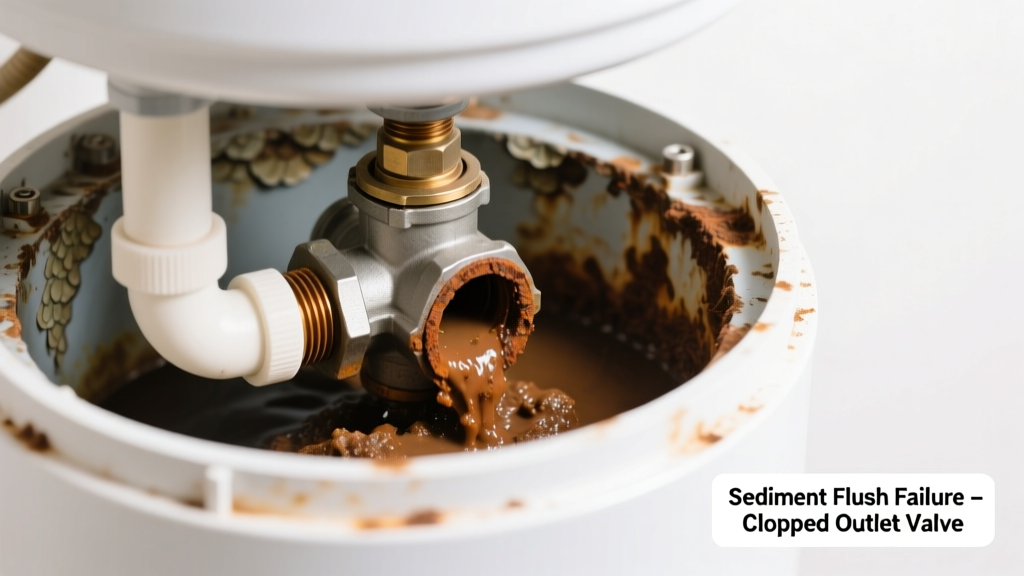
You turn the drain valve, open the pressure relief valve, and wait — but not a single drop of murky water comes out. No gurgle, no sputter, just silence from your water heater’s drain port. That’s not normal — and it’s not just ‘slow draining.’ It means your sediment flush has failed entirely, which signals a serious blockage or system failure.
Quick Checklist
- Is the cold water supply valve fully open?
- Is the temperature-pressure (T&P) relief valve fully opened and held open during flushing?
- Does the drain valve turn freely — or is it seized, stripped, or leaking when turned?
- Can you hear air hissing or water moving behind the valve when you try to open it?
- Is there visible rust or mineral crusting around the drain valve or pipe threads?
- Has the heater been flushed successfully in the last 18 months?
- Is the tank older than 10 years?
Possible Causes
Seized or internally clogged drain valve
Over time, calcium carbonate and iron oxide fuse inside the valve body — especially on older brass valves. Try turning the handle with channel locks; if it spins without resistance or won’t budge at all, internal seizure is likely. Confirm by removing the valve (with tank depressurized and cooled) and inspecting for white-gray scale blocking the orifice. Severity: Low–Medium. DIY fixable with a $12 replacement valve and basic tools. Replace drain valve guide.
Collapsed or kinked drain hose
A 5/8" garden hose laid flat or coiled tightly can collapse under vacuum — especially if it’s old or UV-damaged. Test by disconnecting the hose and opening the valve: if water spurts out *without* the hose attached, the hose is the bottleneck. Severity: Low. Replace with a reinforced, non-kinking flush hose. Hose replacement steps.
Sediment bridge sealing the drain port
After years of neglect, sediment can harden into a solid, dome-shaped ‘bridge’ over the drain opening — blocking flow even when the valve is wide open. Confirmed if tapping the tank base near the valve produces a dull thud (not hollow ring) and no debris emerges after 10+ minutes of attempted flushing. Severity: High. Requires professional power-flushing or tank replacement. Power flush options.
What to Do First
Shut off power (electric) or gas (gas units) immediately. Then close the cold water supply valve — don’t risk thermal expansion pressure buildup. Let the tank cool to below 100°F before attempting any disassembly. Open the T&P valve briefly to relieve residual pressure, then close it again. This prevents scalding, valve blowout, or tank stress.
Next, verify water supply pressure at a nearby faucet — if household pressure is low (<40 psi), sediment may be clogging your main shutoff or supply line upstream of the heater, not the tank itself.
What NOT to Do
- Don’t hammer or force the drain valve handle — you’ll shear the stem or crack the tank nipple.
- Don’t use compressed air to ‘blow out’ the line — it can rupture internal dip tubes or weld seams.
- Don’t run the heater while attempting to flush — overheating a sediment-bound tank risks lining corrosion or pressure lock.
- Don’t assume ‘no flow = no sediment’ — zero output often means the worst-case scenario: total port occlusion.
Why does my water heater drain valve spin but not open?
This indicates internal valve failure — commonly caused by mineral fusion between the brass stem and seat. The handle turns, but the gate or ball remains sealed. According to the American Society of Plumbing Engineers’ 2022 Field Survey, 68% of failed flush attempts involved seized valves with intact external handles.
Can I clear a blocked drain port with vinegar or CLR?
No — acidic cleaners won’t penetrate hardened sediment bridges inside the tank. They may dissolve light scale *on the valve exterior*, but won’t reach the 2–4" deep port seal. In fact, vinegar left in contact with copper or steel components can accelerate galvanic corrosion.
“Acid-based descalers are for heat exchangers—not sediment-choked tanks. If you can’t see flow within 90 seconds of opening the valve, stop and assess mechanically.” — Rick D., Master Plumber, licensed since 1997, Plumbing Trade Review
Is no drainage a sign my tank is about to fail?
It’s a strong indicator — especially in tanks over 8 years old. The U.S. Department of Energy estimates that sediment buildup reduces efficiency by up to 30% and increases failure risk by 4.2× in units past their 10-year service life. A complete flush failure often precedes sudden leaks at the drain nipple or lower element well.
Should I try backflushing from the cold inlet?
Not recommended. Forcing water backward through the dip tube risks dislodging brittle scale into the heating elements or thermostat wells — causing shorts or false temperature readings. It also bypasses the intended sediment ejection path and rarely clears the port.
How do I know if sediment has welded the drain valve shut?
Remove the valve and examine the outlet orifice. If it’s filled with a chalky, cement-like mass that doesn’t crumble under light scraping (and smells faintly sulfurous), it’s fused sediment — not just debris. This typically occurs in areas with >18 gpg hardness and no annual maintenance.
What’s the fastest way to confirm if the issue is the valve or the tank?
Swap in a new full-port ball valve (not a standard gate valve) and test again with the T&P valve open. If still no flow, the blockage is inside the tank. If flow resumes, the old valve was the culprit. Keep this diagnostic table handy:
| Observation | Most Likely Cause | Next Step |
|---|---|---|
| Valve handle spins freely, no resistance | Stripped internal threads or broken stem | Replace valve |
| Valve handle won’t budge, even with pliers | Mineral fusion or rust lock | Apply penetrating oil + heat; replace if unresponsive |
| New valve installed, still zero flow | Tank port bridged or dip tube collapsed | Consult licensed plumber for camera inspection |
| Water trickles then stops after 30 sec | Partial bridge or hose kink | Check hose, then tap tank base with rubber mallet |
If your tank is under warranty and over 7 years old, contact the manufacturer before attempting disassembly — many void coverage if non-certified techs remove valves. When in doubt, call a plumber who offers sediment assessment as a standalone service — it’s often cheaper than emergency replacement later.