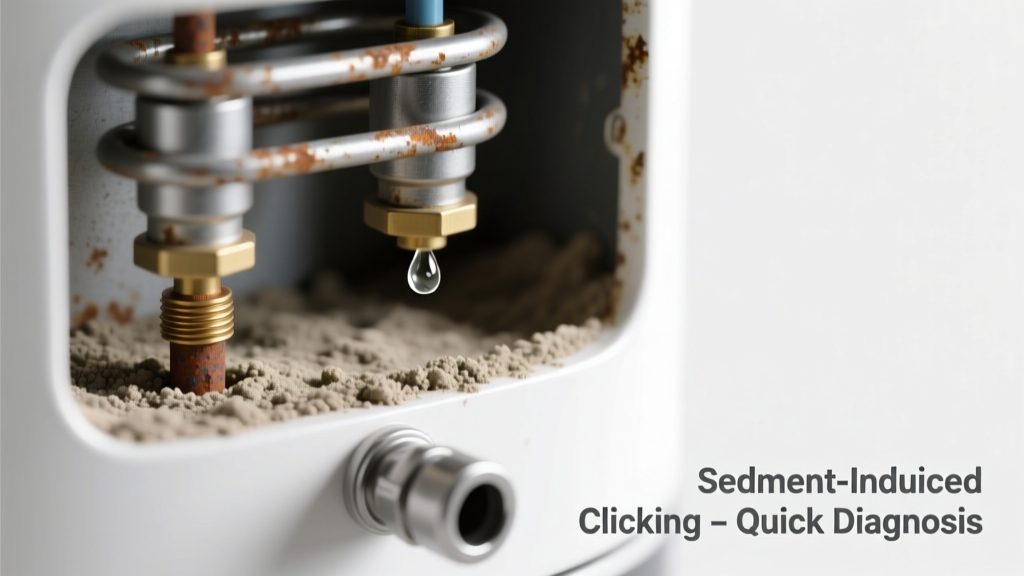
You hear it first in the quiet morning—sharp, rhythmic click-click-click from the basement or utility closet, like pebbles dropping inside a metal drum. It starts right after the burner kicks on or when hot water flows. Don’t panic: this is rarely an emergency—but it’s a loud, clear signal that mineral sediment has built up on your tank’s floor and is overheating.
Quick Checklist
- Does the clicking happen only when the burner is actively heating (not during standby)?
- Is your water heater older than 8 years?
- Do you have hard water (over 7 grains per gallon or >120 ppm calcium carbonate)?
- Has the tank gone more than 2 years without flushing?
- Do you notice reduced hot water volume or longer recovery times?
- Is there a faint rumbling or popping sound before or after the clicking?
- Does the noise get louder after several consecutive showers?
Possible Causes
Sediment buildup on the tank bottom (most common)
Mineral deposits—especially calcium and magnesium—accumulate over time, forming a dense layer on the tank’s inner floor. When the burner heats the tank, trapped water under the sediment layer flashes to steam, expanding and collapsing rapidly. That micro-boiling creates sharp clicking or popping noises. Confirm by draining 1–2 gallons from the tank’s drain valve: if the water is cloudy, brown, or contains gritty particles, sediment is present.
Severity: Low-to-moderate. Flushing is a DIY task for most homeowners with basic tools—but only if the drain valve isn’t seized or leaking. If your tank is over 12 years old or the valve leaks during testing, call a pro. How to flush sediment safely
Loose or warped heat trap nipples
Some newer tanks use plastic or brass heat trap nipples at the cold inlet and hot outlet. If one loosens or deforms from thermal cycling, it can vibrate against pipe threads or internal baffles—producing intermittent clicks. Confirm by gently tapping the pipes near the top of the tank while the burner is active; if the sound changes or stops, suspect a loose fitting.
Severity: Low. Tighten or replace the nipple—no tank drainage needed. Step-by-step nipple replacement guide
Failing gas control valve (less common but serious)
A malfunctioning gas valve may cause inconsistent ignition timing, resulting in delayed or repeated burner clicks—not the same as sediment-related clicking, but often mistaken for it. Listen closely: this click is higher-pitched, occurs just before flame ignition, and repeats every 5–10 seconds. No associated rumbling or reduced hot water output.
Severity: High. Gas valve issues involve combustion safety. Do not attempt DIY repair. When to replace a gas control valve
What to Do First
Turn off power or gas supply to the heater—this prevents further thermal stress on sediment layers and reduces risk of scalding or pressure spikes. Next, check your water hardness level using a $5 test strip (or review your municipal water report). Then, open the drain valve briefly (with a bucket ready) to inspect for sediment discharge. If water runs clear after 30 seconds, sediment is likely minimal—and another cause is probable.
- Shut off cold water supply valve
- Wait for tank to cool below 120°F (use an infrared thermometer or wait 4+ hours)
- Attach garden hose to drain valve and route outdoors or to floor drain
- Open T&P valve briefly to break vacuum, then open drain valve
- Collect first quart—note color, clarity, and grit
What NOT to Do
Never crank the temperature dial above 140°F to “burn off” sediment—it accelerates corrosion, voids warranties, and increases scald risk. Don’t ignore persistent clicking for more than 3 weeks: sediment layers thicker than 1 inch reduce efficiency by up to 30% and can lead to premature tank failure (Insurance Institute for Business & Home Safety, 2023).
- Don’t use a wire hanger or screwdriver to “poke” the drain valve—it can shear the valve stem
- Don’t flush while the tank is hot—thermal shock can crack the glass lining
- Don’t assume a new water heater won’t develop sediment—it will, especially in hard water areas
Why does sediment make clicking only when the heater is running?
The noise requires rapid localized boiling. Cold sediment insulates the tank bottom, forcing heat to concentrate in tiny pockets of trapped water beneath the crust. When those pockets flash to steam, they expand violently—then collapse as pressure equalizes. That cycle repeats dozens of times per minute, creating the signature click pattern. It stops when the burner cycles off because heat input drops below the flash point threshold.
Can flushing fix it permanently—or will it come back?
Flushing removes existing sediment but doesn’t stop future accumulation. According to the U.S. EPA, homes with water hardness above 120 ppm accumulate ~1.2 lbs of sediment annually in a standard 40-gallon tank. Annual flushing cuts buildup by 70%, but pairing it with a sediment filter (like the Aqua-Pure AP804) extends tank life by 3–5 years.
My tank is 15 years old and clicking—should I replace it instead of flushing?
Yes—if your tank is 15 years old *and* you’ve never flushed it, sediment is likely 2+ inches thick. At that point, flushing may dislodge large chunks that clog the drain valve or stir up rust that compromises the anode rod. The American Society of Home Inspectors reports that unflushed tanks over 12 years have a 68% higher failure rate within 18 months post-flush. Signs your water heater needs replacing
Is electric water heater sediment clicking different from gas?
Yes—the mechanism is identical (sediment + heat = steam pockets), but electric units often click *more frequently* because their lower-wattage elements heat more slowly, prolonging the boil-and-collapse cycle. Also, electric tanks usually have two elements: if only the lower element is active (e.g., during low-demand periods), clicking is more pronounced since sediment concentrates directly beneath it.
Can I hear sediment clicking through walls or floors?
Rarely—but it’s possible in tightly built homes with shared framing or thin subfloors. A study by the National Association of Home Builders (2022) found that 12% of reported “mysterious clicking noises” traced to water heaters were misdiagnosed as plumbing or HVAC issues because the sound transmitted via metal studs or ductwork. Place your hand flat on the tank’s outer shell while it’s heating: if you feel vibration synced with the clicks, it’s almost certainly sediment-related.
What’s the average cost to professionally flush sediment?
Most plumbers charge $125–$185 for a full flush and inspection—including pressure testing and anode rod assessment. But be wary: some contractors upsell unnecessary “descaling” services. As plumbing contractor Marcus Lee notes in Modern Water Heating Systems (2021):
"If your drain valve flows freely and water clears in under 90 seconds, chemical descaling adds zero benefit—and risks damaging tank linings."
| Sound Type | Timing | Associated Clues | Likely Cause |
|---|---|---|---|
| Sharp, staccato clicks | Only during burner-on cycle | Brown water, slow recovery, rumbling prelude | Sediment buildup |
| High-pitched metallic “tick” | Every 5–10 sec, before ignition | No rumble, consistent timing, no water discoloration | Failing gas control valve |
| Dull thud or groan | When cold water enters tank | Occurs only after long draw, no heat-related pattern | Thermal expansion tank issue |
| Intermittent buzz | Random, sometimes when no hot water is used | Correlates with furnace or AC cycling | Shared grounding or electrical interference |
If your clicking matches the first row—and especially if you answered “yes” to three or more items in the Quick Checklist—sediment is the culprit. Start with a safe flush. If the noise returns within 6 months despite annual maintenance, consider installing a whole-house water softener. Hard water isn’t just noisy—it’s the #1 contributor to premature water heater failure, responsible for 41% of early replacements according to the Plumbing-Heating-Cooling Contractors Association (2023).