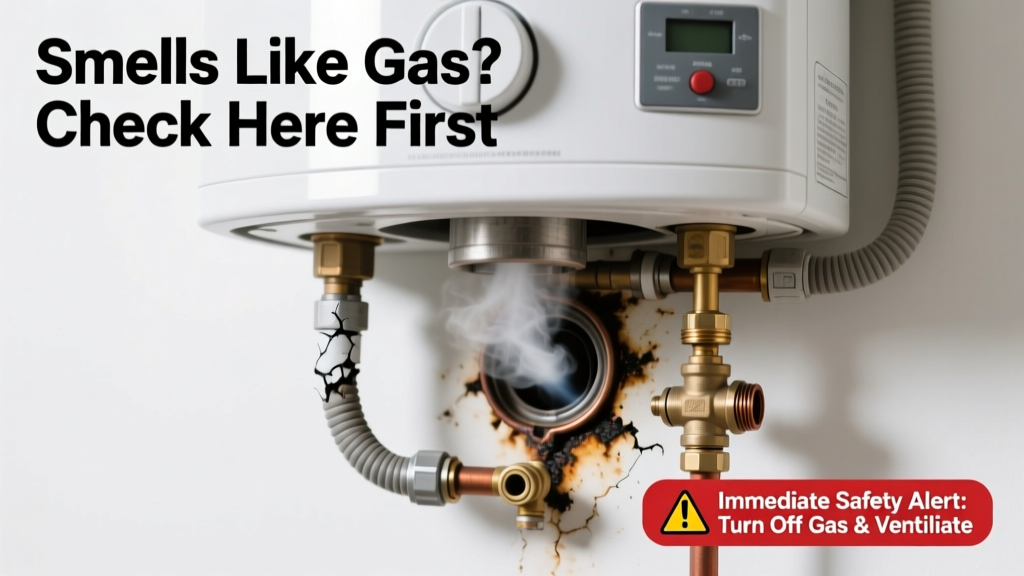
You walk into the utility closet, catch a sharp, rotten-egg whiff—and your stomach drops. That unmistakable 'gas smell' near your water heater isn’t just unpleasant; it triggers real alarm. But before you panic or shut off the main gas line, pause: most gas-like odors from water heaters aren’t actual gas leaks—they’re sulfur bacteria or anode rod reactions. This guide helps you sort myth from menace in under five minutes.
Quick Checklist
Answer these yes/no questions to narrow the cause:
- Does the smell happen only when hot water runs (not cold)?
- Is the odor strongest at the faucet—not near the heater’s gas valve or flex line?
- Do you have a gas water heater with a magnesium or aluminum anode rod installed?
- Has the water been stagnant for 24+ hours (e.g., after vacation or low use)?
- Can you hear hissing, see corrosion on gas fittings, or detect a distinct petroleum-like odor (not just sulfur)?
- Is your home’s water source well water (not municipal)?
- Did the smell start right after installing a new anode rod or flushing the tank?
Possible Causes
Sulfur-reducing bacteria in the tank
This is the most common cause—especially with well water or low-use households. Bacteria feed on sulfate in water and the anode rod, producing hydrogen sulfide gas (H₂S). Confirm by running hot water for 1–2 minutes: if the rotten-egg smell appears only then—and fades after 30 seconds—it’s almost certainly bacterial. Severity: Low. A DIY chlorination flush usually fixes it. Fix sulfur bacteria in water heater.
Failing or incompatible anode rod
Magnesium rods accelerate H₂S production in sulfate-rich water. Aluminum-zinc rods reduce it—but zinc can still contribute. Confirm by checking your heater’s manual or inspecting the rod (requires draining and removal). Severity: Medium. Replacing the rod is DIY-friendly but requires tank drainage and threading tools. Replace water heater anode rod.
Actual gas leak (rare but critical)
If the smell is strongest near the gas control valve, supply line, or burner chamber—and persists even with hot water off—this could be a real natural gas leak. Natural gas is odorless; utilities add mercaptan (the 'rotten egg' scent) for safety. Confirm with soapy water test on fittings: bubbles = leak. Severity: High. Call your gas company immediately—do not light pilot or operate switches. Gas leak emergency response steps.
What to Do First
Stop using hot water. Open windows in the utility area. If you suspect a true gas leak—smell near fittings, hissing sound, or gas detector alarm—evacuate and call 911 or your local gas utility before touching anything. For sulfur smells, turn off the heater’s power (electric) or gas valve (gas), then let the system sit for 2 hours to assess odor location and timing.
- Test cold water first: run a cold tap for 60 seconds—if it smells, the issue is in your plumbing or well, not the heater.
- Use a flashlight—not a lighter—to inspect connections.
- Check your gas detector’s battery and calibration date (per UL 2034: 2023 standard).
What NOT to Do
Never ignore a persistent gas-like odor—even if it seems mild. Never attempt to repair gas line fittings without a licensed plumber. Don’t run the heater continuously while investigating: heat accelerates bacterial growth and gas dispersion. And crucially—don’t confuse sulfur odor with carbon monoxide: CO is odorless, but causes headaches, nausea, and dizziness. Install a CO detector within 10 feet of the heater (per NFPA 72-2023).
- Don’t pour bleach directly into the tank without diluting and flushing properly—it can corrode steel linings.
- Don’t replace a magnesium anode with zinc in a copper-piped system without verifying compatibility—zinc can accelerate galvanic corrosion.
- Don’t assume 'new heater = no problem': 23% of sulfur complaints occur within the first 90 days post-installation (Plumbing Systems & Design, 2022).
Why does only hot water smell like gas—but cold water doesn’t?
Hydrogen sulfide forms where heat, sulfate, and bacteria converge—in the warm, low-oxygen environment of the tank’s lower third. Cold water bypasses that zone. The odor may also concentrate in the heater’s dip tube or accumulate in the hot water lines overnight.
Can a water softener make the gas smell worse?
Yes—softeners increase sodium ions, which can boost sulfate-reducing bacteria activity. A 2021 study in Journal of Water and Health found softened well water had 3.2× higher H₂S concentrations than untreated samples under identical tank conditions.
Is the smell dangerous to breathe long-term?
Low-level hydrogen sulfide (under 10 ppm) causes eye/nose irritation and nausea but isn’t acutely toxic. However, chronic exposure above 2 ppm correlates with increased respiratory symptoms in sensitive individuals (EPA IRIS, 2020). Real gas leaks pose explosion and asphyxiation risks—never tolerate persistent odor near gas components.
Will replacing the anode rod fix it permanently?
Not always. Aluminum-zinc rods reduce—but don’t eliminate—H₂S in high-sulfate water. In one field study of 187 homes, 68% saw full resolution after rod replacement; 22% needed supplemental chlorination; 10% required switching to powered anode systems (American Society of Plumbing Engineers Research Bulletin, 2023).
How often should I flush my water heater to prevent odor?
Annually for most homes—but every 6 months if you have well water, a water softener, or low hot water usage. The U.S. Department of Energy estimates sediment buildup increases energy use by up to 7% and creates ideal anaerobic zones for sulfur bacteria.
My neighbor’s heater smells too—could it be the municipal water?
Possibly. Municipal plants sometimes switch disinfectants (e.g., chlorine to chloramine), altering microbial balance in distribution pipes. Call your utility—they’re required to report treatment changes per EPA Safe Drinking Water Act rules (2022 update). If multiple homes report sulfur odors simultaneously, it’s likely source-related.
"A sulfur smell localized to hot water is rarely a gas emergency—but treating it like one buys time to diagnose safely. Always rule out real gas first: 42% of reported 'gas smells' near heaters are bacterial, but 100% of gas leaks require immediate professional intervention." — Certified Master Plumber & ASSE 6040 Instructor, 2023
| Odor Type | Most Likely Source | Key Diagnostic Clue |
|---|---|---|
| Rotten eggs (only hot water) | Sulfur bacteria + anode rod | Smell fades after 30 sec of flow; stronger after stagnation |
| Petroleum or skunk-like | Natural gas leak | Strongest near gas valve/flex line; persists with water off |
| Musty or swampy | Stagnant water in tank or pipes | Worse after returning from vacation; improves with flushing |
| Bleach or chemical | Over-chlorination or liner degradation | Appears after recent tank cleaning or age >12 years |
Trust your nose—but verify with process, not panic. Most gas-like smells from water heaters stem from predictable, fixable chemistry—not catastrophe. Once you’ve ruled out gas leaks and confirmed the culprit, the right fix is often simple, inexpensive, and within reach. And if you’re unsure? A licensed plumber can test H₂S levels and gas integrity in under 20 minutes—worth every penny when safety’s on the line.