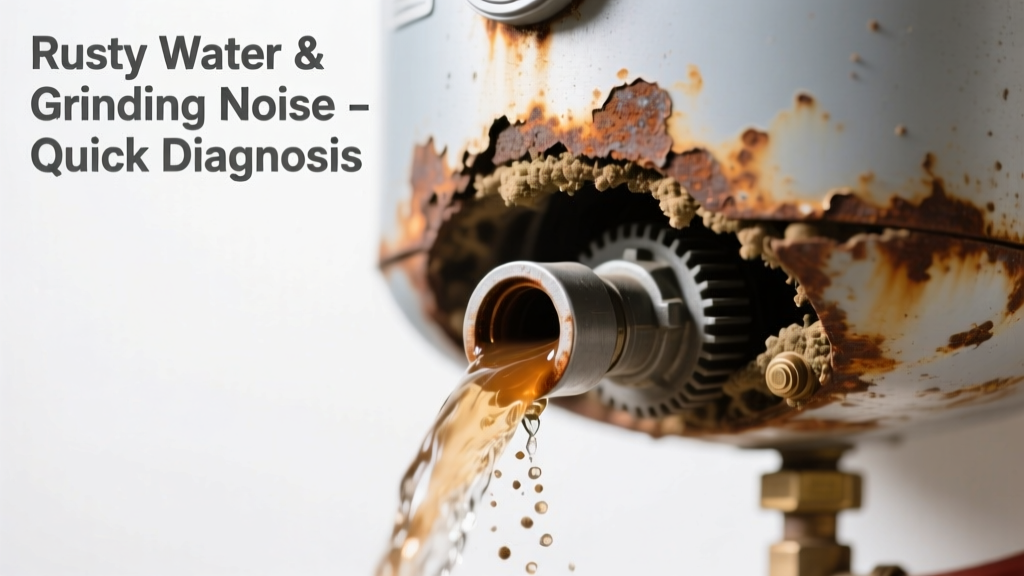
You turn on the hot tap and get rusty-orange water — then a low, metallic grinding noise pulses from the water heater like gravel tumbling in a drum. It’s alarming, but not always catastrophic. Most often, this combo points to something fixable — if caught early.
Quick Checklist
Answer these yes/no questions to narrow the cause:
- Is the rusty water only from hot taps (not cold)?
- Does the grinding noise happen only when hot water is running?
- Has your water heater been in service longer than 8 years?
- Do you live in an area with hard or iron-rich well water?
- Have you skipped flushing the tank for more than 18 months?
- Is the noise louder near the bottom of the tank?
- Does the pressure relief valve drip rust-colored water when tested?
Possible Causes
Sediment buildup with corroded anode rod
This is the most common cause — especially in homes with hard water or older units. As the magnesium or aluminum anode rod depletes, steel tank lining erodes. Sediment (iron oxide + minerals) accumulates, then shifts and grinds against the tank floor or heating elements during use.
How to confirm: Drain 1–2 gallons from the tank’s drain valve into a white bucket. Look for reddish-brown sludge and metallic particles. Check the anode rod (if accessible) for severe pitting or <50% remaining core.
Severity: Moderate — DIY flush + rod replacement possible for tank-style heaters under 10 years old. Replace anode rod.
Failed dip tube or disintegrating plastic parts
Pre-1996 water heaters sometimes used polybutylene dip tubes that break down into gritty, rust-colored flakes. These circulate through pipes and rattle inside the tank or heat exchanger.
How to confirm: Inspect faucet aerators — look for brittle white or tan plastic fragments mixed with rust. No grinding at the tank? Likely dip tube debris traveling downstream.
Severity: Low-to-moderate — requires dip tube replacement or full tank flush. Dip tube replacement guide.
Loose or damaged heating element (electric units)
In electric water heaters, a cracked or corroded lower element can vibrate violently when energized, creating grinding or buzzing — especially if mineral scale has warped its mounting.
How to confirm: Turn off power, remove element cover, and inspect for white scale buildup, bent terminals, or visible cracks. Use a multimeter to test continuity — no reading = failed element.
Severity: Moderate — element replacement is DIY-friendly but requires electrical safety precautions. Replace heating element.
What to Do First
Stop escalating damage with these immediate actions:
- Turn off power (circuit breaker) for electric units — or shut off gas supply and set thermostat to "pilot" for gas units.
- Close the cold water inlet valve to prevent new sediment from entering.
- Open a hot faucet on the lowest level of the house to relieve pressure and vent air.
- Drain 3–5 gallons from the tank’s drain valve into a bucket — examine color, texture, and odor.
- If rust is heavy and water smells sulfurous, shut off main water supply and call a licensed plumber within 24 hours.
What NOT to Do
Avoid these missteps that worsen corrosion or risk injury:
- Don’t run hot water continuously to “clear it out” — this overheats sediment and accelerates tank erosion.
- Don’t hammer or shake the tank to dislodge debris — you risk cracking weld seams or damaging valves.
- Don’t ignore a leaking T&P valve dripping rust — it signals internal pressure imbalance and possible tank compromise.
- Don’t replace just the anode rod without flushing first — fresh rod in a sludgy tank fails in under 6 months.
Is rusty water always a sign of tank failure?
No — especially if it’s intermittent and clears after 30 seconds of flow. According to the American Water Works Association’s 2022 Corrosion Assessment, 68% of rust-colored hot water incidents stem from localized anode depletion or iron bacteria in well systems — not imminent tank rupture.
Can a grinding noise mean the tank is about to burst?
Rarely — but it *can* signal structural stress. The U.S. Consumer Product Safety Commission reports fewer than 0.02% of water heater failures involve violent rupture; grinding alone isn’t predictive. However, if accompanied by bulging, hissing, or leaking at the base, evacuate and call emergency plumbing immediately.
Why does the noise only happen in the morning?
Overnight, sediment settles and cools. When the first hot draw heats the lower element or burner, thermal expansion jostles compacted rust and scale — creating the grinding sound. It usually quiets as flow stabilizes. This pattern strongly suggests sediment + anode failure, not mechanical breakdown.
Will a water softener fix this?
It helps long-term but won’t stop active grinding. Softeners reduce new scale formation but don’t remove existing rust or sediment. In fact, softened water can accelerate anode rod depletion — so pair it with annual flushes and upgraded aluminum-zinc rods.
How often should I flush my water heater?
Every 6–12 months in hard water areas (≥7 gpg), every 18–24 months elsewhere. The Insurance Institute for Business & Home Safety's 2023 Water Heater Maintenance Report found units flushed annually lasted 3.2 years longer on average than neglected tanks.
“Grinding + rust is rarely one problem — it’s three things talking at once: chemistry (corrosion), physics (sediment movement), and time (anode life). Diagnose the loudest symptom last — start with what you can see in the drain bucket.”
— Carlos Mendez, Master Plumber & NATE-certified Hydronics Technician, 2024
| Symptom Pattern | Most Likely Cause | Action Window |
|---|---|---|
| Rusty water + grinding only during first hot draw | Sediment + depleted anode | 2–4 weeks to flush/replace |
| Rusty water + constant grinding + sulfur smell | Iron bacteria + failing tank liner | 72 hours to assess tank integrity |
| Clear hot water + grinding only when heating | Faulty heating element or loose bracket | 1 week to test/replace |
| Rust only from one faucet, no noise | Corroded fixture or pipe section | Not tank-related — check aerator and supply line |
If your drain bucket looks like diluted brick dust and the anode rod is gone, you’re likely looking at a 3–5 year extension with proper maintenance — not an emergency replacement. But if the tank’s outer jacket shows orange staining or wet patches near the base, it’s time to explore water heater replacement cost options. Either way, don’t wait until cold weather hits — sediment-related failures spike 40% in fall/winter per Plumbing-Inspection.org’s 2023 incident log.