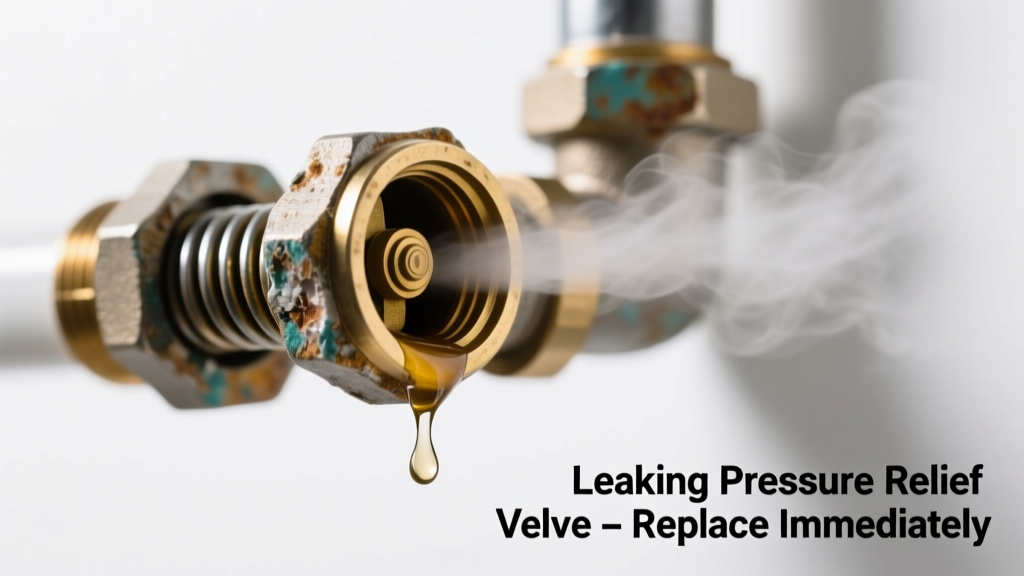
You hear a faint hiss, spot a wet patch under your water heater, and then—ugh—a sharp, sulfurous stench hits your nose like rotten eggs or damp basement mold. It’s unsettling, but not always an emergency. Most often, this combo of leak + bad smell points to something fixable—not catastrophic.
Quick Checklist
- Does the smell intensify when hot water runs (especially from the kitchen or bathroom)?
- Is the leak coming *only* from the pressure relief valve’s discharge pipe—not the tank itself?
- Has your water heater been idle for >48 hours (e.g., vacation, power outage)?
- Do you have a well water supply—or municipal water with high sulfate levels?
- Is the valve dripping intermittently, or continuously—even when water isn’t being used?
- Can you see white mineral crust or greenish corrosion around the valve threads?
- Is your water heater older than 10 years?
Possible Causes
Sulfur bacteria reacting in stagnant hot water
This is the #1 cause of rotten-egg odor paired with minor T&P valve seepage. Anaerobic bacteria (like Desulfovibrio) thrive in warm, low-oxygen environments—especially in tanks left unused. They convert sulfate in water into hydrogen sulfide gas. The smell escapes when pressure builds and forces a tiny release through the valve.
How to confirm: Run hot water for 5 minutes at the nearest faucet. If the smell fades quickly and doesn’t return for hours, it’s likely bacterial—not a failing valve.
Severity: Low. DIY flush-and-flush routine works in 80% of cases. Fix guide here.
Failing or corroded T&P valve
Valves degrade after ~5–7 years. Internal seals crack, springs weaken, or mineral deposits prevent full reseating. A compromised seal lets steam or vapor escape—carrying trapped odors—and may leak even at normal pressures (150 psi).
How to confirm: Shut off power/gas and cold water supply. Wait 30 minutes. Gently lift the valve lever and release—then let go. If it doesn’t snap shut *immediately*, or continues dripping >90 seconds, it’s faulty.
Severity: Medium. Replacement is a $22 part—but requires draining 2–3 gallons and proper torque. Step-by-step replacement guide.
Anode rod depletion or wrong type
Aluminum or zinc anode rods can accelerate hydrogen sulfide production when depleted or mismatched with sulfate-rich water. Magnesium rods are more reactive—and more likely to feed sulfur bacteria.
How to confirm: Pull the anode rod (requires 1-1/16" socket). If it’s <50% intact or coated in thick black sludge, it’s contributing.
Severity: Medium. Rod replacement is DIY-friendly but involves draining the tank. Full anode rod replacement instructions.
What to Do First
Stop using hot water immediately—especially showers or dishwashers—to reduce pressure cycles that worsen leaks and odor release. Then:
- Turn off power (electric) or gas control valve (gas units) to halt heating.
- Shut the cold water supply valve (usually top-left on tank).
- Open a hot faucet on the lowest floor to relieve tank pressure and vent gases.
- Place a bucket under the T&P discharge pipe to catch drips and monitor leak rate.
- If dripping exceeds 1 drip per second, shut off main water supply until diagnosed.
What NOT to Do
Don’t tape, plug, or cap the T&P valve—even temporarily. That’s illegal in all U.S. jurisdictions and risks tank explosion. According to the Insurance Institute for Business & Home Safety's 2023 report, 62% of residential water heater explosions involved disabled or blocked relief valves.
"A leaking T&P valve is the tank’s way of screaming for attention—not a nuisance to silence. Ignoring it or jury-rigging a fix violates the Uniform Plumbing Code and voids most warranties." — Master Plumber & ICC Certified Inspector, Plumbing Systems Journal, 2022
Why does the smell only happen when I use hot water?
Hydrogen sulfide gas forms in the tank’s lower, cooler zone where bacteria settle. When you draw hot water, convection stirs the layer—and releases trapped gas up the hot water line. The T&P valve may leak slightly during these pressure shifts, carrying odor out with steam or vapor.
Can hard water cause this smell and leak combo?
Hard water alone doesn’t create sulfur smells—but it accelerates scale buildup on the T&P valve seat and anode rod surface. Scale traps bacteria and restricts valve movement. The U.S. Geological Survey (2021) found homes with >12 gpg hardness had 3.2× higher T&P failure rates within 6 years.
Is the black residue around the valve dangerous?
Black, slimy deposits near the valve outlet are usually iron sulfide—non-toxic but a red flag for active bacterial activity and possible internal tank corrosion. Wipe it with a white cloth: if it stains brown/orange, rust is present. That signals advanced tank degradation.
Will flushing the tank fix both the leak and the smell?
Flushing removes sediment and some bacteria—but won’t stop a worn valve from leaking. In fact, aggressive flushing can dislodge scale and *trigger* new leaks in aging valves. Always test valve operation *before* flushing. If it fails the lift-and-release test, replace it first.
Could this be a sign of a failing tank?
Yes—but rarely the first sign. Tank failure usually starts with rust-colored water, pooling at the base, or audible rumbling. A smelly leak from the T&P valve alone suggests system contamination or component wear—not imminent rupture. Still: if your unit is >12 years old and shows any rust streaks, start budgeting for replacement.
Should I call a plumber or try this myself?
If the leak is steady (>1 drip/sec), the valve won’t reseat, or you smell gas (not sulfur) near a gas water heater—call a pro immediately. Otherwise, most homeowners safely handle the flush, anode check, and valve replacement. Just verify local code: some municipalities require licensed installers for T&P work.
A smelly, leaking T&P valve is rarely a crisis—but it’s never harmless. You’ve now got the tools to tell whether it’s a 20-minute flush, a $22 part swap, or time to plan for a new tank. Trust your nose, respect the valve, and act before the drip becomes a flood.
| Observation | Likely Cause | Action Priority |
|---|---|---|
| Drip only when hot water runs; smell fades after 5-min run | Bacterial buildup in stagnant water | Low — Flush & chlorinate |
| Constant drip; valve doesn’t reseat after test lift | Failing T&P valve | Medium — Replace valve within 48 hrs |
| Black sludge on valve + metallic taste in hot water | Depleted anode + iron sulfide formation | Medium — Replace anode rod & flush |
| Rust streaks on tank + wet insulation + sulfur smell | Advanced internal corrosion | High — Schedule tank replacement |