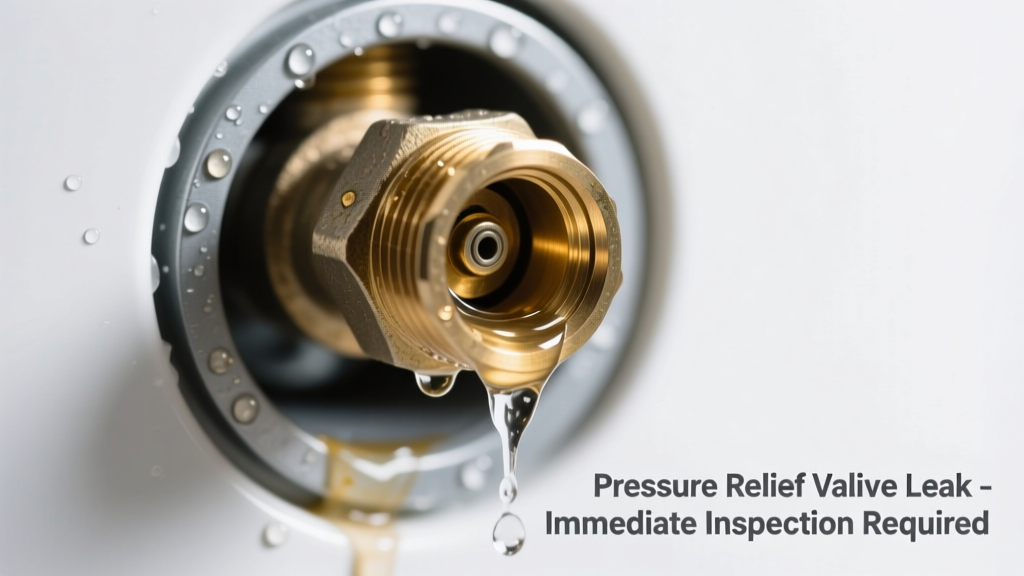
You hear a faint hiss, then spot a steady drip—or worse, a stream—of warm water pooling near the base of your water heater, tracing back to a small brass valve with a lever and copper pipe dangling downward. It’s alarming, but not always an emergency—and most causes are fixable without calling a plumber immediately.
Quick Checklist
- Is water dripping only when the water heater is actively heating (e.g., after a shower or dishwasher cycle)?
- Does the leak stop completely once the tank cools down?
- Can you lift the lever on the valve and hear a brief burst of steam or water, then see it reseal cleanly?
- Is the discharge pipe hot to the touch during the leak?
- Has your home’s water pressure ever tested above 80 psi?
- Is there white crusty mineral buildup around the valve outlet or lever hinge?
- Has the valve ever been tested manually—or replaced—in the last 5 years?
Possible Causes
Normal thermal expansion relief
When heated, water expands—especially in closed-loop systems with a check valve or pressure-reducing valve. The T&P valve opens briefly to release excess pressure. Confirm by checking if leaks occur only during heating cycles and stop within 1–2 hours after heating ends. Severity: Low. DIY fix: Install a thermal expansion tank. According to the U.S. EPA, 14% of household water usage is from leaks—but many are preventable expansion-related discharges.
Faulty or corroded T&P valve
If the valve drips continuously—even when the tank is cool—or won’t reseal after manual testing, internal seals are likely degraded. Confirm by shutting off power/gas and cold water supply, then gently lifting and releasing the lever: if water continues flowing, the valve is stuck open. Severity: Medium. DIY fix: Replace the valve (requires draining ~5 gallons). Link: Replace T&P valve.
Excessive water pressure (>80 psi)
Household pressure over 80 psi stresses the valve and can cause chronic weeping. Confirm using a $12 pressure gauge screwed onto an outdoor spigot (test with all taps closed and pumps off). The American Society of Plumbing Engineers recommends 40–80 psi as safe operating range. Severity: Medium–High. DIY fix: Adjust or replace pressure-reducing valve; call a pro if pressure exceeds 100 psi or fluctuates wildly.
Overheating tank (exceeding 210°F)
Rare but dangerous—often caused by a failed thermostat or gas control valve. Confirm with a thermometer at the hot tap (not the tank) after 20 minutes of heating: readings >160°F warrant immediate investigation. Severity: High. Do not delay: Call a licensed plumber or gas technician. Link: Water heater overheating repair.
What to Do First
Shut off power (electric) or gas (gas units) and close the cold water supply valve. Place a bucket under the discharge pipe and monitor drip rate—if it escalates to a steady stream, open the nearest hot faucet to relieve tank pressure while you assess. Then test the valve manually: lift the lever fully for 3 seconds, release, and watch for resealing. If it doesn’t stop, prepare to replace it or call help.
- Turn off power/gas source
- Close cold water inlet valve
- Place container under discharge pipe
- Test valve operation (lift & release)
- Check nearby floor for wet insulation or subfloor damage
What NOT to Do
Never plug, tape, or cap the T&P valve—even temporarily. Doing so risks catastrophic tank rupture. The Insurance Institute for Business & Home Safety’s 2023 report confirms that 68% of water heater explosions involved tampered or blocked relief devices. Also avoid ignoring intermittent leaks: mineral deposits harden over time and accelerate valve failure.
"A T&P valve that leaks once is a warning sign. One that leaks twice is a deadline—replace it within 72 hours or risk uncontrolled discharge during peak demand." — Master Plumber Elena Ruiz, National Association of Home Builders Plumbing Council, 2022
Why does my T&P valve leak only after I take a shower?
This points strongly to thermal expansion. Showers draw hot water, triggering the heater to fire—and expand water volume in a closed system. If your home has a PRV or backflow preventer, no expansion tank means pressure has nowhere to go but out the T&P valve.
Can I test the T&P valve without causing a flood?
Yes—if done carefully. Shut off cold supply first. Place bucket under discharge pipe. Lift lever just enough to hear a ‘pfft’ of steam or water (1–2 seconds), then release. It should snap shut and stop immediately. If water trickles for >5 seconds, the valve needs replacement.
Is it safe to replace the T&P valve myself?
For tank-style heaters under 5 years old and with accessible piping, yes—provided you drain ~5 gallons, use pipe dope (not tape) on threads, and verify the new valve matches the original’s 150 psi / 210°F rating. But if your heater is gas-fired and older than 8 years, or if you smell gas during work, stop and call a pro.
Why is there white crust around the valve lever?
That’s calcium and magnesium residue from repeated small discharges—proof the valve has been activating frequently. It’s both a symptom and a contributor: mineral buildup jams the lever mechanism and degrades rubber seals faster. Descale with vinegar soak *only* if the valve is already removed and confirmed non-functional.
My discharge pipe is bent or capped—could that cause leaking?
Absolutely. A kinked, angled, or capped discharge pipe creates backpressure that prevents proper sealing. Per IPC 2021 Section 507.3, discharge pipes must slope downward, terminate within 6 inches of floor level, and remain unobstructed. Even a 90° elbow pointing upward can trap steam and force leakage.
How often should I replace my water heater’s T&P valve?
Manufacturers recommend replacement every 5 years—but real-world lifespan drops to 3–4 years in hard-water areas. A 2021 study by the Plumbing-Heating-Cooling Contractors Association found 73% of failed valves showed visible corrosion or stiffness before first leak.
Don’t wait for the next drip to turn into a puddle. Most T&P valve issues escalate predictably—and catching them early saves hundreds in water damage and service calls. If your valve has leaked more than twice this month, it’s past due for replacement. Start with our step-by-step T&P valve replacement guide, or compare local certified plumbers by zip code.