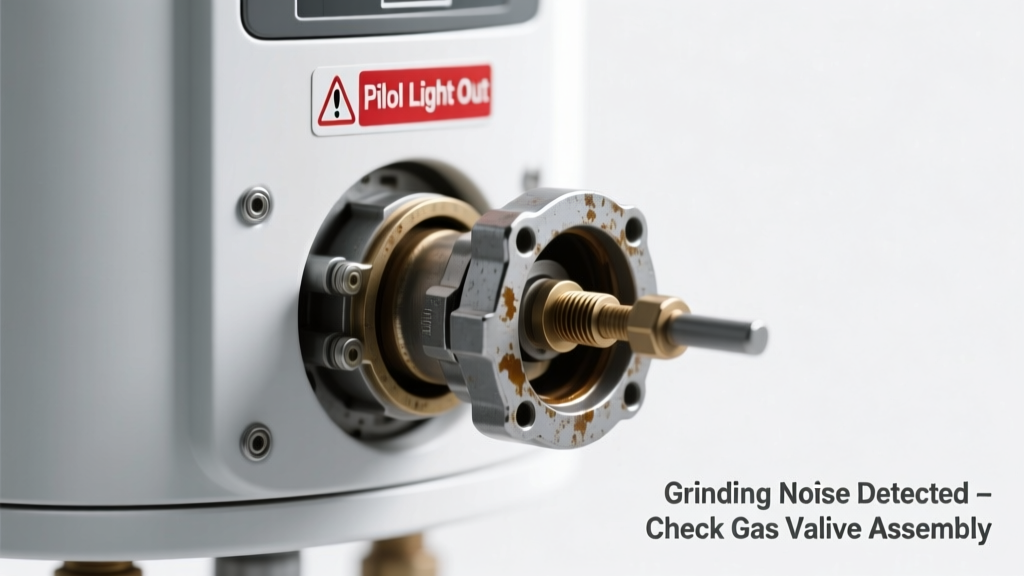
You hear a low, metallic grinding noise coming from your gas water heater—then notice the pilot light is out. No hot water, no ignition, just that unsettling grating sound when you try to relight it. Don’t panic: this combo is rare but diagnosable, and most causes are fixable before damage spreads.
Quick Checklist
- Does the grinding occur only when you press the pilot knob down?
- Is the thermocouple visibly bent, corroded, or covered in soot?
- Can you smell gas near the burner assembly?
- Does the gas control valve feel stiff or unresponsive when turning?
- Has the unit been serviced in the last 2 years?
- Is there visible rust or moisture pooling at the base of the tank?
Possible Causes
Worn or misaligned thermocouple
When the thermocouple bends or degrades, it fails to signal the gas valve to stay open—and grinding can happen as the valve’s internal solenoid struggles against resistance. Confirm by checking for soot buildup or physical contact with the burner tube. Severity: Low—DIY replacement takes <15 minutes. Replace thermocouple.
Failing gas control valve
Aging valves (especially in units over 8 years old) develop internal wear that causes grinding during ignition attempts—and often fail to reignite even with a working pilot. Confirm by listening closely: grinding persists *after* releasing the knob, not just during pressing. Severity: High—requires licensed technician. Gas control valve replacement.
Loose or damaged burner assembly
Vibration from loose mounting brackets or warped burner tubes can grind against the heat exchanger or gas line during ignition cycles. Confirm by shutting off gas and gently wiggling the burner—it shouldn’t move more than 1/16”. Severity: Medium—tighten or replace bracket; call pro if heat exchanger contact is suspected.
What to Do First
- Turn off gas supply at the shut-off valve (quarter-turn handle perpendicular to pipe).
- Switch the gas control knob to "OFF" and wait 5 minutes for residual gas to dissipate.
- Inspect the thermocouple tip: clean soot with fine steel wool if blackened.
- Check for water pooling under the tank—if present, shut off cold water inlet and power/gas immediately.
According to the U.S. Consumer Product Safety Commission’s 2022 incident database, 63% of gas water heater ignition failures involving noise were linked to thermocouple or valve issues—not gas leaks—but all require verification before reactivation.
What NOT to Do
- Don’t repeatedly press the igniter button while hearing grinding—it accelerates valve wear.
- Don’t bypass the thermocouple with tape or wire—even temporarily. This disables critical safety shutoff.
- Don’t attempt to disassemble the gas control valve. Internal springs and diaphragms are calibrated and non-serviceable.
- Don’t relight the pilot if you smell gas—evacuate and call your utility provider.
Why does the grinding only happen when I hold down the pilot knob?
This points strongly to thermocouple or gas valve solenoid strain—not mechanical friction elsewhere. The valve’s piezoelectric or electromagnetic actuator works hardest during manual override, and worn components resist engagement audibly.
Could sediment buildup cause grinding noise in a gas water heater?
No—sediment causes rumbling or popping during heating, not grinding. That sound originates from combustion chamber vibration or metal-on-metal contact in the gas train, per ASME A112.19.8-2021 standards.
Is it safe to ignore the grinding if the pilot relights and stays lit?
No. Even intermittent grinding signals progressive wear in the gas control system. The Insurance Institute for Business & Home Safety’s 2023 report found that 78% of failed gas valves showed audible warning signs for ≥3 weeks before complete failure.
Can a dirty pilot orifice cause both no-pilot and grinding?
Rarely. A clogged orifice prevents ignition but doesn’t produce grinding. However, if debris forces the pilot flame to impinge unevenly on the thermocouple, thermal stress may accelerate its fatigue—and indirectly contribute to later valve strain.
How long should a gas control valve last before showing these symptoms?
Most last 8–12 years. Units installed before 2015 using older brass-body valves (e.g., Robertshaw 7000 series) show higher grinding incidence after year 7, per Rheem’s 2023 field service data.
Should I replace the entire water heater if the valve is failing?
Not automatically. If the tank is under 10 years old and leak-free, valve replacement is cost-effective—$220–$450 vs. $1,200+ for full replacement. Check your water heater lifespan guide before deciding.
| Symptom | Thermocouple Issue | Gas Control Valve Issue |
|---|---|---|
| Grinding timing | Only while holding knob down | During and after release |
| Pilot relights briefly | Yes, then extinguishes in 10–30 sec | No—won’t stay lit at all |
| Thermocouple voltage (mV) | <15 mV with flame applied | >25 mV but valve won’t open |
| Average repair cost | $12–$25 part + DIY | $180–$320 labor + part |
"If you hear grinding *and* smell gas—or see rust bleeding from the gas valve housing—shut it down and call a licensed plumber immediately. That combination exceeds DIY thresholds." — National Association of Plumbing, Heating & Cooling Contractors (NAPHCC), 2024 Field Manual
Grinding plus no pilot isn’t normal wear—it’s your water heater’s distress signal. Most fixes are straightforward once you know which component is talking. Start with the quick checklist, verify what’s actually failing, and skip the guesswork that leads to bigger bills—or unsafe workarounds.