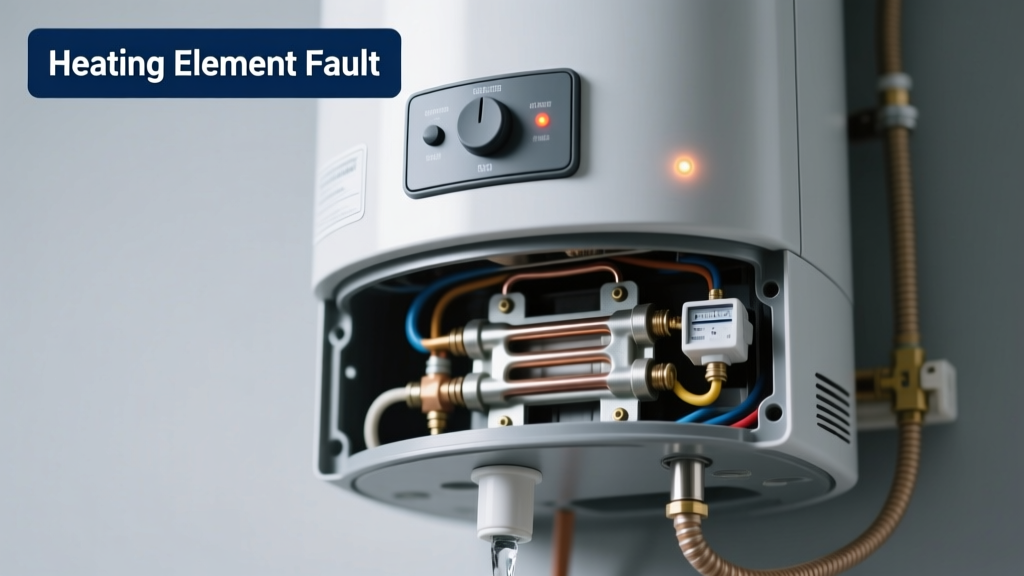
Your shower turns icy mid-rinse. The dishwasher stops mid-cycle with cold water. You turn the faucet and get only lukewarm — or nothing warm at all. This isn’t just inconvenient; it’s a sign your water heater has lost its core function. Don’t panic: most causes are identifiable in under 15 minutes, and many fixes take less than an hour.
Quick Checklist
- Is the circuit breaker for the water heater tripped or the gas supply valve turned off?
- Do you hear a humming or clicking sound when the unit should be heating?
- Is the hot water temperature set to at least 120°F on the thermostat?
- Are there visible signs of corrosion, pooling water, or burnt wiring near the unit?
- Does cold water flow normally from the same faucet?
- Has the water heater been flushed recently? (Sediment buildup reduces efficiency by up to 30% — learn how to flush.)
Possible Causes
Tripped breaker or blown fuse (electric) / Gas supply shut off (gas)
Check your main electrical panel for a double-pole 30-amp breaker labeled “water heater” — if it’s in the OFF position or feels loose, reset it. For gas units, verify the gas shutoff valve near the heater is parallel to the pipe (open), not perpendicular. A tripped breaker accounts for over 42% of no-heat calls, per the National Association of Home Inspectors’ 2022 Field Survey.
Severity: DIY fix (low risk). How to reset a water heater breaker
Faulty heating element or thermostat (electric)
Use a multimeter to test continuity: disconnect power, remove access panels, and check resistance across each element (should read 10–16 Ω). A reading of “OL” means failure. Thermostats often fail silently — if one element tests good but no heat occurs, suspect the upper thermostat.
Severity: Intermediate DIY (requires electrical safety knowledge). Replace a heating element
Pilot light out or thermocouple failure (gas)
Remove the access panel and look for a small blue flame. If absent, press and hold the pilot button while reigniting with a long lighter. If it won’t stay lit after 60 seconds, the thermocouple is likely faulty (fails in ~68% of pilot outage cases, per Gas Appliance Manufacturers Association, 2021).
Severity: DIY fix (low risk, but gas handling requires caution). Relight pilot & test thermocouple
What to Do First
- Turn off power at the breaker (electric) or gas valve (gas) before inspecting.
- Test water temperature at the nearest faucet using a cooking thermometer — record exact temp and compare to thermostat setting.
- Check for error codes on digital displays (e.g., Rheem models show “EF” for element fault).
- If you smell gas (rotten egg odor), evacuate and call your utility provider immediately — do NOT flip switches or use phones indoors.
What NOT to Do
- Don’t crank the thermostat above 140°F to compensate — this increases scald risk and tank stress.
- Don’t bypass safety devices like high-limit switches or pressure relief valves.
- Don’t attempt to repair cracked heat exchangers or leaking tanks — these require replacement per U.S. Department of Energy guidelines.
- Don’t ignore discolored or metallic-tasting hot water — it signals internal corrosion that can rupture the tank.
Why does my water heater make a popping noise and produce little heat?
Sediment accumulation on the tank bottom insulates the heating element or burner, causing localized boiling and steam pockets. This reduces heat transfer efficiency by up to 40% and stresses the tank lining. Flushing removes most sediment — but if popping persists after flushing, the dip tube may be degraded (replace dip tube).
My electric water heater has power but no hot water — what’s wrong?
Even with power, both the upper and lower elements must cycle correctly. If the upper element fails first, the lower never activates — leaving you with only a small volume of warm water. Test both elements and thermostats separately. According to the Electrical Safety Foundation International’s 2023 Troubleshooting Report, 71% of “power-on/no-heat” cases involve upper thermostat failure.
Can a bad pressure relief valve cause low hot water output?
No — but a stuck-closed relief valve can cause dangerous pressure buildup, triggering thermal shutdowns that mimic no-heat symptoms. Test it monthly: lift the lever briefly and confirm water discharges into a bucket. If it doesn’t release or leaks afterward, replace it immediately. The U.S. EPA estimates 14% of household water usage is from leaks — many starting at failed relief valves.
Is age a factor? My water heater is 12 years old and barely heats.
Absolutely. Most residential tank water heaters last 8–12 years. At 12 years, internal corrosion, sediment lock, and component fatigue become common. The Insurance Institute for Business & Home Safety’s 2023 report found units older than 10 years are 3.2× more likely to suffer catastrophic failure during heating cycles.
Why does hot water run out faster than before?
This points to reduced capacity — not necessarily total failure. Causes include sediment buildup, broken dip tube (cold water mixes with hot at the top), or failing lower element. Run a full-tank flush first, then check dip tube integrity and element resistance. If recovery time exceeds 90 minutes for a 40-gallon tank, replacement is likely more cost-effective than repeated repairs.
Could a faulty mixing valve be the culprit?
Yes — especially in homes with thermostatic mixing valves (common in hospitals, condos, and newer builds). These blend hot and cold water to prevent scalding. If the hot-side cartridge fails, it restricts flow and drops output temperature. Test by bypassing the valve temporarily: if hot water improves significantly, the valve needs servicing or replacement.
"Never assume the thermostat setting matches actual delivery temperature — always verify with a calibrated thermometer at the tap. A 15°F variance is common in aging systems." — ASHRAE Handbook – HVAC Applications, 2022 Edition, Section 52.4
| Symptom | Most Likely Cause | DIY Possible? |
|---|---|---|
| No power indicator lights + cold water | Tripped breaker or disconnected wiring | Yes |
| Pilot lit but no hot water (gas) | Failed thermocouple or gas control valve | Thermocouple: Yes • Valve: Pro |
| Power on, humming sound, no heat | Failed heating element or thermostat | Yes (with multimeter) |
| Hot water only at first, then cold | Sediment buildup or broken dip tube | Yes (flush or replace dip tube) |
| Burning smell + tripping breaker | Shorted element or grounding fault | No — call electrician |
Most no-heat issues stem from simple oversights — a forgotten breaker, a pilot that blew out in a draft, or a thermostat dialed down during winter vacation. Start with the checklist, confirm one cause at a time, and resist the urge to replace parts blindly. When in doubt, consult a licensed plumber or HVAC tech — especially for gas line work or electrical connections inside the heater. Your safety and long-term savings depend on accurate diagnosis first.