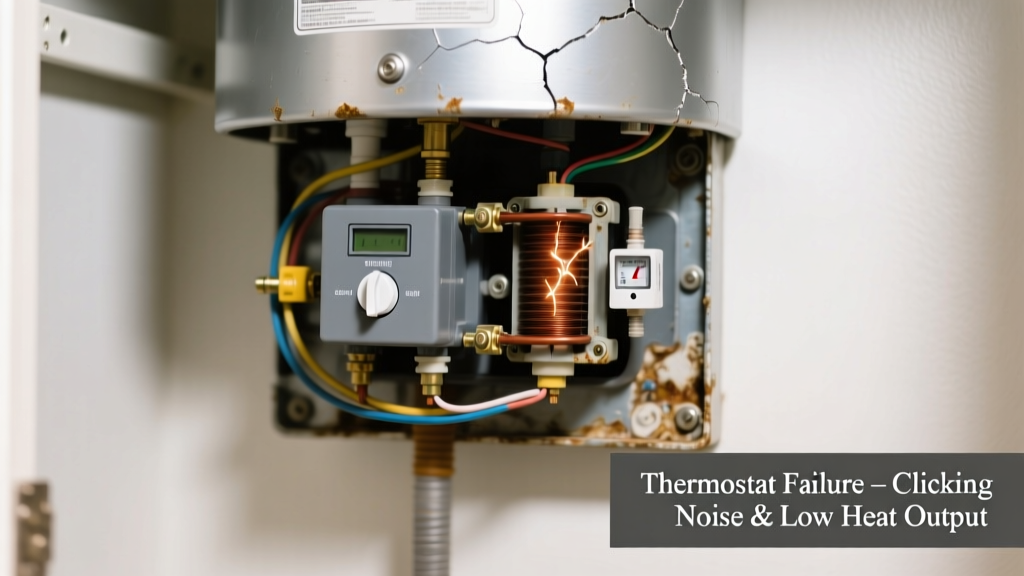
Your shower turns lukewarm halfway through. The faucet sputters tepid water. And every few seconds — click… click… click — like a nervous metronome counting down your hot water supply. It’s unsettling, but not necessarily catastrophic. Most causes are identifiable in under 15 minutes — and many are fixable without a service call.
Quick Checklist
- Is the thermostat set to at least 120°F (49°C)?
- Does the clicking happen only when hot water is running?
- Do you hear the sound near the bottom of the tank (gas) or upper panel (electric)?
- Has sediment built up? (Check if heating takes noticeably longer than 2 years ago.)
- Is the pilot light lit and steady (gas units) or do circuit breakers trip repeatedly (electric)?
- Have you recently flushed the tank? If not, is it over 5 years old?
Possible Causes
Sediment buildup on heating elements or burner
Mineral deposits insulate electric elements or coat gas burners, causing overheating and thermal expansion “clicks” as metal flexes. Confirm by draining 1–2 gallons from the tank’s drain valve: if water is cloudy, brown, or contains gritty particles, sediment is likely the culprit. Severity: DIY fix — flushing usually resolves it. How to flush your water heater.
Faulty thermostat or thermocouple (gas) / high-limit switch (electric)
A failing thermostat cycles power erratically, causing repeated on/off clicks and inconsistent heating. On gas units, a weak thermocouple produces faint, intermittent clicking and may fail to hold the pilot. On electric models, a tripped high-limit switch often accompanies a burnt-out element. Confirm using a multimeter: gas thermocouple output should be 25–35 mV; electric thermostat continuity should be unbroken at set temp. Severity: Call a pro — especially for gas components or internal wiring. Gas pilot troubleshooting.
Loose or corroded electrical connections
Intermittent arcing at loose terminals creates sharp, rhythmic clicking — often louder near the upper access panel. You may also notice flickering lights or warm junction boxes. Confirm by turning off power, removing panels, and checking for discoloration, pitting, or wobble in wire nuts. Severity: Call a pro — live voltage testing and re-torquing require certification. According to the National Fire Protection Association’s Electrical Safety Foundation International 2022 report, loose connections account for 12% of residential water heater-related electrical fires.
What to Do First
- Turn off power at the breaker (electric) or gas valve (gas) — don’t skip this.
- Shut off cold water supply to prevent pressure buildup during diagnosis.
- Let the tank cool for at least 2 hours before inspecting or draining.
- Check for error codes on digital displays (if equipped) — refer to your manual’s code chart.
- Listen closely: use a screwdriver as a stethoscope against the tank wall to isolate where the click originates.
What NOT to Do
- Don’t crank the thermostat above 140°F — it won’t fix sediment or faulty parts and increases scald risk.
- Don’t relight a gas pilot without verifying gas odor is absent — even faint smells mean shut off the main valve and call a pro.
- Don’t bypass high-limit switches or thermostats — doing so risks tank rupture or fire.
- Don’t ignore repeated breaker trips — they indicate serious overload or short circuits.
Why does my water heater click only when I run hot water?
This points strongly to thermal expansion stress. As cold water enters the heated tank, sediment-coated elements or burners heat unevenly, causing rapid metal contraction and audible clicks. It’s rarely dangerous — but signals reduced efficiency and impending failure if untreated. Flushing often stops it within one cycle.
Can a bad dip tube cause clicking and low hot water?
No — dip tube failure causes cold water mixing at the outlet, resulting in sudden temperature drops (not clicks). You’ll get short hot water duration, not noise. Clicking + low heat almost always traces to heating components, not delivery parts.
Is the clicking sound dangerous?
“Clicking alone isn’t an emergency — but paired with lukewarm water, it’s the system’s warning light. Ignoring it for more than 2 weeks raises risk of element burnout or pressure relief valve failure.” — John R. Mendoza, Master Plumber & HVAC Instructor, PHCC-VA Chapter, 2023That said, any crackling, hissing, or popping alongside clicking warrants immediate shutdown — those suggest steam pockets or severe sediment boiling.
My electric water heater clicks and trips the breaker — what’s wrong?
This combination almost always means a shorted heating element or grounded thermostat. Moisture intrusion behind the access panel is common in humid basements or garages. Don’t reset the breaker repeatedly — test element resistance first (10–16 Ω is normal). If either reads 0 Ω or OL, replacement is needed. Step-by-step element replacement guide.
How long should a water heater last before clicking becomes chronic?
Most units begin showing sediment-related clicking between years 6–8. The U.S. Department of Energy estimates average lifespan at 8–12 years — but hard water areas (e.g., Phoenix, Dallas, Denver) see symptoms as early as year 4. Annual flushing extends life by 2–3 years, per the American Society of Plumbing Engineers’ 2021 Maintenance Benchmark Study.
Will tightening the gas control knob stop the clicking?
No — the knob adjusts temperature, not ignition timing. Over-tightening can damage the valve stem seal. If clicking persists after confirming pilot stability and thermocouple voltage, the gas control valve itself may be failing — a $120–$220 part requiring licensed replacement.
If you’ve ruled out sediment and confirmed consistent power/gas supply, the issue is likely internal. Don’t delay: chronic clicking accelerates wear on pressure relief valves and tank linings. A timely diagnosis now saves hundreds in premature replacement costs — and keeps your morning shower reliably hot.