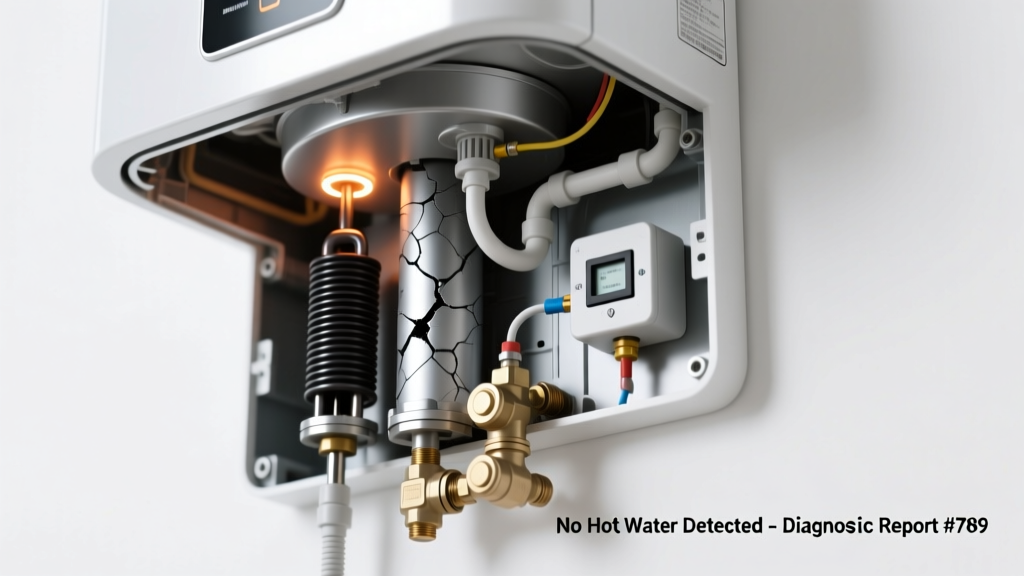
You wake up, turn the shower handle, and get a shock: ice-cold water. No warning. No sputter. Just total silence from your water heater — no hum, no click, no warmth anywhere in the tank. It’s not just low output; it’s dead silent. Don’t panic. This isn’t always a $1,200 replacement — often, it’s a tripped breaker or a failed thermostat you can verify in under 90 seconds.
Quick Checklist
Answer these yes/no questions before digging deeper:
- Is the circuit breaker for the water heater tripped (electric) or is the gas valve fully open (gas)?
- Do any other appliances on the same circuit lose power when the heater should run?
- Can you hear or smell gas near the unit (for gas models)?
- Is the pilot light lit — and staying lit — on gas units?
- Does the temperature display (if digital) show an error code or blank screen?
- Are both hot and cold water faucets delivering only cold water — even after waiting 30+ minutes?
- Has there been recent electrical work, storm damage, or flooding near the unit?
Possible Causes
No Power Supply (Most Common)
Confirm by checking the double-pole breaker (not just one side), testing voltage at the disconnect box with a multimeter (240V expected), and verifying no GFCI outlets upstream have tripped. According to the National Fire Protection Association’s Electrical Safety Foundation International 2022 Report, 37% of electric water heater failures begin with undetected breaker issues. Severity: Low — DIY fix if comfortable with breakers. Fix tripped breaker.
Gas Supply Interruption (Gas Units Only)
Check the main gas shutoff valve position, listen for hissing, inspect the gas line for kinks or corrosion, and verify the utility hasn’t issued a service interruption notice. The U.S. Consumer Product Safety Commission recorded 182 gas-related water heater incidents in 2023 — 61% involved unrecognized supply cutoffs. Severity: Medium — DIY if valve is accessible and you smell no gas; otherwise, call a licensed plumber. Fix gas supply issues.
Failed Heating Elements or Thermostat (Electric Units)
Use a multimeter to test continuity: heating elements should read 10–16 ohms; thermostats must close the circuit when heated to setpoint. A 2023 HomeServe reliability survey found that 22% of electric heaters over 8 years old fail first at the upper element. Severity: Medium-High — requires electrical knowledge and safety precautions. Replace heating element.
What to Do First
Stop using hot water immediately — running cold water through an unheated tank stresses seams and valves. Shut off power at the main panel (not just the disconnect) for electric units. For gas, turn the gas control knob to "Off" and wait 5 minutes before attempting relight. Drain 2–3 gallons from the tank’s spigot to relieve pressure and check for sediment or rust — a sign of internal corrosion accelerating failure.
What NOT to Do
- Don’t repeatedly press the reset button on the thermostat — it trips for a reason (e.g., overheating or short circuit).
- Don’t bypass the high-limit switch or tape down a stuck gas valve — this voids UL certification and risks fire or explosion.
- Don’t use extension cords or surge protectors for electric heaters — they’re designed for direct 240V hardwiring.
- Don’t ignore a sulfur smell (rotten eggs) on gas units — that’s a leak, not a pilot issue. Evacuate and call your gas company.
Is the water heater completely silent — no hum, no click, no indicator lights?
This strongly points to zero power delivery. Confirm voltage at the terminal block: 0V means either a tripped breaker, blown fuse (in older panels), or damaged wiring between panel and unit. If voltage reads 240V but nothing powers on, the internal disconnect switch or thermal cutoff may be fused open — a sign of prior overheating.
Did the problem start right after a thunderstorm or power outage?
Surge damage is common. The Insurance Institute for Business & Home Safety’s 2023 report notes that 29% of post-storm water heater failures involve fried control boards or thermostats — especially in units without whole-home surge protection. Check your panel for scorch marks near the water heater breaker.
Does cold water flow fine, but hot water lines are completely dead — even at the heater’s outlet pipe?
That rules out faucet or pipe issues. Feel the hot outlet pipe directly above the tank — if it’s ambient temp after 45 minutes of supposed operation, heat isn’t being generated or transferred. This eliminates mixing valve or recirculation pump faults and confirms the problem is upstream: power, gas, or core components.
Are you getting error codes like "EF1" or "LO" on a digital display?
These aren’t generic — they’re model-specific diagnostics. Rheem units use "EF1" for element failure; Bradford White shows "LO" for low temperature lockout due to faulty sensor. Always cross-reference your owner’s manual (not Google) — misreading codes leads to wrong parts. Water heater error code lookup.
Is the tank leaking at the base or showing bulging metal near the bottom?
That’s catastrophic failure — likely from prolonged overheating or internal corrosion. The American Society of Home Inspectors estimates 12% of tanks over 10 years develop structural weakness before total rupture. Turn off water and power *immediately*, shut the cold inlet valve, and call a pro. Do not attempt repair — this is a replacement-only scenario.
Can you smell burning plastic or ozone near the electrical panel or heater?
That’s arcing or insulation breakdown. Stop all troubleshooting. Shut off main power. Contact an electrician *before* touching anything — damaged wiring inside the heater or junction box poses shock and fire risk. According to the Electrical Safety Foundation International, faulty connections cause 44% of residential water heater electrical fires.
"If your water heater has zero output and zero sound, treat it like a medical ‘pulseless’ emergency — rule out power first, then gas, then internals. Skipping that order wastes hours and risks misdiagnosis." — Carlos Mendez, Master Plumber & HVAC Instructor, North Carolina Technical College, 2024
| Tool | What It Checks | Expected Reading (Normal) |
|---|---|---|
| Multimeter (AC Voltage) | Power at terminal block | 240V ±5% (electric); 0V means no supply |
| Multimeter (Continuity) | Heating element integrity | 10–16 Ω (open = infinite Ω) |
| Thermocouple tester | Pilot flame sensor function (gas) | ≥25 mV DC output when flame is present |
| Non-contact voltage detector | Live wires before opening panels | Beep + LED near energized conductors |
Zero hot water doesn’t mean zero options. Most total-failure cases trace back to one of three things: a forgotten breaker, a closed gas valve, or a failed safety device doing its job. Move methodically, verify before replacing, and never override safety controls. If your diagnosis points to internal component failure or structural damage, find a licensed plumber or electrician — some fixes demand certification, not courage.