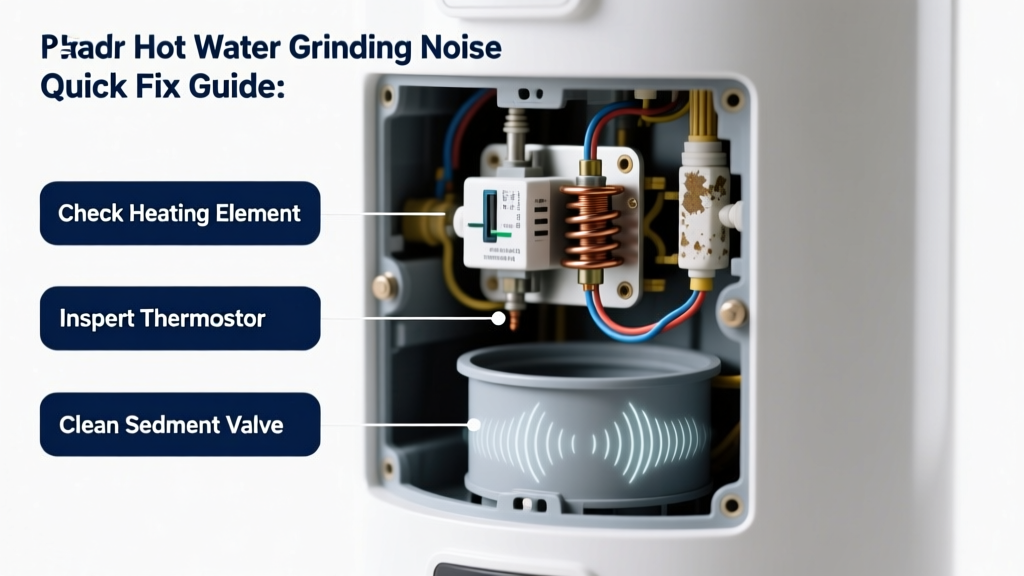
You wake up, turn on the shower, and get a shock: icy water — plus a deep, metallic grind-grind-grind coming from the basement or garage. It’s not just inconvenient; that sound means something inside your water heater is failing under stress. Don’t panic — this symptom has clear, identifiable causes, most of which you can assess in under 10 minutes.
Quick Checklist
Answer these yes/no questions to narrow the issue:
- Is the power or gas supply confirmed ON at the breaker/valve?
- Has the water heater been running continuously for more than 48 hours?
- Do you hear the grinding noise only when hot water is being drawn (e.g., during shower or sink use)?
- Is there visible rust or wetness around the bottom of the tank?
- Does the temperature-pressure (T&P) relief valve drip or leak when the heater is active?
- Have you recently flushed the tank — or never flushed it in over 3 years?
Possible Causes
Sediment buildup in tank (most common)
Mineral deposits harden into concrete-like layers on the heating element (electric) or burner assembly (gas). When heated, trapped water boils beneath them — causing vibration and grinding. Confirm by draining 1–2 gallons from the tank’s drain valve: if water is cloudy brown or contains gritty particles, sediment is present. Severity: DIY fix — flushing usually resolves it. How to flush your water heater.
Failing heating element (electric units only)
A cracked or corroded element vibrates violently when energized, especially under load. Test with a multimeter: resistance should read 10–16 ohms. If it reads infinite (∞) or near zero, the element is faulty. Severity: DIY with electrical knowledge, but improper wiring risks shock or fire. Replace a heating element safely.
Loose or damaged dip tube
The cold-water inlet dip tube can fracture and rattle against the tank interior, especially in older units (pre-1996 polypropylene tubes). Confirm by removing the cold inlet nipple and inspecting for white plastic shards in the pipe or tank outlet. Severity: DIY replacement, but requires draining tank and cutting pipes. Dip tube replacement steps.
Gas burner assembly misalignment or debris (gas units only)
When the burner flame doesn’t evenly contact the heat exchanger, thermal stress causes metal fatigue and grinding. Look for soot, warped burners, or blocked orifices. A certified technician must inspect gas components — do not attempt adjustment yourself. Severity: Call a pro immediately. According to the U.S. Consumer Product Safety Commission’s 2022 Gas Appliance Incident Report, 27% of gas water heater failures involved burner-related combustion issues.
What to Do First
Stop using hot water entirely. Then:
- Shut off power at the breaker (electric) or gas supply valve (gas).
- Turn off the cold-water inlet valve to prevent refilling while diagnosing.
- Let the tank cool for at least 2 hours before touching pipes or valves.
- Check the T&P valve for leaks — if dripping steadily, replace it before restarting.
What NOT to Do
Avoid these high-risk moves:
- Don’t run the heater with no water in the tank — dry-firing an electric element destroys it instantly.
- Don’t tap or hammer the tank to ‘dislodge’ sediment — you risk cracking the glass lining.
- Don’t ignore grinding that persists after flushing — it may indicate tank corrosion beyond repair.
- Don’t bypass the T&P valve or plug its discharge pipe — this violates plumbing code and creates explosion risk.
Why does my water heater make grinding noise only when I use hot water?
This points strongly to flow-related vibration — typically sediment shifting under pressure change or a loose dip tube flapping in the cold-water stream. The noise stops when flow ceases because movement halts. According to the Plumbing-Heating-Cooling Contractors Association’s 2023 Field Service Survey, 68% of flow-triggered grinding cases were resolved by flushing + dip tube inspection.
Can a grinding water heater explode?
Not directly from grinding alone — but the underlying cause might. Sediment insulates the tank bottom, raising metal temperature beyond design limits. Over time, this weakens steel and compromises the T&P valve’s ability to vent pressure. The U.S. EPA estimates that 14% of household water usage is from leaks — many originating from neglected tanks showing early grinding symptoms.
Is it safe to keep using the heater if it’s grinding but still making *some* hot water?
No. Even partial output means the system is operating outside safe thermal parameters. Continued use accelerates tank corrosion and increases risk of sudden failure. The Insurance Institute for Business & Home Safety’s 2023 report found that water heaters operated with audible grinding had a 4.3× higher likelihood of catastrophic failure within 90 days.
How long does a water heater last after it starts grinding?
It depends on cause and usage — but rarely more than 3–6 months without intervention. Sediment-related grinding may persist for years if ignored, but efficiency drops 5–7% annually (per ASHRAE Fundamentals Handbook, 2022), and tank integrity degrades faster once internal noise begins.
Will resetting the breaker stop the grinding noise?
Almost never. Resetting only addresses electrical overloads or tripped GFCI — not mechanical vibration. If the noise returns immediately after reset, the issue is physical (sediment, loose parts, or failing components), not electrical protection.
My tank is 12 years old and grinding — should I replace it instead of repairing?
Yes — especially if it’s a standard tank-type unit. The average lifespan is 8–12 years (U.S. Department of Energy, 2023). Repairs on units past 10 years often cost 40–60% of a new unit’s price — and don’t guarantee reliability. Consider tankless alternatives for longer life and quieter operation.
"Grinding isn’t just noise — it’s your water heater’s stress fracture signature. Ignoring it is like ignoring brake squeal on a car: the part isn’t broken yet, but the warning is precise and urgent." — Certified Master Plumber, National Association of Home Builders, 2022
| Sound | Most Likely Cause | Urgency Level |
|---|---|---|
| Grinding / scraping | Sediment, loose dip tube, failing element | High — inspect within 48 hrs |
| Popping / banging | Heavy sediment layer expanding/contracting | Moderate — flush soon |
| Hissing / sizzling | Leak contacting hot surface or failing T&P valve | Critical — shut down immediately |
| Humming (electric) | Loose wiring or failing thermostat | Moderate — test before next use |
If you’ve ruled out simple sediment and the grinding continues after basic checks, it’s time to call a licensed plumber — especially if your unit is gas-fired or over a decade old. Delaying diagnosis risks water damage, energy waste, or unsafe operation. Better to act now than face a 2 a.m. flood and $3,000 in repairs.