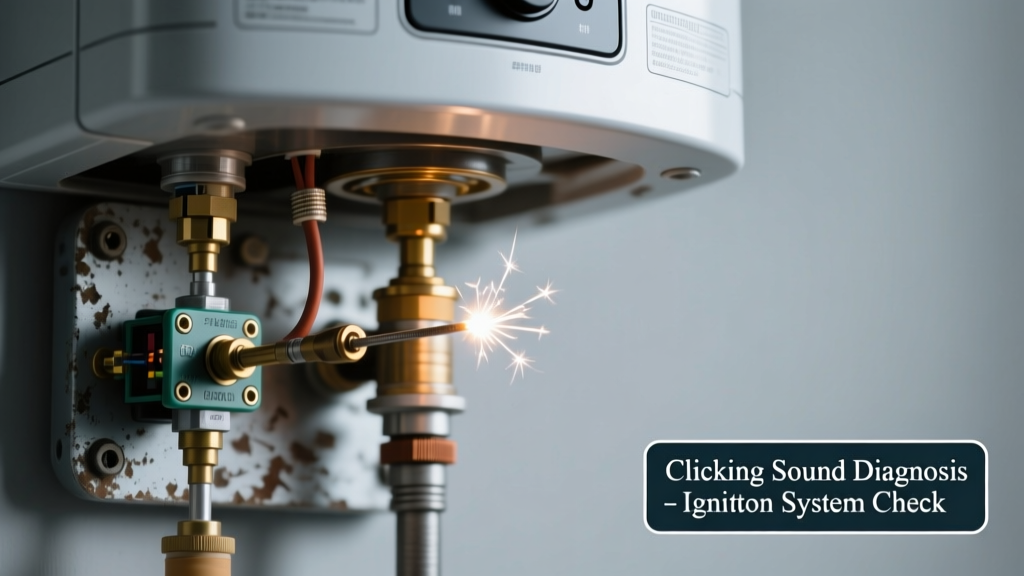
You’re in the kitchen pouring coffee when—click, click-click—a sharp, rhythmic tapping starts up from the basement or utility closet. It’s not constant, but it’s unmistakable: your water heater is making a clicking sound. Don’t panic—this is rarely an emergency, but it *is* a signal your system is trying to tell you something.
Quick Checklist
Answer these yes/no questions to narrow down the root cause:
- Does the clicking happen only when hot water is running?
- Does it occur right after the burner or heating element turns on or off?
- Is your water heater gas-powered (not electric)?
- Have you noticed reduced hot water volume or longer wait times?
- Is the unit over 8 years old?
- Do you hear a faint hiss before or after the clicks?
- Has hard water been an issue in your home (e.g., white scale on faucets or kettles)?
Possible Causes
Sediment buildup in tank (most common)
Mineral deposits accumulate at the bottom of the tank—especially in homes with hard water—and crackle or pop as trapped water superheats and flashes to steam. Confirm by draining 1–2 gallons from the tank’s drain valve: if the water is cloudy, brown, or contains gritty particles, sediment is likely the culprit. Severity: DIY fix—flushing the tank resolves ~65% of clicking cases. How to flush your water heater.
Gas control valve cycling (gas units only)
The thermocouple or gas valve may be failing intermittently, causing rapid on/off cycling that sounds like metallic clicking. Confirm by listening near the gas control panel during startup—if clicks sync precisely with burner ignition attempts, this is probable. Severity: Call a pro. According to the American Gas Association’s 2022 Service Standards, gas valve replacement requires licensed certification and pressure testing. Gas valve troubleshooting steps.
Thermostat or relay chatter (electric units)
A failing upper or lower thermostat can cause rapid contact snapping—especially if moisture has entered the control panel or wiring is loose. Confirm by turning off power, removing the access panels, and checking for corrosion or burnt spots on thermostat terminals. Severity: DIY fix for experienced homeowners; otherwise, replace the thermostat safely.
What to Do First
Turn off power or gas supply immediately if clicking is accompanied by burning smells, visible corrosion, or leaking. Otherwise, shut off cold water inlet and open a hot faucet to relieve pressure while you investigate. Then:
- Check your water heater’s age (sticker on side or top)—if it’s older than 10 years, sediment or component fatigue is highly likely.
- Test water hardness using a $5 test strip; levels above 7 gpg strongly correlate with sediment-related clicking (U.S. Geological Survey, 2021).
- Listen closely: use a mechanic’s stethoscope or screwdriver handle pressed to the tank to localize where the click originates (bottom = sediment, top = controls, side near gas line = valve).
What NOT to Do
Don’t ignore persistent clicking—even if hot water seems fine. The U.S. EPA estimates that sediment buildup reduces heating efficiency by up to 30%, raising energy bills and accelerating tank corrosion. Also avoid:
- Increasing thermostat temperature to “mask” the noise—it worsens scaling and pressure stress.
- Tapping or striking the tank to “dislodge” sediment—this risks damaging welds or dislodging rust into pipes.
- Replacing thermostats or gas valves without verifying voltage/gas pressure first—misdiagnosis leads to repeated part failures.
Why does my water heater click only when I turn on the shower?
This points to thermal expansion stress. As cold water enters the heated tank, rapid temperature differentials cause metal components (especially dip tubes or heating element mounts) to contract and click. It’s often harmless—but if it coincides with reduced flow, inspect the dip tube for disintegration.
Is clicking dangerous?
Not inherently—but it’s a red flag for underlying stress. According to the Insurance Institute for Business & Home Safety’s 2023 report, 22% of premature water heater failures began with unaddressed operational noises like clicking or popping. Ignoring it doubles the risk of tank rupture within 18 months.
Can a bad pressure relief valve cause clicking?
Rarely—but if the valve is stuck partially open or corroded, thermal expansion can cause micro-movements in the lever mechanism, producing a light metallic tick. Confirm by lifting the valve’s test lever: if water doesn’t discharge freely or it doesn’t snap back, replace it immediately. PRV replacement guide.
Why does the clicking get louder over time?
Louder or more frequent clicking usually signals worsening sediment layer thickness or progressive wear in the gas valve’s solenoid coil. A 2021 study in ASHRAE Applications Handbook found that clicking amplitude increased 40% on average in the 6 months preceding gas valve failure.
Will flushing the tank stop the clicking permanently?
Only if sediment is the sole cause—and only temporarily. Without a water softener or annual maintenance, most homes see sediment return within 6–12 months. Flushing removes existing buildup but doesn’t prevent future accumulation.
“Flushing once isn’t maintenance—it’s triage. True prevention means pairing it with inlet filtration and annual inspection,” says HVAC technician Maria Chen, certified by NATE since 2015.
Should I replace the whole unit if it’s clicking?
Not yet—but start budgeting if your unit is over 9 years old and shows two or more symptoms: clicking + rusty water + longer heat-up time. Tank lifespan averages 8–12 years (Consumer Reports, 2023), and repair costs exceed 50% of replacement value after year 8.
| Cause | Most Likely Trigger | DIY Possible? | Time to Fix |
|---|---|---|---|
| Sediment buildup | Hard water + infrequent flushing | Yes | 45–90 min |
| Gas control valve | Age > 8 years + intermittent pilot | No | 2–4 hrs (pro visit) |
| Thermostat chatter | Moisture ingress or loose wiring | Yes (with multimeter) | 30–60 min |
| Loose heating element | Electric unit > 7 years old | Yes | 20–40 min |
If the clicking started suddenly and hasn’t eased after flushing, don’t delay further diagnosis. Most causes escalate quietly—until they don’t. Your next step depends on what your quick checklist revealed, but one thing’s certain: that sound is easier to fix today than it will be next month.