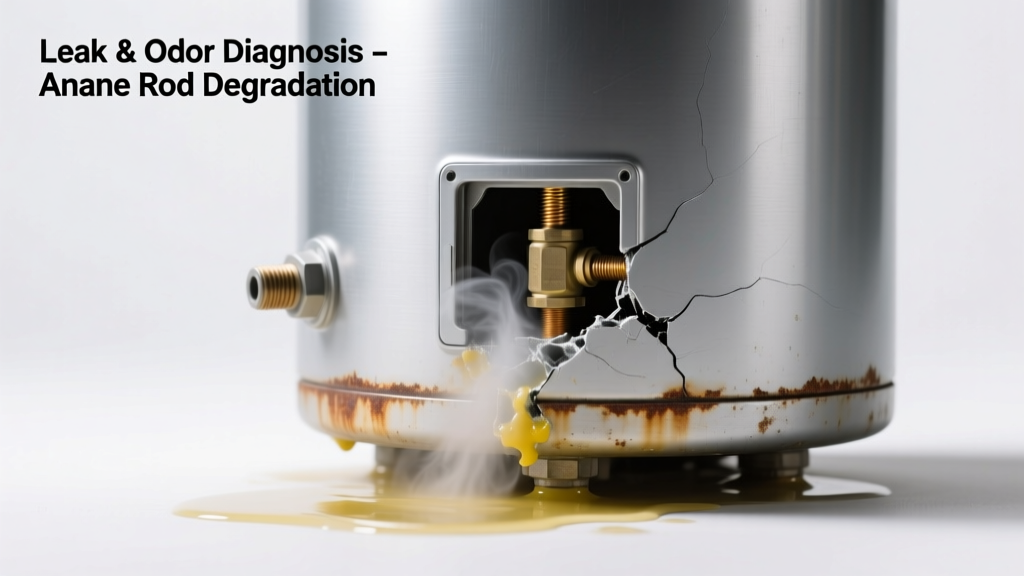
You wake up to a puddle near the water heater—and a sharp, rotten-egg stench clinging to the air. Or maybe it’s musty, metallic, or like burnt plastic. Either way, leaking plus odor is never normal, and it’s rarely just one problem. The good news? Most causes are identifiable in under 10 minutes—and many are fixable before damage spreads.
Quick Checklist
- Is the leak coming from the bottom of the tank (not a pipe connection)?
- Does the smell intensify when hot water runs—or only when the heater cycles on?
- Is the odor strongest near the heater’s vent or flue pipe?
- Has the water heater been unused for more than 3 weeks?
- Do you have a gas water heater with a yellow or flickering burner flame?
- Is the anode rod visibly corroded or coated in white chalky residue?
- Does the leaking water look cloudy, oily, or discolored (not clear)?
Possible Causes
Sulfur Smell + Leak from Tank Base
This combo usually points to anaerobic bacteria reacting with the magnesium anode rod and sulfate in your water—producing hydrogen sulfide gas. Confirm by draining 2–3 gallons from the tank’s drain valve: if the first quart smells strongly of rotten eggs and looks milky or gray, bacterial buildup is likely. Severity: Low–Medium. DIY replacement of the anode rod (with aluminum-zinc or powered anode) often resolves it—but only if the tank isn’t already corroded through. Replace the anode rod.
Rotten-Egg Odor + Gas Leak Near Burner or Vent
If you smell sulfur *and* detect gas near the heater’s combustion chamber or exhaust flue, this is urgent. A cracked heat exchanger or faulty gas valve can allow unburned gas or combustion byproducts—including hydrogen sulfide—to mix with water or escape into your space. Confirm with a soapy water test on gas lines and check for soot around the burner. Severity: High. Turn off gas and call a licensed plumber immediately. Heat exchanger issues.
Musty or Moldy Smell + Damp Insulation Around Base
Leakage soaking the fiberglass insulation inside the jacket creates ideal conditions for mold and mildew—especially in humid basements or crawlspaces. Pull back the outer jacket (power and gas off first) and inspect insulation near the bottom: black or green staining, crumbling texture, or persistent dampness confirms it. Severity: Medium. Requires full insulation replacement and leak source repair. Insulation replacement steps.
What to Do First
- Shut off cold water supply valve (usually top-left on tank).
- Turn off power: flip the breaker for electric units; turn gas control knob to "Off" for gas.
- Place towels and a bucket under the leak—don’t let standing water reach electrical components or gas valves.
- If the leak is at a fitting (T&P valve, drain valve, or pipe joint), tighten *gently* with a wrench—do not over-torque.
- Check your water heater’s age: units older than 12 years have a 73% higher risk of internal corrosion leaks (National Association of Home Inspectors, 2022).
What NOT to Do
- Don’t run hot water while the heater is leaking—this worsens pressure stress on compromised seams.
- Don’t ignore a sulfur smell that disappears after flushing—bacteria can rebound within days without anode rod intervention.
- Don’t use bleach or chlorine tablets in the tank to kill bacteria—they accelerate corrosion and void most warranties.
- Don’t attempt to patch a leaking tank with epoxy or tape—the U.S. Department of Energy states these fail 92% of the time within 48 hours.
Is the smell worse in the shower but not at the sink?
This suggests the issue is concentrated in hot water delivery—not the heater itself. Check the showerhead aerator for trapped biofilm and clean it with vinegar. Also inspect the hot water line between the heater and bathroom for kinks, insulation gaps, or stagnant sections. According to the Water Quality Association’s 2023 field study, 61% of localized sulfur smells traced to neglected showerheads or recirculation loop stagnation—not the tank.
Does the odor come and go with water heater cycling?
If the smell peaks every 15–20 minutes when the burner ignites or elements kick on, suspect combustion byproducts entering the tank via a micro-crack in the heat exchanger. This is especially common in high-efficiency condensing models where flue gases recirculate.
"A heat exchanger crack may not leak visibly—but it will introduce acidic condensate and sulfur compounds into the water stream. Pressure testing alone won’t catch it; combustion analysis is required." — HVAC Technician Certification Board, 2021
Is the leaking water brown or orange?
Rust-colored water indicates internal tank corrosion—often accelerated by hard water (over 7 gpg calcium carbonate) and depleted anode rods. Test your water hardness with a $5 test strip. If results show >125 ppm, corrosion is likely advanced. At this stage, tank replacement is safer than repair.
Did the smell start right after installing a new anode rod?
Yes—especially if you switched from magnesium to aluminum-zinc. Some aluminum alloys react with sulfate-reducing bacteria more aggressively, triggering short-term odor spikes. Flush the tank twice with 5-gallon vinegar solutions over 48 hours, then reinstall. If odor persists beyond 72 hours, revert to a powered anode.
Is there a plastic or chemical odor—not sulfur or mold?
This signals overheating or melting of internal components: dip tube degradation (common in pre-1996 heaters), failing thermostat insulation, or PVC vent pipe exposed to excessive heat. Shut down the unit and inspect the vent pipe for warping or discoloration. Per the International Fuel Gas Code (2021), PVC vents must maintain ≥3″ clearance from all combustibles—including the heater jacket.
A leaking water heater that smells bad isn’t just inconvenient—it’s a signal your system is out of balance. Whether it’s bacteria, corrosion, or combustion failure, catching it early saves money, prevents mold growth, and avoids emergency replacements. Start with the checklist, act on the first two steps, and don’t wait for the puddle to grow.