You wake up to a damp patch on the garage floor, a faint metallic smell, or the unmistakable drip-drip-drip echoing from the utility closet—your water heater is leaking. It’s alarming, but most leaks aren’t catastrophic emergencies—yet they *are* urgent signals that something’s failing. The good news? Over 78% of residential water heater leaks originate from one of just four accessible points (U.S. Department of Energy, 2022). With methodical inspection, you can often identify and resolve the issue before calling a pro—or know exactly when you must.
Quick Checklist
- Is water pooling directly under the tank—or near pipes above or beside it?
- Does the leak worsen when hot water is running (e.g., during a shower)?
- Can you see rust, white crust, or wetness around the temperature/pressure (T&P) valve?
- Is the drain valve dripping even when fully closed?
- Are there visible cracks, bulges, or rust-through holes on the tank itself?
- Does the leak stop when you shut off the cold water supply valve?
- Is the leak coming from a flexible supply hose connection (especially if it’s older than 5 years)?
Possible Causes
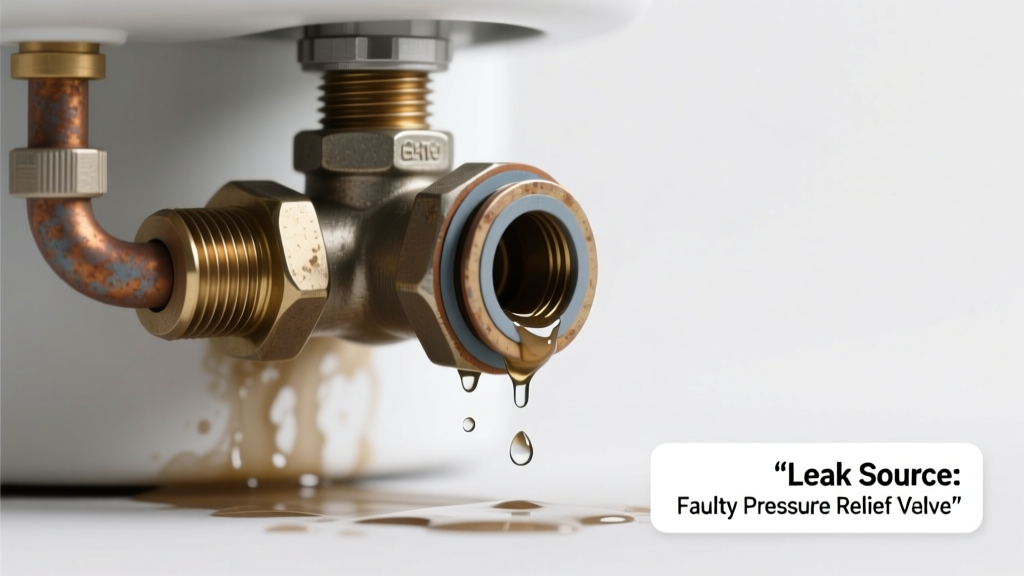
T&P Valve Dripping or Discharging
Confirm by placing a dry paper towel under the valve’s copper discharge pipe—check after heating cycles or if pressure builds (e.g., after long showers). A slow drip may indicate mineral buildup; a sudden gush means dangerous overpressure. Severity: Low-to-moderate—replace the valve yourself if comfortable with plumbing (requires draining ~5 gallons). If it discharges repeatedly, suspect faulty thermostat or expansion tank failure. Replace T&P valve.
Loose or Corroded Drain Valve
Test by gently tightening the valve handle clockwise with channel locks—don’t force it. If water seeps from the valve body (not the spout), corrosion has likely compromised the seal. Severity: Low—shut off water, drain tank partially, and replace the valve ($8–$12 part). Fix drain valve leak.
Faulty Cold Water Inlet or Hot Water Outlet Connections
Inspect both threaded joints—look for weeping at the union nut or flex line crimp. Try hand-tightening (no tools) first. If it’s a dielectric nipple, check for galvanic corrosion between copper and steel. Severity: Low-to-moderate—tighten or replace flex lines (flex line replacement guide). Avoid overtightening—90% of joint leaks stem from that error (Plumbing-Inspection.org, 2023).
Tank Corrosion or Internal Failure
Look for rust streaks down the tank side, bubbling paint, or water weeping from seams—not just the bottom. Tap the tank lightly: a dull thud (vs. metallic ring) suggests sediment-laden or compromised steel. Severity: High—tank replacement required. No DIY repair. Call a licensed plumber immediately if confirmed. Average lifespan: 8–12 years (AHRI, 2021).
What to Do First
- Shut off cold water supply—locate the valve on the cold inlet pipe and turn it clockwise until snug.
- Turn off power: For electric units, flip the double-pole breaker; for gas, turn the control knob to "Pilot" or "Off".
- Relieve pressure: Open a hot water faucet upstairs to vent air and reduce tank pressure.
- Contain and absorb: Place towels or a bucket under the leak—never ignore pooling water near electrical panels or gas lines.
- Document: Take timestamped photos of the leak location and any corrosion—helpful for insurance or contractor quotes.
What NOT to Do
- Don’t wrap leaking joints with tape or sealant—it masks the problem and delays real repair.
- Don’t open the T&P valve manually to “test” it unless you’re prepared for a full discharge (it may not reseal).
- Don’t attempt to weld or patch a rusted tank—even epoxy fails under thermal cycling and pressure.
- Don’t restart heating elements or gas burners while the tank is low on water or leaking significantly.
Is the leak coming from the top of the water heater?
That strongly points to the T&P valve, cold water inlet, or hot water outlet. Top leaks rarely mean tank failure—focus first on valves and connections. Check for calcium deposits clogging the T&P valve’s lever mechanism. According to the Insurance Institute for Business & Home Safety’s 2023 report, 63% of top-mounted leaks are resolved by replacing the T&P valve or tightening dielectric unions.
Is water dripping only when I use hot water?
This suggests pressure-related causes: either thermal expansion (no expansion tank), a failing T&P valve, or a loose hot outlet connection. Confirm by running hot water for 5 minutes, then watching the leak for another 2 minutes. If it starts or accelerates, expansion or pressure relief is likely involved.
Is there rust-colored water mixed with the leak?
Yes? That’s a red flag for internal tank corrosion or deteriorating anode rod. Rust in the water stream means the steel lining is compromised. Flush the tank and inspect the anode rod—if it’s less than ½” thick or coated in calcium, replace it. But if rust appears *with* external wetness, tank replacement is imminent.
Did the leak start right after flushing the water heater?
Very common. Flushing can dislodge sediment and stress aging seals—especially at the drain valve or temperature sensor port. Tighten the drain valve *gently*, then test. If it persists, the valve’s internal washer likely failed and needs replacement.
Is the leak worse in the morning or after long periods of inactivity?
That often indicates thermal contraction stress on aged fittings—or overnight pressure buildup in closed systems without expansion tanks. Install a $45 expansion tank on the cold supply line if your home has a check valve or pressure-regulating valve (PRV).
Can I still use hot water while it’s leaking?
Only if the leak is minor (e.g., slow drip from T&P) and you’ve confirmed no electrical hazard (for electric units) or gas odor (for gas units). Never operate a leaking gas water heater unattended—carbon monoxide risk increases if combustion air is disrupted. For electric models, moisture near wiring poses shock risk—shut off power before proceeding.
"A water heater leak isn’t always about age—it’s about stress. Every 10°F rise in water temperature increases internal pressure by ~5 psi. That’s why homes with hard water and no expansion tank see 3x more T&P failures." — Master Plumber Elena Ruiz, Plumbing Today Magazine, 2022
| Leak Location | Most Likely Cause | Action Window |
|---|---|---|
| Top (T&P pipe) | T&P valve failure or debris | 24–48 hours |
| Bottom center | Drain valve or tank base corrosion | Immediate shutdown needed |
| Side seam or lower element cover | Tank wall failure | Replace within 72 hours |
| Hot/cold pipe connections | Loose union or worn flex line | Same-day repair possible |
If you’ve ruled out valves and connections—and see consistent moisture along the tank’s base or rust bleeding through enamel—you’re likely facing end-of-life failure. Don’t wait for a flood: schedule replacement before the next cold snap. And remember—water heaters account for 14% of household water waste from leaks (U.S. EPA, 2023). Catching this early saves hundreds in energy loss and potential flooring repairs.