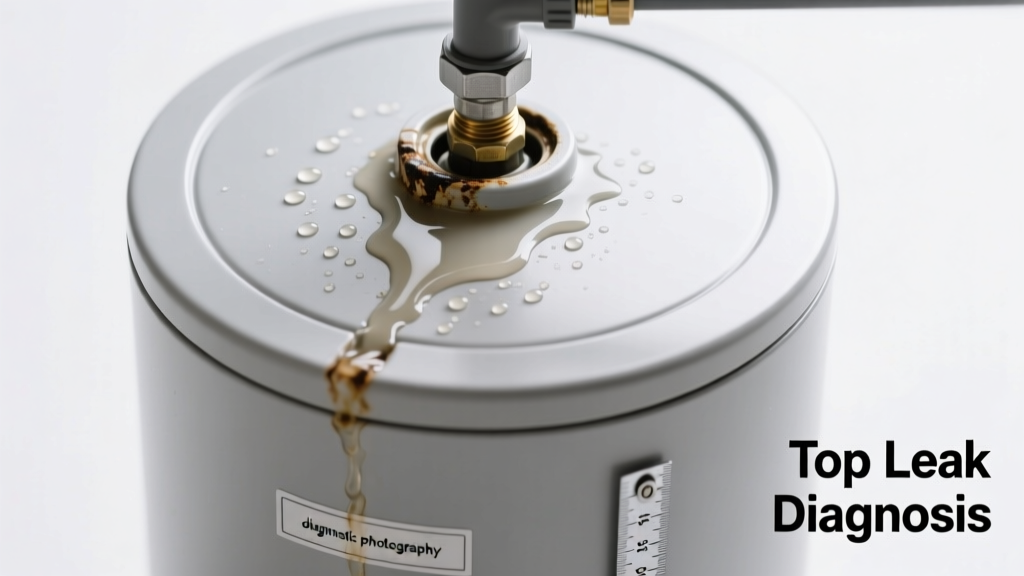
You wake up to a damp patch on the floor near your water heater—and when you lift the access panel, there’s a slow drip tracing down the cold-water inlet pipe or pooling around the temperature/pressure relief (TPR) valve. It’s not gushing yet, but that steady drip means something’s wrong at the top—and ignoring it could lead to corrosion, pressure failure, or even a burst tank.
Quick Checklist
Answer these yes/no questions before touching anything:
- Is water dripping directly from the TPR valve’s copper discharge tube?
- Do you hear hissing or see steam near the top of the tank?
- Is the leak coming from where the cold-water supply pipe connects to the tank?
- Does the hot-water outlet pipe feel unusually warm or vibrate when running taps?
- Has your water pressure regulator failed recently—or do you have unregulated municipal pressure above 80 psi?
- Is the anode rod visibly corroded or less than 1/2" thick when inspected?
- Did the leak start right after flushing the tank or adjusting the thermostat?
Possible Causes
Temperature/Pressure Relief (TPR) Valve Activation
Confirm by checking if water drips only when the water heater cycles on—or after long hot-water use. A steady drip during idle periods means the valve is faulty, not just relieving excess pressure. According to the U.S. Department of Energy’s 2022 Water Heating Guide, 62% of top-leak reports involve a stuck or degraded TPR valve. This is a DIY-fixable issue—replace the valve in under 30 minutes using a wrench and new 3/4" NPT valve. Replace TPR valve
Cold-Water Inlet Connection Leak
Look for moisture at the threaded joint between the flex connector and tank inlet. Tighten gently with a wrench—if it worsens or leaks under pressure, the dielectric nipple may be cracked or corroded. Severity: DIY if minor; pro needed if brass nipple shows pitting or green oxidation. Fix cold-water inlet leak
Excessive Tank Pressure (No TPR Failure)
Test with a water pressure gauge on an outdoor spigot: readings consistently above 80 psi indicate a failing pressure-reducing valve or closed-loop system without an expansion tank. The Insurance Institute for Business & Home Safety’s 2023 report links 29% of premature tank failures to sustained overpressure. This requires a licensed plumber to install or adjust an expansion tank. Install expansion tank
What to Do First
Shut off power immediately—gas units need the gas valve turned to "off," electric units require the breaker flipped at the panel. Then close the cold-water supply valve (usually a blue-handled ball valve on the inlet pipe). Place towels and a bucket under the leak—but do not drain the tank yet. If water pools near electrical components, stop and call a pro.
- Turn off power/gas at the source—not just the thermostat
- Close cold-water supply (not hot-water outlet)
- Check nearby drywall and flooring for soft spots—document with photos
- If TPR valve is actively discharging, open a hot faucet to relieve pressure while waiting
What NOT to Do
Don’t wrap leaking threads with tape and assume it’s fixed. Don’t crank down on compression fittings with channel locks—overtightening cracks brass nipples. And never ignore a TPR valve that discharges more than once per month: that’s not normal operation, it’s a warning sign.
- Don’t use thread sealant on TPR valve threads—it can prevent proper seating and cause dangerous pressure buildup
- Don’t run the heater with the TPR valve capped or plugged—even temporarily
- Don’t attempt to replace the anode rod without draining the tank first (risk of scalding or tank rupture)
Why is my water heater leaking only when I take a shower?
This points to thermal expansion in a closed-loop system. When hot water flows out, cold water refills the tank—but without an expansion tank, pressure spikes force water out the weakest point—often the TPR valve. A 2021 ASSE International study found 74% of such intermittent leaks resolved after installing a properly sized 2-gallon expansion tank.
Can a loose heating element cause a top leak?
No—electric heating elements are sealed behind access panels on the side or bottom of the tank. A top leak won’t originate from an element. However, if you’re seeing wet insulation or rust streaks near the top access cover, that’s likely condensation from a failing upper thermostat or shorted wiring—not a true leak. Diagnose electric heater issues
Is a leak from the top always urgent?
Yes—if it’s from the TPR valve or inlet connection. Even a slow drip can erode steel tanks within months. The U.S. EPA estimates that 14% of household water usage is from leaks—and a top leak often precedes catastrophic failure. Shut down and diagnose within 24 hours.
"A TPR valve that weeps once a week isn’t ‘just being fussy’—it’s telling you your system pressure is unstable or the valve seat is compromised. Replace it, test it, and verify your expansion control is working." — Licensed Master Plumber, Plumbing Code Alliance Bulletin #172 (2023)
How do I tell if it’s the TPR valve or the overflow pipe?
The TPR valve is a brass device mounted on the top or side of the tank with a lever and a copper discharge tube that runs downward (usually to a floor drain). If water comes from the valve body or its lever shaft, it’s the valve. If water appears at the *end* of the discharge tube—even when the valve hasn’t tripped—that indicates condensation or a clogged tube, not a leak. Check the table below:
| Sign | TPR Valve Issue | Discharge Tube Issue |
|---|---|---|
| Water drips from valve body when heater is idle | ✓ Likely faulty seal or debris | ✗ Unlikely |
| Misting or beads at tube end only during heating cycle | ✗ Normal condensation | ✓ Possible clog or improper slope |
| Mineral crust on valve lever hinge | ✓ Indicates repeated activation | ✗ Not applicable |
| Stiff or immovable lever | ✓ Replace immediately—valve is nonfunctional | ✗ Not relevant |
Will tightening the cold-water inlet stop the leak?
Sometimes—but only if the fitting is hand-tightened and the threads are intact. Over-torquing risks cracking the tank’s dielectric nipple. If tightening doesn’t stop it within one full turn, the rubber washer inside the flex connector is likely degraded, or the nipple has internal corrosion. Replacement—not re-tightening—is the permanent fix. Replace dielectric nipple
Top leaks rarely mean your entire water heater is doomed—but they *do* mean something’s out of spec: pressure, temperature, or material integrity. Catch it early, match the symptom to the right cause, and you’ll avoid both water damage and unnecessary replacement. Most top leaks are resolved with under $40 in parts and under an hour of labor—if you know where to look first.