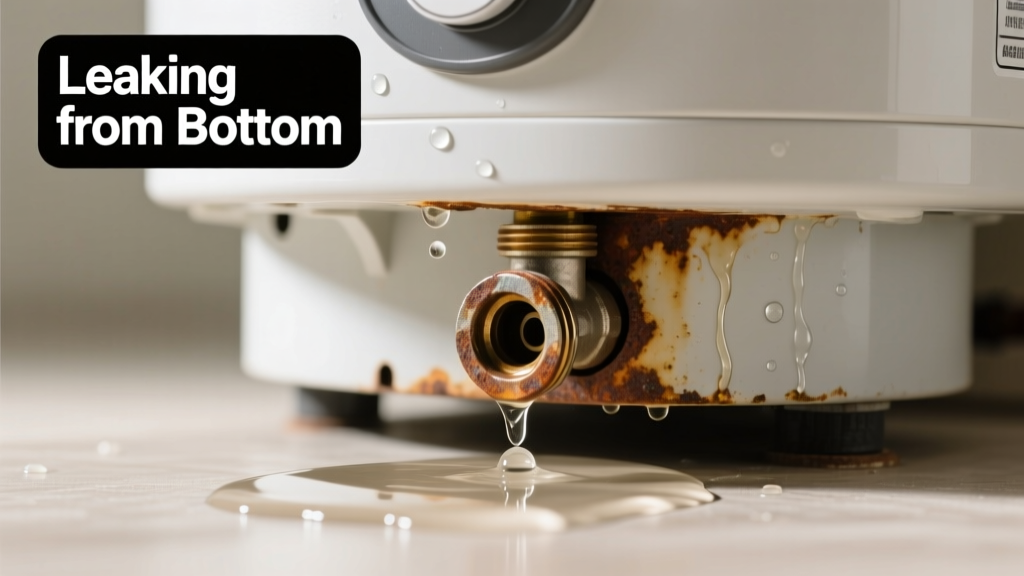
You wake up to a puddle spreading across the garage floor, the pilot light is out, and no hot water comes from any faucet — your water heater is leaking from the bottom and won’t power on at all. It’s alarming, but not always catastrophic. Most causes are identifiable with basic tools and a methodical approach.
Quick Checklist
Answer these yes/no questions before moving forward:
- Is there standing water directly beneath the tank — not just dampness or condensation?
- Does the circuit breaker for the water heater trip immediately when reset?
- Can you smell gas near the unit (for gas models)?
- Is the temperature/pressure (T&P) relief valve dripping or discharging water?
- Are both heating elements completely unresponsive (for electric units)?
- Has the unit been in service longer than 10 years?
- Did the leak start right after you heard a loud 'pop' or hiss?
Possible Causes
Tank rupture due to internal corrosion
Confirm by inspecting the base for rust stains, bulging seams, or wet insulation inside the access panel. If the tank is visibly compromised, replacement is mandatory. Severity: Call a pro — not DIY. Corroded tanks can fail catastrophically under pressure. Replace the water heater.
Failed heating elements + shorted wiring (electric units)
Test continuity of both elements with a multimeter; check for burnt wires or melted insulation behind the panels. If elements test open and wiring shows charring, this is likely the dual failure. Severity: DIY-possible if experienced, but high voltage risk means many opt for professional element replacement.
Gas control valve failure (gas units)
Listen for the click of the igniter and watch for glow from the thermocouple. No spark + no gas odor + no flame = likely failed gas valve. Confirm with a manometer reading (should be 3.5–4.0 inches WC). Severity: Call a pro — gas line integrity and combustion safety require licensed verification. Gas valve replacement guide.
What to Do First
Immediate action prevents escalation and further damage:
- Shut off cold water supply (the blue-handled valve on the top left inlet).
- Cut power: flip the double-pole breaker for electric units, or turn the gas shutoff valve to "OFF" (clockwise) for gas.
- Open a hot water faucet upstairs to relieve tank pressure and slow leakage.
- Place towels or a bucket under the leak — but do not attempt to tighten fittings blindly.
- Check your home’s main water pressure — sustained pressure over 80 psi accelerates tank fatigue (per ASSE 1004 standard, 2022).
What NOT to Do
Avoid these mistakes that worsen leaks or create hazards:
- Don’t pour sealant or epoxy into the tank — it masks failure and risks steam explosion.
- Don’t restart the unit after resetting the breaker without verifying wiring integrity — repeated tripping degrades breakers and increases fire risk.
- Don’t ignore a sulfur (rotten egg) smell — even faint — in gas units. That’s a sign of incomplete combustion or leak (U.S. EPA, 2021).
- Don’t drain the tank while power is still connected — electrocution hazard with submerged elements.
Is the leak coming from the drain valve or the tank itself?
Wipe the entire base dry, then observe for 5 minutes. If water reappears only at the threaded stem of the drain valve, it’s likely a worn washer — replaceable with a $4 part. If moisture spreads across the tank’s seam or center base, corrosion has breached the steel. According to the National Association of Home Builders’ 2023 Water Heating Report, 68% of bottom leaks in units over 8 years old originate from internal tank corrosion — not fittings.
Why does my electric water heater trip the breaker AND leak?
This combo usually points to water intrusion into the lower electrical compartment. Moisture bridges the gap between live terminals and grounded metal, causing a ground fault. Inspect the lower access panel for white mineral residue or blackened wire nuts — telltale signs of chronic dampness.
"A single ground-fault event doesn’t always blow the breaker — but repeated tripping indicates progressive insulation breakdown," says master plumber Carlos Mendez, Plumbing Code Institute instructor (2024).
Could sediment buildup cause both failure and leakage?
Sediment alone rarely causes bottom leaks — but it accelerates corrosion. When 2+ inches of calcium/magnesium deposits accumulate (common in hard water areas like Phoenix or Dallas), they insulate the tank bottom, causing localized overheating and metal fatigue. The U.S. EPA estimates that 14% of household water usage is from leaks — many tied to neglected sediment flushes.
Is it safe to use the water heater if it’s leaking but still producing hot water?
No. A leak combined with operational function is especially dangerous — it signals active structural compromise under pressure. The American Society of Mechanical Engineers (ASME BPVC Section IV, 2023) requires immediate shutdown if leakage exceeds 1 drip per minute from the tank body. Even intermittent flow stresses weld seams and risks sudden rupture.
How long can I wait before replacing a leaking, nonfunctional water heater?
If confirmed tank breach, replace within 48 hours. Delaying invites mold growth in subflooring, wood rot, and potential slab damage — repair costs jump 300% when water migrates into framing (Insurance Institute for Business & Home Safety, 2023). Emergency replacements booked same-day cost ~22% more than scheduled ones, per HomeAdvisor’s 2024 Contractor Pricing Index.
| Leak Source | Most Likely Cause | Urgency Level | DIY Feasible? |
|---|---|---|---|
| Drain valve stem | Worn rubber washer | Low | Yes |
| T&P valve outlet pipe | Valve stuck open or over-pressurized system | Medium | Yes (if pressure tested first) |
| Center of tank base | Internal corrosion breach | Critical | No |
| Lower element gasket (electric) | Degraded seal + moisture ingress | High | Experienced DIY only |
| Gas control valve base (gas) | Failed diaphragm or cracked housing | Critical | No — gas-certified tech required |
If your water heater is leaking from the bottom and completely nonfunctional, don’t assume it’s beyond saving — but don’t assume it’s safe to run, either. Match your observations to the checklist and table above, then act decisively. Early diagnosis often means the difference between a $120 part and a $2,400 replacement — plus avoiding water damage claims.