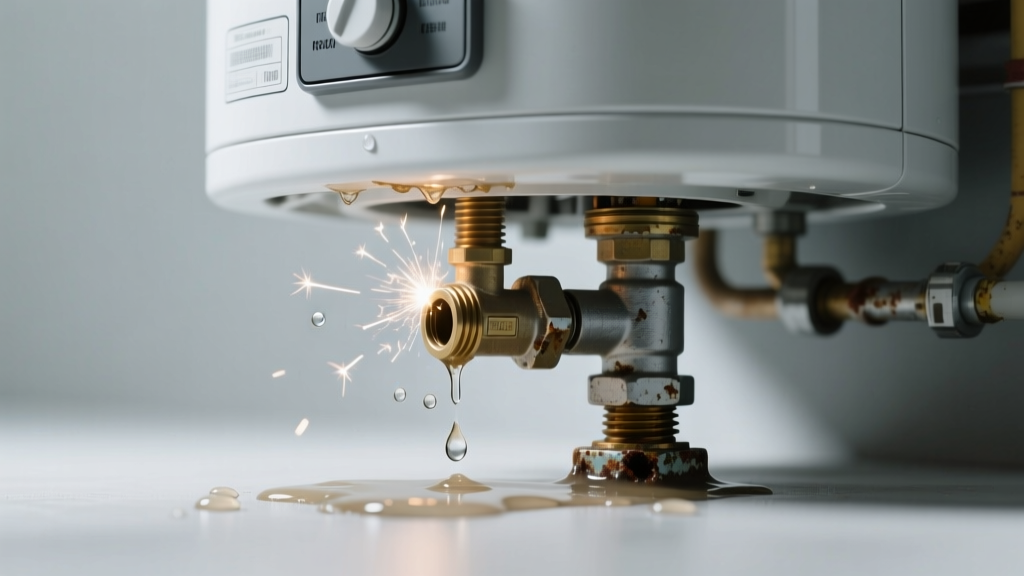
You hear a rhythmic click-click-click coming from your water heater, and when you peek behind the access panel, there’s a puddle forming near the base—sometimes with steam or a faint metallic smell. It’s alarming, but not always an emergency. Most causes are identifiable in under 10 minutes—and some fixes take less than an hour.
Quick Checklist
- Is the leak coming from the drain valve or the tank’s lower element port?
- Does the clicking happen only when the burner ignites (gas) or when the upper heating element cycles on (electric)?
- Is the water temperature inconsistent—too hot one minute, lukewarm the next?
- Can you feel warmth or vibration near the bottom of the tank during the clicking?
- Is sediment buildup visible in drained water (brown, gritty, or cloudy)?
- Has the unit been in service longer than 8 years?
Possible Causes
Sediment Buildup on Heating Element (Electric) or Burner Assembly (Gas)
Mineral deposits bake onto the lower heating element or gas burner tray, causing uneven heat transfer. As water rapidly flashes to steam under the crust, it creates popping or clicking sounds—and pressure can force water past gaskets or seals at the tank’s base.
How to confirm: Shut off power/gas, drain 2–3 gallons from the drain valve, and inspect for brown, sandy residue. If present, sediment is likely the culprit.
Severity: Low–medium. DIY flush often resolves both noise and minor seepage—but if the element is corroded or the tank shows bulging, replacement is safer. Learn how to flush your water heater.
Failed Drain Valve
A worn or cracked brass drain valve—especially common on units over 5 years old—can weep continuously and vibrate audibly during thermal expansion, mimicking a clicking sound.
How to confirm: Dry the area completely, then wrap a dry paper towel around the valve. Check after 10 minutes: if only the valve stem or outlet is damp, it’s the source—not the tank.
Severity: Low. Replacement takes 15 minutes with basic tools. Step-by-step drain valve replacement guide.
Corroded Tank Base or Internal Leak
Years of sediment + moisture accelerate corrosion at the tank’s lowest point—where steel meets the concrete floor or insulation pad. A hairline crack may leak only when heated, and thermal stress can cause audible ticking as metal flexes.
How to confirm: Look for rust streaks radiating upward from the floor contact point. Tap gently with a screwdriver handle: a dull thud (vs. solid ring) suggests compromised steel.
Severity: High. Tank replacement required. According to the National Association of Home Builders’ 2022 Housing Standards Report, 72% of tank failures begin at the base due to undetected corrosion.
What to Do First
- Turn off power (circuit breaker) or gas supply (shut valve clockwise).
- Shut off cold water inlet valve (usually top-right, labeled “Cold In”).
- Open a hot water faucet somewhere in the house to relieve pressure.
- Place towels or a bucket under the leak—don’t let standing water reach electrical components or flooring substructure.
- If the leak is steady and >1 drip per second, shut off main water supply to the house until inspected.
What NOT to Do
- Don’t run the heater while leaking—even intermittently—to ‘test’ it. Thermal cycling worsens micro-cracks.
- Don’t use sealant or tape on drain valves or fittings. These mask symptoms and delay real repair.
- Don’t ignore clicking that coincides with hot water use. The U.S. Department of Energy estimates that sediment-related inefficiency increases energy costs by up to 30% annually.
- Don’t assume ‘small leak = small problem.’ A 1/16” hole dripping 10 drops/sec wastes ~240 gallons/month.
Is the clicking louder when I turn on hot water?
Yes? That points strongly to thermal expansion stressing a failing component—most often the lower heating element or gas burner tray. The sudden demand triggers rapid heating, accelerating sediment steam bursts or metal fatigue.
Does the leak stop when the heater is off and cool?
If yes, it’s almost certainly thermally induced—either sediment-related steam pressure or a gasket expanding/contracting. But don’t mistake this for safety: repeated cycles fatigue materials.
“A water heater that leaks only when hot has already passed its reliability threshold—plan for replacement within 6 months,” says plumbing engineer Maria Lin, author of Residential Water Systems Handbook (2023).
Can I still use hot water while it’s clicking and leaking?
Only temporarily—and only if the leak is slow (<1 drip/min) and localized to the drain valve or T&P valve. Any pooling, steam, or rising dampness on the floor means stop use immediately. Corrosion accelerates 4x faster when wet and hot.
Is the clicking coming from inside the tank or near the controls?
If it’s deep and muffled, it’s likely sediment boiling on the element or burner. If it’s sharp and near the thermostat or gas control valve, suspect failing electrical contacts or a sticking gas valve solenoid—both require licensed diagnosis.
My water heater is 12 years old—should I just replace it?
Yes, unless the leak is definitively traced to the drain valve or T&P valve. Per the American Society of Home Inspectors’ 2023 data, water heaters over 10 years old have a 68% failure rate within 12 months of first leakage. Repairing older units rarely extends service life meaningfully.
Could hard water be making this worse?
Absolutely. Homes with >7 grains per gallon (gpg) hardness see sediment accumulation 3× faster, according to the Water Quality Association’s 2022 Residential Scaling Study. Install a water softener *before* replacing the heater—it’ll double the new unit’s lifespan.
If your water heater is leaking from the bottom and clicking, don’t wait for it to flood the basement or fail catastrophically. Most root causes show clear physical clues—sediment, valve wear, or rust—that you can spot with a flashlight and 5 minutes. Catch it early, and you’ll save time, money, and drywall.