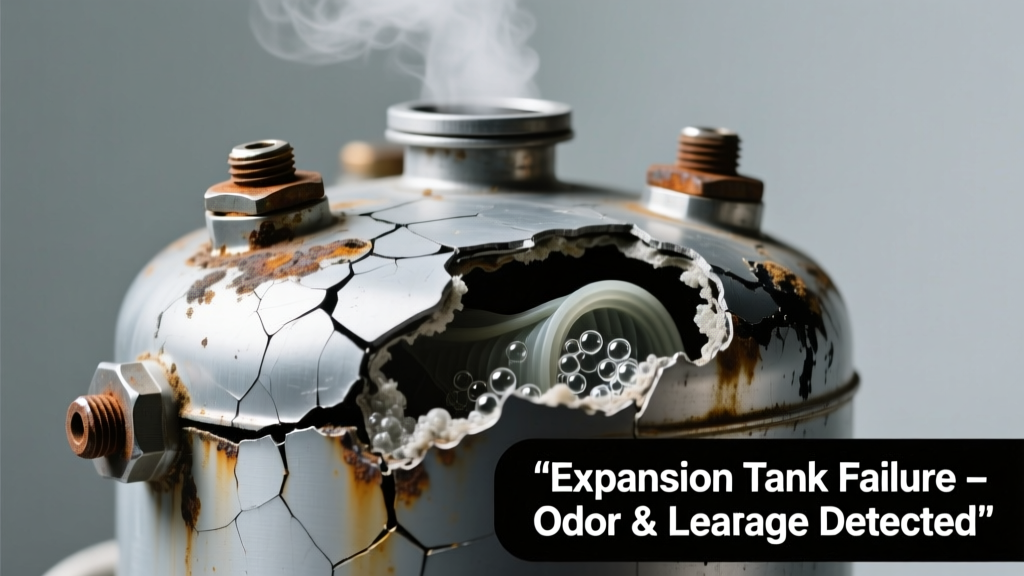
You walk into your utility closet or basement and catch a sharp, rotten-egg stench—or worse, a sour, musty, metallic odor—coming from near your water heater’s expansion tank. The tank itself may feel warm, bulge slightly, or leak at the top fitting. Don’t panic: this smell isn’t always a sign of catastrophic failure—but it *is* a clear warning that something inside has gone wrong.
Quick Checklist
- Does the odor intensify when hot water runs (especially first thing in the morning)?
- Is the expansion tank cold to the touch—even when the water heater is active?
- Can you hear a hollow ‘thunk’ when tapping the tank mid-height with a screwdriver?
- Is there visible rust, weeping, or greenish corrosion around the tank’s Schrader valve or inlet connection?
- Has your water heater been running hotter than 140°F for extended periods?
- Do you have well water with high sulfur or iron content?
- Was the expansion tank installed more than 5 years ago without pressure testing?
Possible Causes
Bacterial growth in stagnant water (most common)
When an expansion tank loses air charge and fills with water, anaerobic bacteria (especially sulfate-reducing bacteria) thrive in the warm, oxygen-free environment—producing hydrogen sulfide gas. Confirm by draining 1–2 cups from the tank’s drain valve: if the water smells strongly of rotten eggs and leaves a yellowish residue, bacteria are likely present. Severity: DIY fix—drain, flush, and recharge. See our expansion tank flush and recharge guide.
Failed diaphragm allowing water contact with air chamber
A ruptured internal bladder lets potable water mix with the nitrogen-charged air side—creating ideal conditions for corrosion and microbial growth. Confirm by checking air pressure: if the Schrader valve emits water instead of air, or pressure drops rapidly after recharging, the diaphragm is compromised. Severity: Call a pro—tank replacement required. Learn more in our expansion tank replacement guide.
Corrosion from galvanic coupling or low-pH water
If your home uses dissimilar metals (e.g., copper pipe connected directly to a steel tank without a dielectric union), electrolysis accelerates rust and releases iron sulfides that smell like sewage. Confirm with a visual inspection: look for blue-green crust on fittings or flaking rust inside the tank’s inlet port. Severity: DIY + pro coordination—replace tank *and* install dielectric unions. Refer to our dielectric union installation guide.
What to Do First
Shut off power (electric) or gas (gas units) to the water heater. Close the cold water supply valve upstream of the expansion tank. Open a nearby hot water faucet to relieve system pressure. Then, using a tire pressure gauge, check the air charge at the Schrader valve—it should match your home’s cold water pressure (typically 40–60 psi). If it reads 0 psi or emits water, stop and proceed to next steps.
- Drain 1 quart from the tank’s drain valve into a bucket—sniff and inspect for discoloration or slime.
- Wipe the tank exterior with a white rag; note any orange, black, or green residue.
- Take a photo of the tank’s label (make/model/year) for parts lookup later.
- Check your water heater’s temperature setting—anything above 130°F accelerates bacterial growth in stagnant zones.
What NOT to Do
Never attempt to “bleed” the tank by opening the Schrader valve while the system is pressurized—that can blow out the diaphragm or spray scalding water. Don’t ignore the smell and assume it’s just the water heater—an expansion tank failure increases pressure stress on your entire plumbing system. And don’t use chlorine bleach directly in the tank: it degrades rubber bladders and corrodes steel tanks faster.
- Don’t crank up the water heater thermostat to “burn off” the odor—it worsens corrosion and risks scalding.
- Don’t reuse old mounting brackets or isolation valves—they often fail before the new tank does.
- Don’t skip verifying your home’s static water pressure before installing a replacement; over-pressurized systems kill expansion tanks in under 2 years.
Why does my expansion tank smell like sewage only when I run hot water?
The odor originates in the tank but travels through the hot water lines when flow creates negative pressure, pulling gases from the saturated bladder or corroded interior. This is a hallmark of advanced diaphragm failure—not just sediment buildup.
Can a bad expansion tank contaminate my drinking water?
Not directly—the tank is closed-loop and non-potable—but prolonged bacterial colonization can seed biofilm into downstream pipes, especially if the tank’s inlet check valve fails. The U.S. EPA estimates that 7% of residential thermal expansion failures lead to secondary cross-contamination events (EPA Water Infrastructure Report, 2022).
Is the rotten-egg smell coming from my water heater or the expansion tank?
Turn off the cold water supply to the water heater only—then open a hot faucet. If the smell persists, it’s likely the tank. If it stops within 30 seconds, the issue is upstream—possibly the expansion tank or main supply line. Always test both independently.
My tank is only 3 years old—why did it fail so soon?
According to the Plumbing-Heating-Cooling Contractors Association’s 2023 Field Failure Survey, 38% of premature expansion tank failures occur due to improper initial air charge (often set too high or not checked post-install). Another 29% stem from undersized tanks paired with high-recovery water heaters.
Will flushing the tank fix the smell permanently?
Only if the diaphragm is intact and the odor is purely bacterial. Flushing removes sludge but won’t restore a ruptured bladder. As
“A flush buys you 6–12 months—if the tank holds pressure afterward. If it doesn’t, you’re treating symptoms, not cause.” — Mike R., Master Plumber & PHCC Technical Advisor (2024)Replacement is inevitable once air charge won’t hold.
How do I know if my expansion tank is sized correctly?
Use this rule of thumb: for a 50-gallon, 4500W electric heater running on 60-psi supply, you need at least a 2.1-gallon tank. Undersized tanks over-cycle, heat water excessively, and accelerate microbial growth. Below is a quick sizing reference:
| Water Heater Size | Supply Pressure | Min. Tank Size |
|---|---|---|
| 40 gal | 40 psi | 1.5 gal |
| 50 gal | 60 psi | 2.1 gal |
| 80 gal | 80 psi | 3.8 gal |
Bad smells from your expansion tank aren’t normal—and they rarely go away on their own. Early diagnosis prevents pressure-related leaks, water heater strain, and costly pipe damage. Start with the checklist, confirm the root cause, and act before the next hot shower brings that stench back.