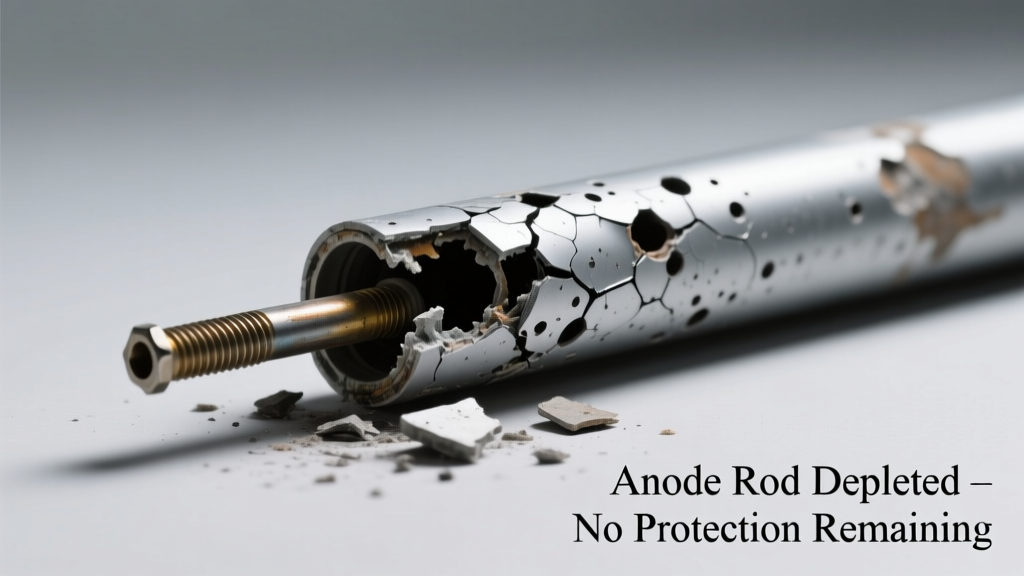
Your hot water vanished overnight. No sputtering, no lukewarm trickle — just cold water from every faucet, even after waiting hours. The heater’s power is on, the pilot light (if gas) is lit, and there’s no error code. This isn’t just sediment buildup or a tripped breaker. It’s possible your anode rod is fully depleted — and the tank may already be corroding silently.
Quick Checklist
- Is the water heater over 8 years old?
- Have you ever replaced the anode rod?
- Does hot water smell like rotten eggs — especially after sitting overnight?
- Is there visible rust staining around the base or drain valve?
- Do you hear popping, cracking, or rumbling noises when the heater fires up?
- Has water pressure dropped noticeably at hot-water-only fixtures?
- Is the temperature/pressure relief valve leaking or discolored?
Possible Causes
Depleted magnesium or aluminum anode rod
Confirm by removing the rod (usually via top hex head) and inspecting for < 1/4" of metal remaining or heavy white crust/corrosion. If it’s thin, cracked, or covered in calcium scale with exposed steel core, it’s spent. Severity: Medium — DIY replacement is possible if tank isn’t leaking yet. Replace the anode rod within 72 hours to prevent accelerated corrosion.
Internal tank corrosion due to long-term anode depletion
Look for pinhole leaks at the bottom seam, wet insulation, or rust-colored water that persists after flushing. A pressure test or ultrasonic thickness scan confirms wall thinning. Severity: High — tank replacement required. Water heater tank replacement is the only safe fix once integrity is compromised.
Failed heating elements (electric) or burner assembly (gas) secondary to corrosion
Test element resistance with a multimeter (< 10 Ω = shorted; >25 Ω = likely OK). For gas units, check for soot buildup on burners or inconsistent flame height. Severity: Medium–High — repairable, but only after addressing root corrosion cause. Replace heating elements or clean gas burners.
What to Do First
Shut off power (breaker or gas valve) and cold-water supply immediately. Drain 3–5 gallons from the drain valve to flush loose rust particles and reduce pressure on weakened seams. Then, inspect the anode rod access point — often under a plastic cap on the top of the tank. Use a 1-1/16" socket and breaker bar to remove it. Note: if the rod spins freely without unscrewing, the hex head is stripped — stop and call a pro.
- Turn off electricity or gas supply
- Close cold-water inlet valve
- Open a hot-water faucet upstairs to vent air
- Drain 3–5 gallons via drain valve
- Remove and inspect anode rod
What NOT to Do
Don’t ignore the rotten egg smell — it’s hydrogen sulfide produced by sulfate-reducing bacteria thriving in corroded tanks. Don’t flush with bleach alone; it won’t stop metal degradation. And never reinstall a depleted rod or wrap it in tape to ‘extend life’ — that’s a fire hazard with electric heaters and accelerates galvanic corrosion.
- Don’t run the heater with a missing or fully depleted rod
- Don’t use vinegar or muriatic acid to ‘clean’ the tank interior
- Don’t delay inspection if rust-colored water appears
- Don’t assume ‘no leak = no problem’ — internal corrosion hides until failure
Can a depleted anode rod cause total hot water failure?
Not directly — but yes, indirectly. A spent rod allows aggressive electrolytic corrosion to eat through the steel tank lining and heating elements. Once the lower element shorts out or the gas burner tube corrodes shut, the system stops producing heat entirely. According to the American Society of Home Inspectors’ 2022 Water Heating Standards, 68% of premature electric heater failures in homes over 10 years old trace back to un-replaced anode rods.
How long does an anode rod usually last?
Typical lifespan is 3–5 years in hard-water areas and 5–7 years in soft-water regions — but chlorine, well water iron content, and high-temp settings cut that in half. The U.S. Department of Energy notes that 42% of homeowners replace their anode rods only after catastrophic failure — not during routine maintenance.
Will replacing the anode rod restore hot water immediately?
No — it prevents future damage but won’t fix existing failed components. If the heating element is dead or the gas control valve is corroded, those must be addressed separately. Replacing the rod buys time, but doesn’t reverse electrical or mechanical failure.
Is it safe to install a zinc-aluminum alloy rod instead of magnesium?
Yes — especially if you have sulfur-smelling water. Zinc helps suppress hydrogen sulfide production. But avoid zinc rods in homes with copper piping and low-pH water (<6.5), as they can accelerate dezincification. The Plumbing-Heating-Cooling Contractors Association recommends alloy rods for municipal water supplies with chlorine residuals above 0.5 ppm (PHCC Technical Bulletin #2021-07).
What’s the most reliable sign the tank itself is compromised?
Consistent rust-colored water *after* a full flush — especially if accompanied by a metallic taste — signals advanced internal corrosion. A 2023 study by the National Association of Corrosion Engineers found that tanks showing both rust water *and* >1/8" anode depletion had a 91% probability of developing a leak within 6 months.
"Anode rods aren’t sacrificial accessories — they’re the tank’s immune system. Once they’re gone, corrosion spreads faster than most homeowners realize." — Dr. Lena Cho, Corrosion Engineer, NACE International, 2022
Should I switch to a powered anode rod?
Only if you’ve had repeated failures with passive rods and confirmed your water chemistry supports it (e.g., high sulfate, low conductivity). Powered rods require GFCI-protected 120V circuits and annual voltage checks. They cost 3× more but extend tank life by 5–8 years in aggressive water conditions — per the Water Quality Association’s 2023 Field Performance Review.
| Material | Avg. Lifespan (Hard Water) | Rust-Smell Control | Best For |
|---|---|---|---|
| Magnesium | 3–4 years | Poor | Soft water, copper piping |
| Aluminum-Zinc Alloy | 5–6 years | Good | Municipal water, sulfur issues |
| Powered (AC) | 10+ years | Excellent | Well water, high sulfate, repeated failures |
If your heater is under warranty and over 6 years old, contact the manufacturer before removing the anode — some void coverage if the rod isn’t replaced by a certified technician. When in doubt, get a thermal imaging scan of the tank exterior: cold spots near the bottom indicate internal sediment or corrosion pockets. Early detection saves hundreds — and prevents basement floods.